The Founding Fathers’ Dinner Table Was a Lie: Food of The American Revolution
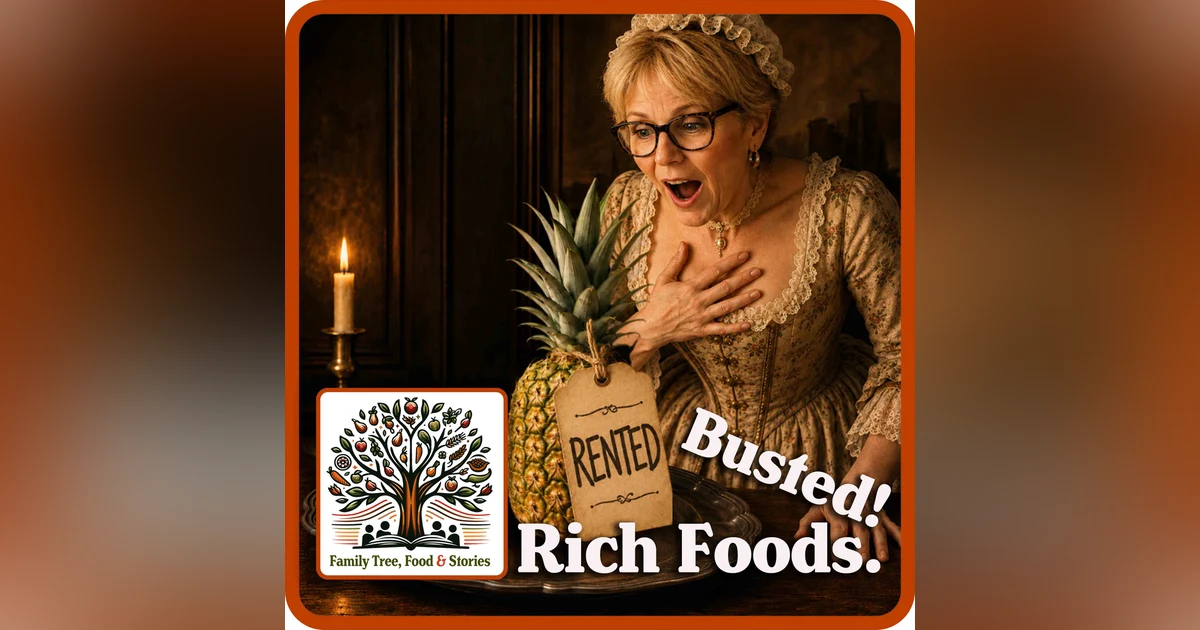


George Washington, Rented Pineapples, America’s First Food Flex. What the rich really ate, and who actually made it.
What if the Founding Fathers’ dinner table was less about elegance and more about power, performance, and people history forgot? Similar to today's power rooms.
In this episode of Family Tree Food & Stories, Nancy May and Sylvia France continue their America 250 Revolutionary food series by sharing the dinner table with America’s colonial gentry. At first glance, these tables looked grand: French-style service, groaning boards (you'll learn what that is later in the show), turtle soup, Madeira wine, fancy sugar, rented fruit, and summer ice cream served, all while much of the country could barely keep drinking water safe and cool.
But behind all that fancy food, there was a more real and sharper story. George Washington’s daily breakfast really was very simple: cornmeal hoecakes, for a reason. Thomas Jefferson often treated meat more like a condiment than the main event. The rich weren't always eating completely different foods from everyone else. They were eating the same basic ingredients but with more expensive toppings, imported luxuries, and better marketing. The wild part is that they even created the appearance of luxury by renting fruit to make it look even fancier.
Nancy and Sylvia also dig into the harder truth behind elite Revolutionary-era dining: the Founding Fathers did not cook these meals. But who did? Highly trained enslaved chefs and cooks, including James Hemings, Hercules Posey, Edith Fossett, and Fanny Hern, were the culinary talents behind many dishes and techniques later credited to the households of many Founding Fathers. Sadly, many of these fabulous chefs and cooks have only become footnotes in much of our history. But we're sharing here in this episode of Family Tree Food & Stories.
This episode explores food, status, slavery, memory, myth, and how some recipes outlive the names of those who cooked them. It is a rich, funny, uncomfortable, and deeply human look at what America’s elite really ate, and who actually ate and fed them.
5 Key Lessons & Takeaways
- The rich were not always eating totally different food.
- Washington’s meals were simple for a health reason.
- Colonial dinner parties were often pure theater. Wealthy tables were designed to impress, intimidate, and advertise status.
- The history of The Groaning Board: What was it?
- Some foods were locked up because of their value.
- The dinner table was a true "war room." Major political conversations and Revolutionary decisions happened over private meals, including strategy discussions and postwar bargains. The table was not just where people ate. It was where power negotiated with dessert nearby.
- The real culinary experts were often erased, but the recipes survived.
Listen to the full episode at Podcast.FamilyTreeFoodStories.com, then join us in the Family Tree Food Stories Facebook group and tell us: whose recipe in your family deserves to have their name remembered?
Because every meal has a story, and every story is a feast.
What to do Next?
Listen to “America Was Built on Beer, Bread, and Stolen Coffee” at Podcast.FamilyTreeFoodStories.com, then join us in the Family Tree Food Stories Facebook group and share the food story your family still carries.
Because every meal has a story, and every story is a feast. Even those we make every day.
Additional Links Shared:❤️
- Yaupon Tea, family-owned. When British tea just won't do.
- Book: My Family Tree, Food & Stories Journal Awarded #1 New Release on Amazon
- Instagram Story updates 📸
- Facebook Family Tree Food Stories GROUP👍
- TikTok: Family Tree Food Stories
- 👇Share Your Story With Nancy & Sylvia!: Leave us a voicemail
- You can send us a DM on Facebook.
About Your Award-Winning Hosts:
Nancy May and Sylvia France are the powerhouse team behind Family Tree, Food & Stories, a member of The Food Stories Media Network, which celebrates the rich traditions and connections everyone has around food, friends, and family meals. Nancy, an award-winning business leader, author, and podcaster, and Sylvia, a visionary author, foodie, and business leader, combine their expertise to bring captivating stories rooted in history, heritage, and food. Together, they weave stories that blend history, tradition, and the love of food, where generations connect and share intriguing mealtime stories and kitchen foibles.
If you missed the first time around... now's your time to listen to Family Tree Food & Stories and get inspired to make better use of what’s already in your kitchen. Then visit our page to share how you're using your leftovers this year. Waste less. Cook smarter. Tell the story behind your fridge.
"Every Meal Has a Story, and Every Story is a Feast." (tm) is a trademark of Family Tree Food & Stories podcast (c) copyright 2026, all US and International Rights Reserved.
@familytreefoodstories, @familyfoodstories, @riseyaupon, #FamilyTreeFoodAndStories #FoodPodcast #FoodHistory #AmericanRevolution #America250 #revolutionaryWar #FoundingFathers #GeorgeWashington #ThomasJefferson #FoodHistory #ColonialFood #RevolutionaryWar #HiddenHistory #BlackHistory #EnslavedChefs #AmericanHistory #HistoryPodcast #FoodPodcast #FamilyFoodStories #RentedPineapples #LockedSugar #FoundingFathersFood #ColonialDining #DinnerTablePolitics #FoodAndPower #ForgottenChefs #JamesHemings #HerculesPosey #RevolutionaryFood #HistoryYouDidntLearn #FoodStories
Nancy A. May: So Sylvia, if you picture a dinner party with George
Speaker:Washington or Thomas Jefferson,
Speaker:w Probably like massive silver platters, exotic roasts, crazy French stuff?
Sylvia France:Oh, 100%.
Sylvia France:You know, powdered wigs, fancy wine, that whole deal
Sylvia France:Nancy A. May: Right, but here's the spoilers.
Sylvia France:The richest men in America literally lived on the simplest cornmeal
Sylvia France:pancake breakfast every single day.
Sylvia France:Wait, really?
Sylvia France:George Washington would truly love IHOP if he lived today.
Sylvia France:You know, sticky, syrup, things and all
Sylvia France:Nancy A. May: Yes, but he'd probably have to endure the wait.
Sylvia France:every morning he ate hoe cakes, just cornmeal, water, swimming
Sylvia France:in honey, butter, and well, I guess that was his syrup.
Sylvia France:So on that note, folks, welcome to Family Tree Food and Stories, where
Sylvia France:every meal has a story, and yes, in this case, every story has a feast.
Sylvia France:I'm Nancy May, your host
Sylvia France:And I'm Sylvia France, your co-host.
Sylvia France:Before we dig into why the guy on the dollar bill was obsessed with
Sylvia France:pancakes, do us a quick favor.
Sylvia France:Go to Podcast.FamilyTreeFoodStories.com.
Sylvia France:Hit like, subscribe, and share this with a friend.
Sylvia France:We're here every single Thursday, and every other day for downloads.
Sylvia France:Nancy A. May: You got it.
Sylvia France:We're glad that you're at our table today, especially for this episode, which is
Sylvia France:episode three of the Revolutionary series.
Sylvia France:Because today we are looking at what the ultra wealthy actually ate, or the
Sylvia France:gentry as they were called in that day.
Sylvia France:And it turns out it looked a lot like what was on everybody else's plate
Sylvia France:But first, we're gonna start a new tradition.
Sylvia France:It's toast time, so grab your coffee, your mimosa, sourdough
Sylvia France:toast, whatever you've got.
Sylvia France:Now raise it up
Sylvia France:Nancy A. May: Woo-hoo.
Sylvia France:Let's go.
Sylvia France:Today we're pouring what they called liquid fuel in the
Sylvia France:entire revolution, the Madeira.
Sylvia France:described as drinking autumn, deep, sweet, I'll call it sticky,
Sylvia France:complex and savory flavors
Sylvia France:So to Madeira, the ultimate 18th century tax dodge.
Sylvia France:Nancy A. May: got it.
Sylvia France:We'll get to that story later
Sylvia France:Okay, let's get back to the pancakes.
Sylvia France:If Washington was eating hoecakes, isn't that like poor people food?
Sylvia France:Like, wasn't that exactly what the enslaved cooks in his kitchen were eating?
Sylvia France:Nancy A. May: Yes, exactly.
Sylvia France:They were, Sylvia.
Sylvia France:The base food wasn't rich.
Sylvia France:It was the stuff on top, the butter, the honey, and all the other goo,
Sylvia France:even the refined white sugar.
Sylvia France:That's what cost serious money back then
Sylvia France:Ah, I get it now.
Sylvia France:It's the toppings, not the actual meal.
Sylvia France:So the colonial rich weren't eating a totally different food, they
Sylvia France:were just paying to customize it
Sylvia France:Nancy A. May: Bingo
Sylvia France:So breakfast is basic, but dinner, dinner was pure theater.
Sylvia France:If you were wealthy in the late seventeen hundreds, a dinner party
Sylvia France:was basically an advertisement for how much you had in your bank account.
Sylvia France:Nancy A. May: Oh, and it was wild, they ate a la Francais, French style.
Sylvia France:I gotta do the tongue twirl for sure.
Sylvia France:Meaning every single dish came out at the exact same time.
Sylvia France:The entire table was completely covered.
Sylvia France:It was like this crazy Thanksgiving buffet, but you were
Sylvia France:sitting down the entire time.
Sylvia France:Thankfully, the plates were small, and you were not expected to eat everything.
Sylvia France:I can't imagine unbuttoning the belt back then.
Sylvia France:Or the corset and we're talking 20 plus
Sylvia France:dishes for a single course.
Sylvia France:It was soup, fish, a mountain of roast, turkey, ham,
Sylvia France:venison and even calves' heads
Sylvia France:Nancy A. May: Yuck, my food's staring back at me.
Sylvia France:No, thank you.
Sylvia France:Nancy A. May: right?
Sylvia France:No thank you for sure.
Sylvia France:And they also called that table the groaning board so that meant that
Sylvia France:the wooden table was supposed to groan under the weight of the food.
Sylvia France:If your furniture wasn't complaining, you were not trying hard enough
Sylvia France:I just simply love that, and I love using fancy terms to sound
Sylvia France:fancy, like boeuf a la mode, which is literally pot roast, or fricassee,
Sylvia France:which is chicken in cream sauce.
Sylvia France:Nancy A. May: Yeah, a la Campbell's.
Sylvia France:Is that how your mom made it?
Sylvia France:Nancy A. May: Absolutely.
Sylvia France:Don't forget my favorite piece of the elite drama, Potage de Tortue,
Sylvia France:which is really turtle soup.
Sylvia France:they'd ship live green turtles up from the Caribbean and if the host couldn't get
Sylvia France:one, they'd just boil a calf's head with spices on it and call it mock turtle soup.
Sylvia France:Although, I think we talked about, I know we talked about
Sylvia France:Cooter soup, which still gets me.
Sylvia France:She can't make fun of that anymore.
Sylvia France:so it's actually was a luxury knockoff in 1776.
Sylvia France:, . That is absolutely hilarious.
Sylvia France:But the catch with that style of dining is that you could only reach
Sylvia France:what was right in front of you.
Sylvia France:It was just a visual weapon to intimidate
Sylvia France:Nancy A. May: Yes, no reaching over, bad manners.
Sylvia France:But speaking of visual weapons, sugar.
Sylvia France:Believe it or not it didn't come in a bag.
Sylvia France:It came as a rock hard cone the size of your forearm and it was wrapped
Sylvia France:in blue paper and it's a sugar loaf and I'm gonna guess those forearms
Sylvia France:back then were pretty big because they were lifting pounds of sugar
Sylvia France:Right?
Sylvia France:And you need those giant iron pliers called sugar nippers, I like that,
Sylvia France:just to break off a chunk for your tea.
Sylvia France:And because it was so expensive, the host kept the sugar locked up
Sylvia France:in a chest with a literal padlock
Sylvia France:Nancy A. May: All right, so we've got a safe in our back, closet, but
Sylvia France:I can't imagine putting sugar in it,
Sylvia France:especially padlocking it, right?
Sylvia France:Well, you told me about those, um, circus peanuts that
Sylvia France:you might need to put them for Bob
Sylvia France:Nancy A. May: right.
Sylvia France:but there's one more ultimate show-off item.
Sylvia France:You know what that was, Sylvia?
Sylvia France:I have no idea.
Sylvia France:Nancy A. May: It was the pineapple.
Sylvia France:You always hear about the old New England story about sea captains spiking
Sylvia France:a pineapple on on their fence post just to show off that they were home
Sylvia France:and they were welcoming back visitors,
Sylvia France:Oh, I t- I've heard it hundreds of times.
Sylvia France:It's everywhere.
Sylvia France:It's the ultimate symbol of hospitality
Sylvia France:Nancy A. May: Yes except there's a hook.
Sylvia France:It is completely and absolutely fake
Sylvia France:Wait, seriously?
Sylvia France:Fake?
Sylvia France:Nancy A. May: Yes.
Sylvia France:Hard to believe this one caught me, 'cause I thought it was true for years.
Sylvia France:Well, it's zero historical record.
Sylvia France:one pineapple back then actually cost more than a servant's entire year's salary.
Sylvia France:People didn't eat them.
Sylvia France:The middle class families would rent a single pineapple for a night just to put
Sylvia France:it on the table and look la-la-di-da rich.
Sylvia France:then they would pass it on to the neighbors who rented it out for
Sylvia France:the next night until it rotted
Sylvia France:Renting fruit?
Sylvia France:It sounds like a modern-day side hustle to me, like an Uber driver.
Sylvia France:Nancy A. May: Right.
Sylvia France:I'll try and rent a pineapple today.
Sylvia France:but I've got more forklaw, as we call it.
Sylvia France:The fence post story was actually invented in 1935 by a magazine ad
Sylvia France:trying to sell Hawaiian pineapples.
Sylvia France:It's just a great 20th century marketing scam
Sylvia France:Since have both been in advertising, we know that firsthand.
Sylvia France:But it makes sense British lords and American founders were chasing
Sylvia France:the exact same French trends.
Sylvia France:The British elites were collecting French porcelain while Jefferson
Sylvia France:was importing every French thing he he could actually get his hands on
Sylvia France:Nancy A. May: Meanwhile, do you remember Amelia Simmons from last week?
Sylvia France:I do
Sylvia France:Nancy A. May: while the rich guys were out ordering off the French menu,
Sylvia France:Amelia, the young orphan girl, wrote the first American cookbook using
Sylvia France:cornmeal, squash, and cranberries as some of the main ingredients.
Sylvia France:The elite imported their style, but she actually defined the country's
Sylvia France:food, and we just can't forget her
Sylvia France:And we won't, which brings us right back to the Madeira wine.
Sylvia France:It loved the heat of the cargo ships.
Sylvia France:The weeks of rocking and swaying and sweating in the hold
Sylvia France:actually made it taste better.
Sylvia France:Sea captains would brag about how many times a barrel crossed the equator
Sylvia France:Nancy A. May: And the real reason the founders drank it like
Sylvia France:water, you know what that was?
Sylvia France:No, I don't.
Sylvia France:Do tell.
Sylvia France:Nancy A. May: I will.
Sylvia France:Of course.
Sylvia France:It was a massive tax loophole because it came directly from Portugal and
Sylvia France:bypassed the British trade taxes.
Sylvia France:It sailed straight into Boston and completely tax-free.
Sylvia France:I guess that was our first duty-free tax shop.
Sylvia France:Anyway, it was basically giving King George the middle finger, liquid style
Sylvia France:Spite and the tax loophole.
Sylvia France:God bless America.
Sylvia France:Nancy A. May: for sure.
Sylvia France:Though we do have to talk about the dark side of that trade.
Sylvia France:Those same Madeira shipping routes were the exact ones
Sylvia France:trafficking enslaved people.
Sylvia France:The wealth in those glasses were completely tied to that system
Sylvia France:Nancy A. May: So that's the party side.
Sylvia France:Well, maybe not.
Sylvia France:But on a normal Thursday, even the wealthiest gentry ate simple, plain food.
Sylvia France:Old George called his daily dinner plain but substantial.
Sylvia France:It was just boiled pork, cabbage, and pickles
Sylvia France:And Jefferson mostly ate vegetables from his garden.
Sylvia France:He literally wrote that he viewed meat as a condiment.
Sylvia France:The guy started a salad trend centuries long before it was a thing
Sylvia France:Nancy A. May: Yeah.
Sylvia France:He was our original foodie first Father Rabbit.
Sylvia France:Well, you know what I mean.
Sylvia France:but your region still totally dictated what was on your plate.
Sylvia France:Down South, it was the most lavish with tons of local ham, low
Sylvia France:country rice, and hours of drinking Madeira on the veranda, darling
Sylvia France:And In the middle colonies like Philly and New York,
Sylvia France:it was super cosmopolitan because they were massive trading ports.
Sylvia France:you got the fresh turtle soup, ducks, and these crazy puddings
Sylvia France:Nancy A. May: Hmm.
Sylvia France:And in my area, New England, back home, we were restrained, the
Sylvia France:rocky soil and heavy Puritan vibes.
Sylvia France:Remember the Pilgrims?
Sylvia France:Oh, yes
Sylvia France:, Nancy A. May: Showing off our wealth up north didn't mean fancy French dishes.
Sylvia France:It just meant serving massive quantities of high-quality cut meats.
Sylvia France:think four-inch steaks.
Sylvia France:in New England, we don't do flair.
Sylvia France:We just give you lots more of it
Sylvia France:We don't show off, we just have more.
Sylvia France:Classic New England.
Sylvia France:But let's talk about summer dessert.
Sylvia France:This highlights the absolute massive gap in infrastructure back then
Sylvia France:Nancy A. May: This one got me and I found it rather interesting because
Sylvia France:in our research we found that ice houses, yep, ice houses in the
Sylvia France:South and ice houses in 1776 even.
Sylvia France:They built these deep underground pits lined with brick and straw.
Sylvia France:Washington had one and Jefferson had one, and they cut the ice from the frozen
Sylvia France:ponds in January and pack it underground, and it would keep all through August.
Sylvia France:But, you know, nobody thinks about Virginia getting that cold.
Sylvia France:It does
Sylvia France:Doesn't get this cold in Florida
Sylvia France:Nancy A. May: No, it doesn't.
Sylvia France:So they were eating fresh ice cream in July while
Sylvia France:the rest of the country didn't even have cool drinking water
Sylvia France:Nancy A. May: Yep.
Sylvia France:That's the case.
Sylvia France:And Jefferson's famous personalized ice cream recipe?
Sylvia France:The one written in his own handwriting that everyone talks about, it was actually
Sylvia France:mastered and prepared by a brilliant chef that he had named James Hemings.
Sylvia France:We're gonna talk about James after the break
Sylvia France:But first, shout out to Abigail Adams.
Sylvia France:While John was away debating independence, Abigail single-handedly
Sylvia France:ran their entire farm in a war zone.
Sylvia France:Years later, she goes to Paris, sees the French aristocracy dining tables,
Sylvia France:and writes home about how absolutely scandaled she was by the ungodly waste.
Sylvia France:Nancy A. May: Gotta love Abby.
Sylvia France:I think we'll call her Abby for here but she is the ultimate reality Yankee chick
Sylvia France:Yeah, totally.
Sylvia France:Before we hit the break, one more quick story.
Sylvia France:The American South became famous for its massive wealthy dining
Sylvia France:style, but the colony of Georgia actually tried to ban it.
Sylvia France:When it was founded in the 1730s, they outlawed slavery, banned hard liquor
Sylvia France:like rum, and put a legal cap on land ownership so lazy, ultrarich ultra-rich
Sylvia France:class elite class would never form
Sylvia France:Nancy A. May: and did it work?
Sylvia France:Nope.
Sylvia France:Within 20 years the system collapsed under economic pressure.
Sylvia France:The bans were lifted, and Georgia became one of the wealthiest
Sylvia France:plantation economies in the world.
Sylvia France:The one place that tried to outlaw the rich became the, ultimate symbol of it
Sylvia France:Nancy A. May: Wow, that's quite a story.
Sylvia France:But speaking of those tables, who was actually back in the heat of
Sylvia France:those kitchens making all this stuff?
Sylvia France:it definitely wasn't those guys with their names on the plaques on
Sylvia France:the front doors of their houses.
Sylvia France:But before we get there, we're gonna take a quick break, and we'll get back to Who
Sylvia France:the real chefs were when we come back
Sylvia France:and we're back.
Sylvia France:So Nancy, you ask who was actually in those kitchens
Sylvia France:Nancy A. May: I did.
Sylvia France:But before we name them, we have to realize that these dining
Sylvia France:tables weren't just to show off.
Sylvia France:They were actually war rooms or war zones for the revolution,
Sylvia France:kind of like we do today
Sylvia France:Yes, I hear stories in Silicon Valley how
Sylvia France:many deals were done on a napkin.
Sylvia France:Nancy A. May: Right?
Sylvia France:So Look at May 1781.
Sylvia France:. Washington and the French General Rochambeau sat down at a dining table at
Sylvia France:the Webb House in Connecticut for days fiercely arguing over the end of the war.
Sylvia France:Washington wanted to attack New York.
Sylvia France:Rochambeau said, "No, no, no. March on Virginia." Virginia won out.
Sylvia France:The dinner argument became the Battle of Yorktown, which literally won the war
Sylvia France:Nancy A. May: So the strategy that secured independence was hammered out over dinner.
Sylvia France:Hmm, pretty interesting, right?
Sylvia France:And even after the war, they were cutting deals over dessert.
Sylvia France:The famous dinner table bargain of 1790, hammered out by Jefferson, Hamilton, and
Sylvia France:Madison took place over a private dinner.
Sylvia France:That's what settled the massive fight or debate over where to put
Sylvia France:the capital of the United States
Sylvia France:So the table decided everything, but here's the thing
Sylvia France:history - books love to leave out.
Sylvia France:The Founding Fathers didn't cook a single bite of this food.
Sylvia France:Nancy A. May: Nope, but they ate it.
Sylvia France:these kitchens were run by highly trained elite professional enslaved
Sylvia France:cooks like James Hemings, Jefferson took Hemings to Paris specifically to have
Sylvia France:him trained in French haute cuisine, kinda like haute couture, but in food.
Sylvia France:He spent three years apprenticing under the best chefs in the world at the time
Sylvia France:Which means things like baked mac and cheese, vanilla ice
Sylvia France:cream, french fries or pommes frites.
Sylvia France:the stuff history books credit to Jefferson's brilliance were actually
Sylvia France:mastered and introduced by James Hemings.
Sylvia France:Jefferson took the bows, Hemings did the work
Sylvia France:Nancy A. May: Yes, he did.
Sylvia France:And in Washington's kitchen, Well, that was run by a man named Hercules Posey.
Sylvia France:I love that name.
Sylvia France:Hercules was an absolute culinary legend in Philly and in Mount Vernon.
Sylvia France:He was a perfectionist, highly celebrated, And he actually made his
Sylvia France:own fortune on the side, gotta have a side hustle, by selling kitchen
Sylvia France:gourmet leftovers to elite citizens.
Sylvia France:and on Washington's 65th birthday, get this, Sylvia,
Sylvia France:Wait
Sylvia France:Nancy A. May: well, Hercules walked out of the estate, and
Sylvia France:he decided to self-emancipate.
Sylvia France:Good for him.
Sylvia France:Nancy A. May: Talk about the ultimate quit, right?
Sylvia France:. Sylvia France: On the president's birthday?
Sylvia France:Wow, love the timing.
Sylvia France:but he did it on his terms, which was highly unusual those days.
Sylvia France:And it wasn't just men.
Sylvia France:Think about Edith Fossett.
Sylvia France:Everyone called her Edy.
Sylvia France:Jefferson sent her to train under a French chef when she was only 15.
Sylvia France:She ran the entire kitchen at Monticello for years along
Sylvia France:another enslaved chef, Fanny Hern
Sylvia France:Nancy A. May: there was a modern historian who said it best.
Sylvia France:These women were operating at the absolute peak of their craft, even at 15.
Sylvia France:Can you imagine?
Sylvia France:No
Sylvia France:Nancy A. May: Right?
Sylvia France:today they'd be household names, like Julia Child's.
Sylvia France:But back then, the elite society just dismissed them in letters as, "The girls."
Sylvia France:So when people say Founding Fathers were foodies what they actually
Sylvia France:mean is they legally owned brilliant professionals whom they refused to free
Sylvia France:Nancy A. May: That's rather greedy, but look at Martha
Sylvia France:Washington's recipe for great cakes.
Sylvia France:This is really interesting.
Sylvia France:it calls for 40 eggs, four pounds of butter, four pounds of
Sylvia France:sugar, and five pounds of flour.
Sylvia France:Talk about muscles,
Sylvia France:I can't imagine the calories
Sylvia France:Nancy A. May: Oh, I know.
Sylvia France:it took a whole team of enslaved cooks a full day of brutal physical
Sylvia France:labor just to beat the batter by hand and manage stoking the wood ovens
Sylvia France:The recipe survived because Martha's granddaughter wrote it down, but
Sylvia France:the actual cooks who made it year after year, their names weren't on the card.
Sylvia France:the cake got remembered, the people were erased
Sylvia France:Nancy A. May: That is so sad.
Sylvia France:But speaking of Washington and food, you know, Sylvia, there's a little
Sylvia France:thing I think we need to clear up, and that, well, maybe we, we should chomp
Sylvia France:on is probably the better word for it.
Sylvia France:That has to do with Washington's wooden teeth and the myth of that
Sylvia France:Oh my goodness, yes.
Sylvia France:Did you know he didn't have a single splinter of wood in his mouth?
Sylvia France:Nancy A. May: No
Sylvia France:His dentures were so painful.
Sylvia France:They were a horrific contraption of hippopotamus ivory, gold wire,
Sylvia France:and real human teeth purchased from impoverished people and enslaved workers
Sylvia France:Nancy A. May: I can't imagine.
Sylvia France:disat- Blah.
Sylvia France:And it was a medical disaster on top of being disgusting.
Sylvia France:He was in constant pain, and that is why his daily breakfast was
Sylvia France:soft, mushy cornmeal hoe cakes.
Sylvia France:He literally couldn't chew hard bread.
Sylvia France:And when you understand this reality, the history makes perfect sense
Sylvia France:Right?
Sylvia France:And that ties directly to what we can actually do in
Sylvia France:our home kitchens this week.
Sylvia France:The whole history is about food outliving the names of the people who made it.
Sylvia France:So how do we stop that from happening in our own families?
Sylvia France:Nancy A. May: Well, it's a little easier than you might think, because we came up
Sylvia France:with a quick guide on how to save your family recipes and preserve the cook.
Sylvia France:Well, even American Revolution-style.
Sylvia France:So rule one, write the name of the cook at the top
Sylvia France:of the card before the ingredients
Sylvia France:Nancy A. May: Yes, for sure.
Sylvia France:then ask them who taught them that recipe.
Sylvia France:Trace the lineage back as far as you can
Sylvia France:recipes have ancestors.
Sylvia France:Rule three, keep their original words.
Sylvia France:If they wrote a handful of this or until it looks right, keep it.
Sylvia France:Don't sanitize it into cups and grams until a footnote later
Sylvia France:Nancy A. May: Everything takes place in the footnotes for sure, but take a
Sylvia France:picture of the original handwritten card.
Sylvia France:There's nothing nicer than seeing somebody's handwriting again,
Sylvia France:even though that's a dying art.
Sylvia France:But the grease stains and the vanilla splatters and yes, that handwriting,
Sylvia France:that's the vital historical record
Sylvia France:And rule five, actually cook with them.
Sylvia France:The real recipe lives in the muscle memory of their hands, not the ink.
Sylvia France:And Nancy, this hits close to home for me
Sylvia France:Nancy A. May: So tell me about that, Sylvia
Sylvia France:Yeah, my grandmother, Mrs. Knight, she did everything right.
Sylvia France:She wrote down her southern syrup cake recipe and actually
Sylvia France:named it after herself.
Sylvia France:But she left out half the instructions because she knew
Sylvia France:just how to do it by heart.
Sylvia France:Sh- I know.
Sylvia France:I miss my grandma.
Sylvia France:She passed away when I was 11.
Sylvia France:Years later, I tried to make it, and I was guessing some of the baking steps.
Sylvia France:My mom still talks about how incredible that cake was, but I never stood
Sylvia France:there and watched her hands mix it, the puzzle that is just gone.
Sylvia France:Nancy A. May: That's so sad
Sylvia France:Well, it's, happy because she still lives with me in my cookbook.
Sylvia France:So she signed it, and there was still guesswork, which leads to
Sylvia France:our final and most important rule
Sylvia France:Nancy A. May: Yep.
Sylvia France:last rule, rule number six, Say their name out loud
Sylvia France:every time you cook that dish.
Sylvia France:And that's how the cook stays seated at the table.
Sylvia France:I say that with my mom's recipe.
Sylvia France:In fact, I actually call one of her favorites Mom's Special Chicken
Sylvia France:Aw.
Sylvia France:Oh, you'll have to cook it for me sometime.
Sylvia France:Nancy A. May: will.
Sylvia France:Food is the ultimate equalizer because at the end of the
Sylvia France:day, no matter how much money you have, you still have to sit down and eat.
Sylvia France:the rich just had the locked sugar cone and the tax-free wine, but the
Sylvia France:same exact cornmeal mush underneath
Sylvia France:Nancy A. May: And the famous names on the documents get 100% of the credit.
Sylvia France:Very sad.
Sylvia France:We have to change that one here.
Sylvia France:But the footnotes are where the real human stories live.
Sylvia France:This week we want you to remember the people who did that heavy lifting for you.
Sylvia France:So what do you say, Sylvia?
Sylvia France:Glasses up everyone.
Sylvia France:Santé to their health and to their memory
Sylvia France:Nancy A. May: And of course, to the cooks.
Sylvia France:ching, ching.
Sylvia France:So here's your assignment this week.
Sylvia France:Just one thing.
Sylvia France:Pick one recipe in your family collection.
Sylvia France:Write it down exactly who cooked it, where they learned it, and one specific
Sylvia France:memory of them standing over the stove
Sylvia France:Nancy A. May: And if you don't know who the recipe came from, call your
Sylvia France:oldest living relative tonight, or maybe your sister, because
Sylvia France:tomorrow, well, that's not promised
Sylvia France:then come tell us about it in our Facebook group.
Sylvia France:Tell us whose recipe still carries a proud name, and whose got lost along the way.
Sylvia France:We're going to read our favorites live on the air next week
Sylvia France:Nancy A. May: and if you liked hanging out with us today and hearing
Sylvia France:these stories, Head on over to Podcast.FamilyTreeFoodStories.com.
Sylvia France:Leave a comment, Hit like and share it with somebody that you love, It's the
Sylvia France:number one way we get new listeners and help you find an extra seat at the
Sylvia France:table for those that you care about
Sylvia France:So next Thursday is our grand finale of the America 250 series.
Sylvia France:Nancy A. May: Woo-hoo!
Sylvia France:we're stopping the talk and stepping into a modern kitchen
Sylvia France:to actually cook recipes from 1776.
Sylvia France:We're going to attempt George Washington's favorite peanut soup, fry some authentic
Sylvia France:hoecakes, and other authentic recipes
Sylvia France:Nancy A. May: recipes from 1776, for sure.
Sylvia France:And Sylvia, if your great-grandmother's syrup cake recipe is any kind of warning,
Sylvia France:it's going to be quite a challenge for us
Sylvia France:I'm sure it will be.
Sylvia France:Okay, Happy cooking everyone
Sylvia France:Nancy A. May: And see you next Thursday or whenever you download
Sylvia France:this 'cause every meal has a story and every story is a feast.
Sylvia France:Take care, be well, and happy birthday, America