A Goat Stomach, a Nobel Prize Winner, and How the Grateful Dead Saved a Yogurt.



Yogurt Secrets: 7,000 Years of Live Cultures, Instant Pot Homemade Yogurt, and the Grateful Dead’s Benefit That Saved Nancy’s Yogurt
This episode of Family Tree Food and Stories explores yogurt’s origins, surprising cultural history, and recipes. From its accidental invention 7,000 years ago when Central Asian herders carried milk in animal-stomach pouches while on horseback to global variations like dahi, labneh, skyr, and Bulgaria’s famous yogurt variety.
Hosts Nancy May and Sylvia France share how to make yogurt simply in an Instant Pot, explain troubleshooting challenges, and make your own starter “culture.”
You'll also learn about a famous Nobel laureate who, in the early 1900s, claimed it as a longevity remedy. Then, did you know the yogurt "bug" was identified and named Lactobacillus bulgaricus, after the country Bulgaria? Well, sort of.
And that's what Nancy and Sylvia claim to be a "fork-lore" about how yogurt once cured a French king.
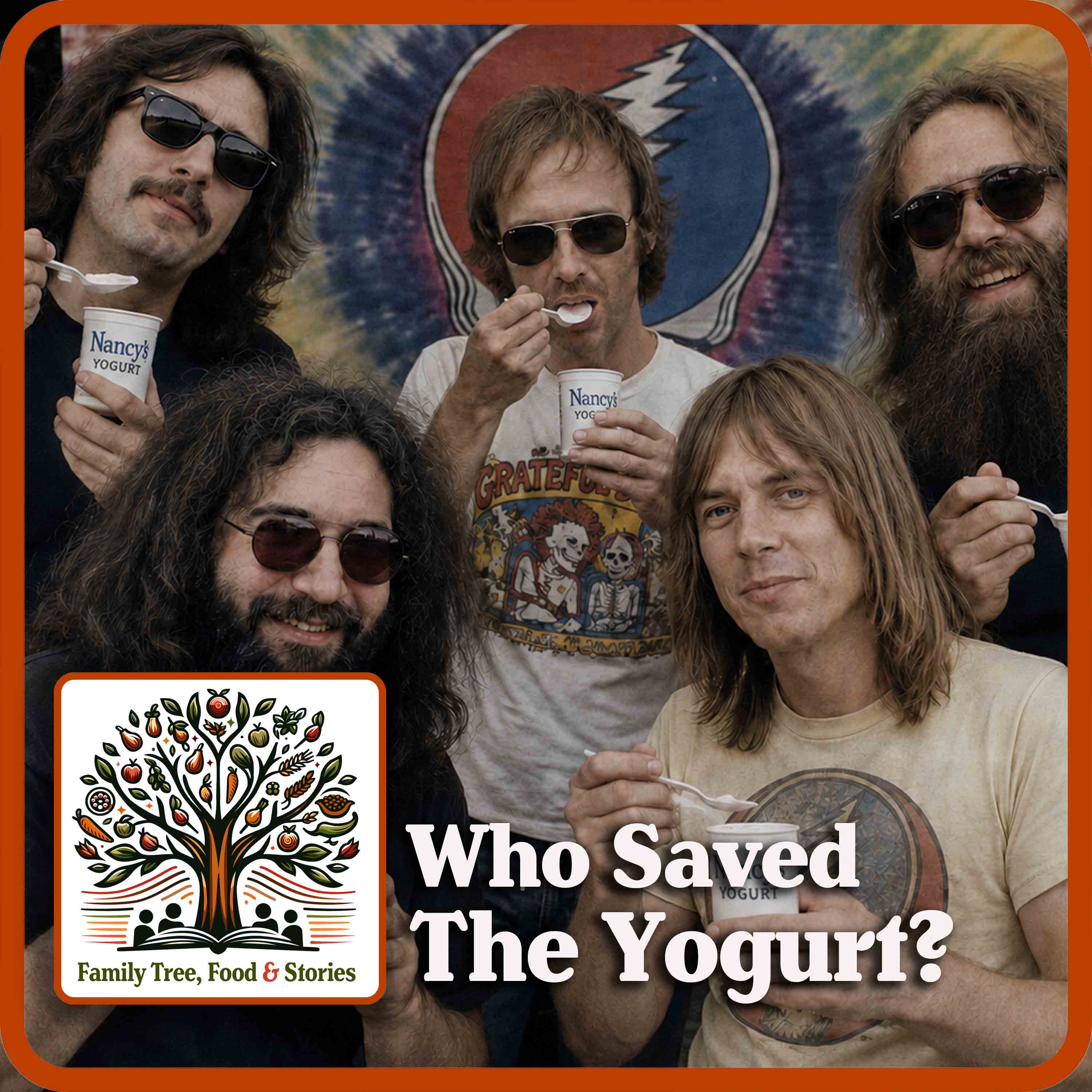
If that's not enough, one of the coolest yogurt history stories centers on Oregon’s Springfield Creamery and Nancy’s Yogurt, including how the Grateful Dead helped save the company from closing. Oh, and the Huey Lewis hauling yogurt story too.... It's all true!
If you want to know more about the truths and secrets about “Greek-style” and the business of marketing, among other cool yogurt culture (yes, pun intended), then tune into this next episode of Family Tree Food and Stories, now.
Key Takeaways
The "invention" of yogurt was an accident in a goat's stomach. It involved a goat stomach, a hot day on horseback, and a lot of bouncing around. No inventor, no lab, just an accident with lots of bacteria that turned into a delicious treat.
A Nobel Prize winner accidentally created the entire probiotics industry. He won medicine's top honor, then got obsessed with why Bulgarian peasants lived long lives eating yogurt. From that question and his slightly oversold theory, the health and wellness aisle was born. The one you walked down to find a gut health probiotic in.
The Grateful Dead once helped bail out and save a yogurt company. Saddled with a $14,000 bill for back taxes, the company founder's friends played a benefit show; tickets were literally printed on yogurt labels, and the company survives to this day. #Nancy'sYogurt!
"Greek-style" on the label might be a lie that shocks you. Real Greek yogurt is just strained yogurt, nothing more. BUT "Greek-style" often fakes that thickness with cornstarch or gelatin instead. The fix: flip the carton over and read the ingredients before deciding whether to spoon it into your breakfast bowl.
You can make better yogurt at home for a quarter of the price, in an Insta Pot! Whole milk, two tablespoons of live-culture yogurt, and eight hours in an Instant Pot. No boiling required if you use ultra-pasteurized milk.
What to do next?
Subscribe to the show at podcast.familytreefoodstories.com so you never miss an episode update. We release new shows every Thursday morning.
Then do one thing for a friend and us too! Send this episode to one person who needs to know yogurt has a Grateful Dead story in it. That's it.
One follow, one share. If every listener does that this week, we genuinely grow together , and next week, we do it again.
Additional Links Shared:❤️
- SURVEY: Please Help Us Learn How To Do More For You
- Book: My Family Tree, Food & Stories Journal Awarded #1 New Release on Amazon
- Instagram Story updates 📸
- Facebook Family Tree Food Stories GROUP👍
- TikTok: Family Tree Food Stories
- 👇Share Your Story With Nancy & Sylvia!: Leave us a voicemail
- You can send us a DM on Facebook.
Episode Timestamps
[00:00] Opening — goat stomachs, a Nobel laureate, and the Grateful Dead
[02:54] Who invented yogurt? Nobody, it was a 7,000-year-old accident
[04:44] Sylvia's Instant Pot yogurt experiment: two ingredients, eight hours
[07:54] Élie Metchnikoff and the 1908 Nobel Prize in Medicine
[08:49] Sour milk, the elixir: how Metchnikoff turned yogurt into a media sensation
[11:39] The real story behind Nancy's Yogurt, Springfield Creamery, Oregon
[12:26] The day the Grateful Dead saved a yogurt company
[15:43] Getting skeptical: what "Greek-style" actually means on the label
[17:48] The six rules of real yogurt, explained
[19:10] Three takeaways to keep your own kitchen culture alive
About Your Award-Winning Hosts:
Nancy May and Sylvia France are the powerhouse team behind Family Tree, Food & Stories, a member of The Food Stories Media Network, which celebrates the rich traditions and connections everyone has around food, friends, and family meals. Nancy, an award-winning business leader, author, and podcaster, and Sylvia, a visionary author, foodie, and business leader, combine their expertise to bring captivating stories rooted in history, heritage, and food. Together, they weave stories that blend history, tradition, and the love of food, where generations connect and share intriguing mealtime stories and kitchen foibles.
If you missed the first time around... now's your time to listen to Family Tree Food & Stories and get inspired to make better use of what’s already in your kitchen. Then visit our page to share how you're using your leftovers this year. Waste less. Cook smarter. Tell the story behind your fridge.
"Every Meal Has a Story, and Every Story is a Feast." (tm) is a trademark of Family Tree Food & Stories podcast (c) copyright 2026, all US and International Rights Reserved.
@familytreefoodstories, @familyfoodstories, #FamilyTreeFoodAndStories #FoodPodcast #FoodHistory #YogurtLover #howtomakeyogurt #instapotrecipes #instapot #FermentedFoods #GreekYogurt #GutHealth #ProbioticFoods #HistoryPodcast #StorytellingPodcast #GratefulDead #FamilyRecipes #HomeFermenting #FoodieFacts #PodcastRecommendations
A story about a goat's stomach, a guy on a horse, a Nobel laureate,
Nancy:and the Grateful Dead trying to save a yogurt company from financial ruin?
Nancy:Yes.
Nancy:It sounds ridiculous, but it's all true.
Nancy:Wanna know more?
Nancy:Stay tuned and have your spoon ready, because this one's all about yogurt.
Nancy:Hey there, food lovers and history buffs.
Nancy:Welcome to Family Tree Food and Stories.
Sylvia:Pull up your chair to the table and get ready to dig
Sylvia:in as we take you on a wild ride through generations of flavors.
Nancy:That's right, we're dishing up the juiciest family history secrets, some
Nancy:epic dinner disasters, and intriguing tastes behind your favorite dishes.
Sylvia:From Grandma's legendary cheese crust apple pie-
Nancy:To Uncle Bob's questionable casserole-
Sylvia:There's a lot more going on at that table than you might realize
Nancy:So join us as we eat, laugh, relive the past, and create
Nancy:new mealtime memories together.
Sylvia:Because every meal has a story and every story is a feast.
Sylvia:Let's dig into the show
Nancy:Hello, everybody.
Nancy:Welcome back to another episode of Family Tree Food and Stories, where every meal
Nancy:has a story and every story's a feast.
Nancy:And, well, honestly, there's a bit of history in every bite that we take, and my
Nancy:kitchen has a few history-related secrets hiding in the pantry right now, and I'm
Nancy:gonna guess that yours does, too, Sylvia.
Sylvia:Oh, you bet it does.
Nancy:But today's secret reveal is quietly sitting in your fridge, dear
Nancy:listeners, right now, and likely behind the orange juice, maybe the milk,
Nancy:and, well, it is summer, and I've got a bottle of Limoncello in mine.
Nancy:I'm gonna guess you probably have yours hiding somewhere in yours, too, Sylvia.
Sylvia:Oh, absolutely.
Nancy:But before we start, could you help us real quickly by going to subscribe at
Nancy:podcast.familytreefoodstories so that you don't miss any episode going forward, we
Nancy:drop every Thursday morning, and send it to someone who loves a good food story.
Nancy:So now, that fridge secret reveals, Sylvia, let's get into that.
Nancy:What's hiding under that lid?
Sylvia:Well, it's actually in plain sight.
Sylvia:Well, sort of.
Sylvia:Today, we're talking yogurt.
Sylvia:The lid says, "Live and active cultures." Read that out loud.
Sylvia:We're eating something that's alive on purpose.
Nancy:That kinda sounds like controlled spoilage that you paid extra for.
Sylvia:And this week, I made some in my Instant Pot.
Sylvia:Two ingredients and one button, plus eight hours.
Nancy:I know you're the experimenter in the kitchen, so we'll get back to
Nancy:that one, but first, let's share that this stuff, we're talking yogurt, is
Nancy:7,000 years old, and there's a saddle bag, a Nobel Prize, and a Grateful
Nancy:Dead story on this one, no joking.
Sylvia:So it's all in one cup.
Sylvia:Pull up a chair.
Sylvia:Something's fermenting.
Nancy:So who invented yogurt, Sylvia?
Sylvia:Nobody.
Nancy:Nobody?
Sylvia:It's an accident about 7,000 years ago in Central Asia.
Sylvia:Herders carried milk in pouches made from animal stomachs.
Nancy:Ooh, that's disgusting.
Sylvia:And a stomach is full of exactly the bacteria you'd
Sylvia:need to turn milk into yogurt.
Sylvia:Body heat, a day on horseback, and by sundown, thick, tangy yogurt.
Nancy:So the first yogurt maker was a guy with a bag, a stomach bag, on a horse, and
Nancy:the first starter culture was something that was living in that disgusting bag.
Sylvia:Yes, and somebody was brave enough to taste it, just
Sylvia:like they did with sourdough.
Sylvia:They lived, and now we're doing it all the time.
Nancy:That sounds like every fermented food, some disgusting story along the
Nancy:way, but a person deciding what went a little wrong and then decided to
Nancy:experiment and have it for dinner.
Sylvia:Or maybe for a snack.
Nancy:And here's the part that I love.
Nancy:The word yogurt is Turkish.
Nancy:It means to thicken.
Sylvia:There's no poetry in that at all.
Nancy:None, just a little got milk, and that's the whole name.
Nancy:Kind of like the commercial, Got Milk?
Sylvia:Now it's time for a story break.
Sylvia:100 families and one accident.
Sylvia:Once yogurt existed, it traveled everywhere milk animals went, and
Sylvia:every culture made it its own.
Sylvia:India folded into marinades and thinned it into lassi and called it dahi.
Sylvia:The Middle East strained it into labneh, thick enough to spread on bread.
Sylvia:Iran stirred the cucumber and herbs.
Sylvia:Iceland strained it into skyr.
Sylvia:Bulgaria kept its own famous strain alive, and that strain is about to
Sylvia:matter a great deal in this story.
Sylvia:Same accident in the saddlebag.
Sylvia:100 different families deciding it was theirs and passing it down
Nancy:Okay.
Nancy:You said you made a batch this week.
Nancy:Why don't you tell me that story?
Sylvia:Most yogurt you buy comes in a little plastic cup.
Sylvia:Mine's sitting in a glass jar in my fridge.
Sylvia:I made it with whole Fairlife milk, two tablespoons of Fage yogurt, hit the yogurt
Sylvia:button, walked away, and went to bed.
Sylvia:If you use ultra high temperature pasteurized milk, you can skip the
Sylvia:step of boiling it first, which makes it a lot easier and less intimidating.
Nancy:So it's really pretty simple.
Nancy:You made it in an Instant Pot, and that's the recipe?
Nancy:Just press a button and go to sleep?
Sylvia:Exactly.
Sylvia:Eight hours later, thick, tangy, real yogurt.
Sylvia:Same thing the saddlebag did, except mine has a digital display.
Nancy:And you didn't have to ride the horse.
Nancy:It's the 21st century equivalent of the goat skin pouch.
Sylvia:And mine probably smelled better.
Nancy:I'm sure it did.
Sylvia:And every question I had is one people type into
Sylvia:artificial intelligence all day.
Sylvia:Why is my yogurt runny?
Sylvia:Under-incubated.
Sylvia:Too cool.
Sylvia:Can I use my batch to start the next one?
Sylvia:Absolutely.
Nancy:So it's kind of like a Fred thing, your sourdough starter.
Nancy:Feed it, keep it alive, pass it down.
Nancy:Next.
Sylvia:Same word even.
Sylvia:It's culture, the bacteria in the jar, and the thing a family
Sylvia:keeps alive by passing down food.
Sylvia:Same act.
Sylvia:You keep something going on purpose.
Nancy:I know you've got some kind of family-related yogurt story.
Nancy:I think there was something about an Afghan restaurant that you told me about?
Sylvia:Oh, absolutely.
Sylvia:When I lived in Silicon Valley just south in San Carlos, there was a place
Sylvia:called Kabul's where they had the most amazing, tender, and lovely meats.
Sylvia:So of course, I had to ask the owners, "How do I make it?"
Sylvia:It was even funnier that when I had friends that would, you know, come
Sylvia:over and I didn't wanna cook, I would say, "Hey, let's go have Afghan
Sylvia:food." And they would always say, without a beat, "Ew, I don't do spicy.
Sylvia:I don't wanna try Afghan food."
Nancy:Well, that's kinda snobby, but it's not spicy.
Sylvia:No, it's not spicy at all.
Sylvia:Not even a little.
Sylvia:It's savory, it's warm.
Sylvia:So I had this idea to throw a make your own kebab party in my
Sylvia:Omaha backyard just to prove it.
Nancy:Love that.
Nancy:So of course you did.
Sylvia:Oh, it was tons of fun.
Sylvia:It had yogurt-marinated chicken.
Sylvia:We had all these different onions and pineapple and green peppers, so
Sylvia:everyone got to build their own skewer.
Sylvia:The kids were running around with squirt guns the whole time, and by
Sylvia:the end, the I don't do spicy crowd was going back for second or thirds.
Nancy:Because it was never spicy, and probably it was fun.
Nancy:It was a participatory sport, or food.
Sylvia:When you have a bunch of boys with squirt guns, yes,
Sylvia:it was definitely participatory.
Sylvia:But what was really great about it, and what I learned from that original recipe,
Sylvia:it was just yogurt doing what it says it does, quietly making everything better and
Sylvia:putting the whole backyard together, and the parents could actually get a break.
Nancy:I love that.
Nancy:Now, the most unhinged chapter in yogurt history is…
Sylvia:Early 1900s, a scientist, Elie Metchnikoff, Pasteur Institute, Paris,
Sylvia:wins the 1908 Nobel Prize in Medicine.
Nancy:So a serious guy, not some really wackadoo quack.
Sylvia:Oh, he was actually dead serious, and late in life he gets obsessed
Sylvia:with aging, just like both of us.
Nancy:Right?
Nancy:So dead serious, I love that term, because this is the guy that invented
Nancy:the term gerontology, correct?
Nancy:I mean, he literally coined that word.
Sylvia:That's him, and his story was very grim.
Sylvia:The bacteria rotting in your gut are what kill you.
Nancy:Cheerful story, for sure.
Sylvia:Then he notices that peasants are living forever in Bulgaria, eating yogurt
Sylvia:every day, and he decides it's yogurt, good bacteria crowding out the bad.
Nancy:And he tells everybody, that loudmouth.
Sylvia:He tells everyone.
Sylvia:Story
Nancy:break.
Nancy:Sour milk, the elixir.
Nancy:Metchnikoff didn't keep it quiet.
Nancy:He gave public lectures in Paris and drank sour milk every single day
Nancy:himself, and the press went crazy for it.
Nancy:Newspapers ran headlines like, "Sour milk is the elixir, secret of long
Nancy:life," and, "Can old age be cured?"
Nancy:Kind of like the National Enquirer of its day.
Nancy:Then drugstores across Europe and America began selling these little,
Nancy:teeny, tiny tablets of Bulgarian bacteria prepared according to the
Nancy:instructions of Professor Metchnikoff.
Nancy:Those pills are the direct ancestors of every probiotic on the shelf
Nancy:today, and the entire modern wellness aisle was born from one Nobel
Nancy:laureate, not a quack, and a region full of healthy Bulgarian grandmas.
Nancy:So every support gut health cup traces back to this one guy.
Sylvia:Straight back to him.
Nancy:And this is an extra Bulgarian part.
Nancy:In 1905, a Bulgarian scientist named Stamen Grigorov
Nancy:actually identifies the bug.
Nancy:Yes, bug, and that's why it's still called Lactobacillus bulgarius,
Nancy:named of course for Bulgaria.
Sylvia:You did a lot of homework for this episode, Nancy.
Nancy:I sure did.
Nancy:There's an old story that yogurt cured a king of France.
Nancy:Is that one real, or is that just one of our fork laws?
Sylvia:Well, it's a great story, especially with my name being France.
Sylvia:It can't be verified, no real record.
Sylvia:It just got repeated until it felt true.
Nancy:Well, and they say a lie told 1,000 times becomes a truth,
Nancy:and we wanted to cure a king, so eventually we did, at least in story.
Sylvia:And look, yogurt is good for you.
Sylvia:Metchnikoff just oversold it by about 2,000 years.
Sylvia:Okay, it's your turn.
Sylvia:I've heard you've been on a whole yogurt journey.
Nancy:I have.
Nancy:So about six months ago I went on a taste test because my old favorite was,
Sylvia:eh,
Nancy:not kind of sticking up to its reputation.
Nancy:But- I won't name names right now.
Sylvia:Oh, come on.
Sylvia:Please name names.
Nancy:All right.
Nancy:You twisting my arm or bending my spoon?
Nancy:Both.
Nancy:It was Chobani.
Nancy:It started tasting a little dry and mealy, so I thought, "Let's hunt for something a
Nancy:little different." And I tested all sorts of brands, but I found one brand called,
Nancy:and I'm not kidding you, Nancy's Yogurt.
Sylvia:That sounds a little fishy to me, but I do like the name.
Nancy:How could I resist?
Nancy:It's whole milk, grass-fed.
Nancy:At least, that's the variety of the brand that I like the best, but
Nancy:there's a story hiding behind it.
Sylvia:Oh, please do tell.
Nancy:It all started with a little creamery in Oregon called Springfield
Nancy:Creamery, and in 1960, Chuck and Nancy Kesey and Chuck's brother,
Nancy:Ken Kesey, the author of One Flew Over the Cuckoo's Nest, founded it.
Sylvia:Well, it does make sense.
Sylvia:And the book was actually set in Oregon.
Nancy:And they had a bookkeeper named Nancy that was making yogurt
Nancy:from her grandmother's recipe.
Nancy:And in 1970, it became the first US yogurt with live probiotics.
Nancy:Didn't even have a name then.
Nancy:They still kept making it, and orders kept coming in and coming in.
Nancy:So they decided just to call it Nancy's Yogurt.
Nancy:They named it right after the bookkeeper, since it was her recipe.
Sylvia:The yogurt is named after the bookkeeper?
Nancy:Yep, after the bookkeeper, but there's more.
Nancy:Story break.
Nancy:The day the rock band saved a yogurt company.
Nancy:By 1972, the little creamery was about to go under.
Nancy:It owed roughly $14,000 in back taxes that it didn't have.
Nancy:So Chuck Kesey drove all the way down to California and asked his
Nancy:brother's old friend's band called the Grateful Dead if they would
Nancy:consider playing a benefit concert.
Sylvia:Grateful Dead?
Nancy:Yep, the Grateful Dead.
Nancy:And on August 27th, 1972, in a field in Veneta, Oregon, the Grateful Dead played
Nancy:a concert to save the yogurt company.
Nancy:More than 20,000 people came, and to save money, the tickets were printed
Nancy:on the back of the Nancy Yogurt labels.
Nancy:The show raised enough money to pay off all the tax bill and keep the doors open.
Nancy:Yay.
Nancy:Yogurt company saved, and that company is still family-owned
Nancy:three generations later.
Sylvia:I understand the tickets were printed on the labels.
Sylvia:I wonder if my good friend in Silicon Valley who is a Grateful Dead
Sylvia:groupie was actually at the concert.
Sylvia:I really wouldn't be surprised.
Nancy:Well, I don't know him, but you never know.
Nancy:But before you hear the rest of the story, we're gonna take a quick
Nancy:break and leave you in suspense.
Nancy:We'll be right back.
Sylvia:Can you smell that meal that your grandmother, mom, or even
Sylvia:dad made at every special family
Nancy:celebration?
Nancy:The one that you can still taste with your eyes closed?
Nancy:Sylvia and I created My Family Tree Food and Stories book because we kept hearing
Nancy:your heartbreaking stories of favorite foods and family meal memories lost.
Nancy:This isn't just a cookbook.
Nancy:It's a specially designed type of journal where you can relive and
Nancy:share your family recipes and stories.
Nancy:Honestly, most people think of a plate of food as just that.
Nancy:But when paired with a good story, each bite becomes a banquet of joy,
Nancy:laughter, maybe even a few tears, and memories that never go stale.
Nancy:To get more details, go to Podcast.FamilyTreeFoodStories.com and
Nancy:select book at the top of the page.
Nancy:We've got a lot more fun and a lot more to come down the
Nancy:road and to put on your plate.
Nancy:But for now, let's get back to the rest of this My Family Tree Food Stories
Nancy:So do you wanna know the rest of that story?
Nancy:The guy who helped drive that yogurt truck all the way down to San Francisco
Nancy:and then back, his name was Huey Lewis.
Nancy:You know, before the news?
Sylvia:I can't believe Huey Lewis was hauling yogurt.
Nancy:Yeah.
Nancy:Huey Hauling, we should call it.
Nancy:Still family-owned three generations later.
Sylvia:A grandmother's recipe, a family business, a town that wouldn't let it die.
Sylvia:That's the whole show in a cup.
Nancy:I love that.
Nancy:And it's not the only one.
Nancy:Because lots of yogurts are named after family members.
Nancy:You know Dannon?
Nancy:Well, that one was named after the company owner's son, Daniel, and
Nancy:that was back in 1919 in Barcelona.
Nancy:And Chobani, a Turkish immigrant buying a plant that was about to
Nancy:close, that's how that one started.
Nancy:And every juror somehow has somebody's heritage in it.
Sylvia:Okay.
Sylvia:Let's time to get skeptical.
Sylvia:Because not everything in that aisle is a grandmother's recipe.
Nancy:No, it's not.
Nancy:And this is where I got kind of fired up or pissed off, because something
Nancy:to do with the term Greek-style, that one g- has got me really, as Bob would
Nancy:say, it's got my panties in a wad.
Sylvia:Real Greek yogurt is just yogurt that's been strained.
Sylvia:The yogurt that I made in the Instant Pot actually spent overnight in a colander
Sylvia:that was lined with coffee filters.
Sylvia:Yes, coffee filters.
Sylvia:But that's what makes it thick and high protein.
Sylvia:It's expensive because you lose volume.
Sylvia:Just for giggles, of course, I had to measure how much water
Sylvia:came out of the yogurt, and it was almost three cups of water.
Nancy:Ooh, that's a lot.
Nancy:And Greek style, I'll put style in quotes.
Sylvia:That skips the straining altogether.
Sylvia:It fakes the thickness with corn starch, gelatin, milk protein concentrate.
Sylvia:Style is just doing a lot of quiet work.
Nancy:Yeah.
Nancy:Style is the lie.
Nancy:Then there's sugar, and lots of it.
Nancy:Some flavored yogurts, the ones especially with the cartoons aimed at kids, have
Nancy:as much sugar as a can of soda in it.
Sylvia:I know.
Sylvia:I confessed.
Sylvia:I did give my kids Go-Gurts.
Sylvia:I would even actually put them in the freezer and put them in their lunch
Sylvia:boxes so they would be the perfect temperature when they ate their lunch.
Nancy:You're a good mom.
Sylvia:But I didn't realize that I was giving my kids something
Sylvia:that for breakfast or in their lunch that wasn't really healthy.
Nancy:Well, I won't blame you, because you just didn't know.
Nancy:Some don't even have real food in them.
Nancy:It's kind of like a dessert in a healthy costume.
Sylvia:So this is what I learned.
Sylvia:I had to read the ingredient list.
Sylvia:Short is good.
Sylvia:Milk and live cultures.
Sylvia:You're in the home stretch.
Sylvia:If it reads like a chemistry set, put it back immediately.
Nancy:You can also make your own for about a third of the price or a
Nancy:quarter of the price, like Sylvia did.
Sylvia:Exactly, 'cause of course, I had to do the math
Sylvia:on how much I paid per ounce.
Sylvia:So I can actually speak with authority here.
Nancy:I like that.
Nancy:The part that we're starting to add to the show is use it tomorrow or use
Nancy:it today, and the six rules to do so.
Nancy:So write them down.
Sylvia:The rules of real yogurt.
Sylvia:Read the ingredient list before the front label.
Sylvia:Milk and live cultures is the whole recipe.
Sylvia:The shorter the list, the closer to real yogurt.
Sylvia:Treat Greek style as a question, not a promise.
Sylvia:Real Greek is strained.
Sylvia:Corn starch and gelatin are a different food.
Sylvia:Check the sugar, especially anything aimed at kids.
Sylvia:Compare it to a can of soda.
Sylvia:If it's close, it's dessert.
Sylvia:Make it once, cold start, whole milk, two tablespoons of live culture yogurt.
Sylvia:The yogurt button on your Instapot for eight hours.
Sylvia:You'll never fear yogurt again, and it tastes so much better.
Sylvia:Save a few spoonfuls of every batch to start the next one.
Sylvia:That's your lineage.
Sylvia:You're keeping the culture alive.
Sylvia:And the whole point, a culture only survives if somebody keeps it going.
Sylvia:So pass it down.
Sylvia:Make the family recipe.
Sylvia:Teach the technique.
Sylvia:Save the starter.
Sylvia:Be that somebody.
Nancy:Two ingredients, one button, and a starter you have
Nancy:to pass on to the next person.
Nancy:It's a 7,000-year-old tradition.
Nancy:You can start right now or tonight on your kitchen countertop.
Sylvia:And maybe you can start it next time I come visit.
Nancy:Absolutely.
Nancy:I've got my grass-fed milk ready to go.
Sylvia:There you go.
Sylvia:Three things that you can take with you: one, yogurt's a 7,000-year-old
Sylvia:accident we keep making on purpose.
Nancy:Two, half of what you've been told is marketing.
Nancy:Marketing slime, as Bob likes to say.
Nancy:It doesn't cure old age, it doesn't heal a king, and Greek style isn't Greek.
Nancy:Oopa!
Nancy:I'll drink to that.
Sylvia:And three, behind the best yogurt is always a family, a grandmother, or
Sylvia:in my case, a nonna, a bookkeeper, a creamery, a rock band that wouldn't
Sylvia:let it die, and a hot hauler.
Sylvia:Hot hauler.
Nancy:That's the best part.
Nancy:Well, maybe the rock band.
Nancy:So tell us your stories.
Nancy:What cultures do you keep in your family alive?
Nancy:The recipes that no one wrote down or the starter that you still feed.
Nancy:Tag us on Facebook, on Instagram, or DM us.
Nancy:Leave a voicemail and a review.
Nancy:We read every one.
Nancy:Just go to podcast.familytreefoodstories and click the button on the side
Nancy:that says, "Send us a message."
Sylvia:Next time, we celebrate America's 250 with a four-part series on the food
Sylvia:of the American Revolution, what the soldiers ate, what the average person
Sylvia:ate, the gentry, think Martha Washington, and authentic all-American recreations.
Sylvia:This topic is important to both of us because we are both descendants of the
Sylvia:scrappy and resourceful Revolutionary War patriots, both male and female.
Nancy:Well, we kind of needed both to get here.
Nancy:Until then, make something.
Nancy:Even two spoonfuls of yogurt into warm milk can be your next kitchen story.
Sylvia:Every story has a feast.
Sylvia:Bye.
Sylvia:Happy cooking and happy experimenting.
Nancy:Bye bye everyone, and keep your cultures alive.
Nancy:Un-pun.
Nancy:Ha ha.
Nancy:Ciao.
Nancy:Sylvia and I hope that you've loved this episode of Family Tree Food and Stories.
Nancy:If there's a family recipe or a story that's been passed down at your table,
Nancy:or even just something that happened yesterday, we'd love to hear it.
Nancy:Maybe your special dish or family moment could be featured on
Nancy:one of our upcoming episodes.
Nancy:You can share it by just heading over to Podcast.FamilyTreeFoodStories.com
Nancy:to submit your story or recipe.
Nancy:And before you go, make sure to subscribe so you'll never miss an episode full of
Nancy:delicious ideas and heartfelt ways to make every meal a memorable experience.
Nancy:It's easier than you think.
Nancy:We'll help you, too.
Nancy:So put those phones aside, unless you're listening, switch off the
Nancy:television, and turn off your laptop, and we'll show you how to turn everyday
Nancy:meals into something more special.
Nancy:Lastly, you can join us by going on over to Facebook and Instagram at
Nancy:Family Tree Food Stories to keep up with the fun, the stories, and the ideas.
Nancy:Let's continue to celebrate the joy of food, family, and gathering
Nancy:with friends that we love.
Nancy:Thanks for listening.
Nancy:Until next time, happy eating, happy storytelling, and ciao.
Nancy:Bye-bye.