Revolutionary War Recipes You Can Cook at Home: Part #4 of our American Revolution Food Series
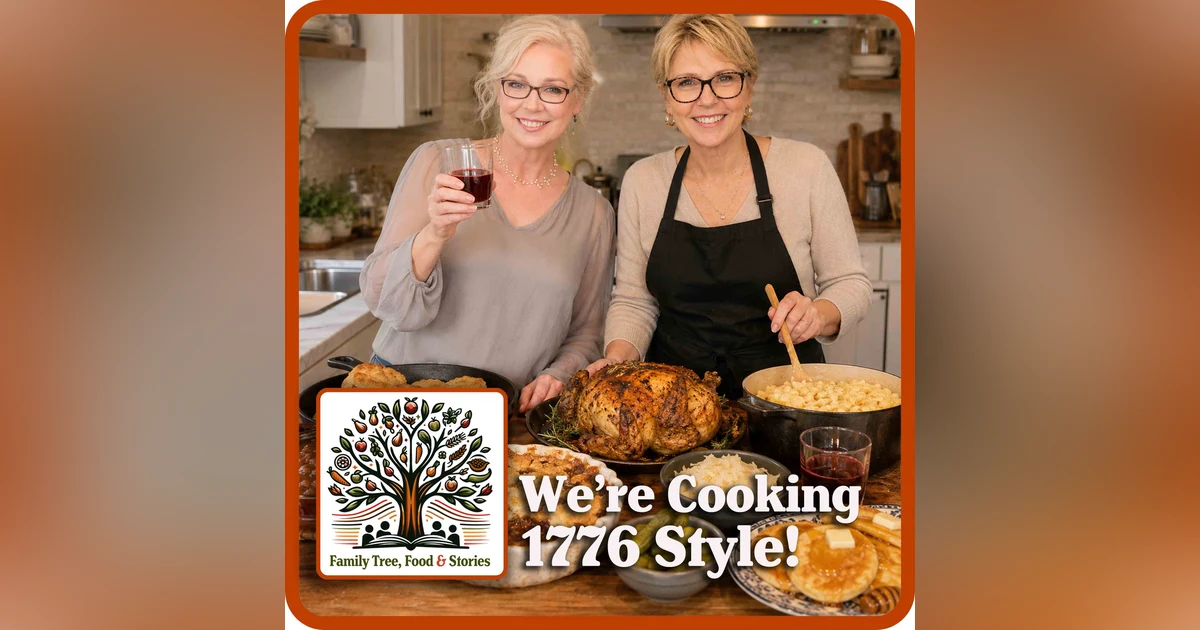



We're cooking 8 shockingly simple colonial recipes today. From George Washington's hoecakes and Jefferson's famous mac and cheese to the cherry bounce that took us three months to make. It really is easy to do 1776-style.
You probably assume Revolutionary War recipes are fussy, obscure, and impossible to make today. In this America 250 grand finale of Family Tree Food & Stories, Nancy May and Sylvia France prove that colonial cooking slides straight into a modern kitchen, no hearth, no weird 1776 ingredients, no fear required.
If you have cornmeal, peanut butter, chicken, elbow noodles, navy beans, and a few apples in your pantry right now, you can cook the exact colonial recipes George Washington and his contemporaries ate. We run a full-day cooking marathon: crispy hoecakes and velvety colonial peanut soup for breakfast; spatchcock chicken and James Hemings' original French-béchamel mac and cheese for the midday feast; slow New England baked beans with homemade sauerkraut and pickles for supper. Dessert is Abigail Adams' rustic apple pandowdy, and the nightcap is George Washington's own cherry bounce, which took three full months.
Don't want to do it all from scratch? Sylvia shares the free grocery store shortcut that does half the work for you.
Along the way, you'll hear the real stories behind these 1776 recipes — including the brilliant, enslaved chefs, Hercules Posey and James Hemings, who built the bedrock of American cuisine. This is comfort-food history you can taste. Grab your cast iron pan and cook through history with us.
What You'll Learn:
- How to cook what George Washington ate for breakfast every single day:— flourless hoecakes, with butter and honey and a savory colonial peanut soup that you can make fast with what’s in your pantry now.
- Who really invented mac and cheese and how to make it fresh: We’re sharing the t French-béchamel technique James Hemings brought home from Paris. Sylvia France pulled this recipe straight from Jefferson's National Archives.
- An easy free butcher-counter shortcut: This one’s for spatchcock chicken from scratch in your own kitchen. Nancy May and Bob, her husband, made this one, and how spatchcocking can cut your roasting time in half. Sylvia shares how you can get the butcher at Publix (or most any meat department) to do the hard part for you at no charge.
- How to make real colonial comfort food, the easy way: This is 12-hour New England baked beans with molasses and salt pork, plus sauerkraut and fermented pickles that need no canning at all. It’s easier than it sounds.
- What to add as an after-dinner drink…George Washington's Cherry Bounce: Although this one takes a little time to plan and make. It’s still very easy. Nancy followed the handwritten recipe from the Mount Vernon archives. George packed a flask of this with his things for military marches.
Additional Links Shared:❤️
- Yaupon Tea, family-owned. When British tea just won't do.
- Book: My Family Tree, Food & Stories Journal Awarded #1 New Release on Amazon
- Instagram Story updates 📸
- Facebook Family Tree Food Stories GROUP👍
- TikTok: Family Tree Food Stories
- 👇Share Your Story With Nancy & Sylvia!: Leave us a voicemail
- You can send us a DM on Facebook.
More From Our American Revolution Food Series
This is the grand finale of our four-part American Revolution food series:
- Part 1 — the American Revolution food series
- Part 2 — colonial recipes and the stories behind them
- Part 3 — how chef Hercules Posey walked out on Washington's birthday to claim his freedom
Next Thursday: we're beating the Florida heat with summer salads, grilled specialties, and homemade dog biscuits for BB and the Mighty Quinn.
About Your Award-Winning Hosts:
Nancy May and Sylvia France are the powerhouse team behind Family Tree, Food & Stories, a member of The Food Stories Media Network, which celebrates the rich traditions and connections everyone has around food, friends, and family meals. Nancy, an award-winning business leader, author, and podcaster, and Sylvia, a visionary author, foodie, and business leader, combine their expertise to bring captivating stories rooted in history, heritage, and food. Together, they weave stories that blend history, tradition, and the love of food, where generations connect and share intriguing mealtime stories and kitchen foibles.
If you missed the first time around... now's your time to listen to Family Tree Food & Stories and get inspired to make better use of what’s already in your kitchen. Then visit our page to share how you're using your leftovers this year. Waste less. Cook smarter. Tell the story behind your fridge.
"Every Meal Has a Story, and Every Story is a Feast." (tm) is a trademark of Family Tree Food & Stories podcast (c) copyright 2026, all US and International Rights Reserved.
@familytreefoodstories, #familytreefoodstories #familyfoodstories, #colonialrecipes1776, #foodpodcast, #historicalrecipes, #hoecakes #johnnycakes #applepandowdy, #cherybounce #macandcheese #colonialslaves #georgewashingtonsslaves #thomasjeffersonscook #abibaleadams #foodhistory
Frequently Asked Questions About Revolutionary War Food
- What did George Washington eat for breakfast? George Washington ate hoe cakes nearly every morning of his life; thick, savory cornmeal cakes with crispy fried edges, served swimming butter and honey, often with colonial peanut soup, another favorite of his.
- What is a hoecake? A hoecake is a flourless colonial cornmeal cake, like a thick savory pancake. It's white cornmeal, a pinch of salt, a little sourdough starter or active dry yeast, and boiling water. You scald the cornmeal into a thick paste and fry it until the edges go crisp. No flour at all.
- Were hoe cakes really cooked on a garden hoe? Partly. Enslaved laborers working the fields did cook them on iron garden hoes over fire pits out of necessity. But in the big estate kitchens, "hoe" was just another word for a flat iron griddle.
- Who really invented mac and cheese? The mac and cheese we eat today traces back to James Hemings, the French-trained enslaved chef who cooked for Thomas Jefferson. Hemings mastered the béchamel technique in Paris and brought it home to Virginia, sourcing Parmesan, mozzarella, and Romano. Jefferson gets the credit mostly because he's the one who wrote it down.
- What is cherry bounce? Cherry bounce is George Washington's favorite colonial cordial made with dark cherries packed tight with sugar, nutmeg, and cinnamon, then covered in rye whiskey or brandy and left alone for about three months. Washington loved it enough to have a traveler's flask packed for his military marches.
- Are Revolutionary War recipes hard to make at home? Not at all! Almost every dish in this episode uses ordinary pantry ingredients: cornmeal, peanut butter, chicken, navy beans, apples, so you can cook authentic 1776 recipes in a modern kitchen with nothing fancier than a cast iron pan.
- What is an apple pandowdy? Apple pandowdy is a rustic colonial dessert and the laid-back cousin of apple pie: sliced apples with brown sugar, cinnamon, and a splash of cider under a loose pie dough. Halfway through baking, you smash the crust down into the bubbling juices with a wooden spoon, so it comes out half-crispy, half-gooey. It was Abigail Adams' favorite, and there's no crimping required.
. Nancy A. May: Hello, everybody.
Speaker:Welcome back to another episode of Family Tree Food and Stories, where
Speaker:every single dish has a little bit of history and certainly a story.
Speaker:I'm Nancy May, or Fancy Nancy, as we've been saying behind the scenes, your host
Sylvia France:And I'm Sylvia Frantz, your co-host
Sylvia France:Nancy A. May: Yes, you're fancy too, darling.
Sylvia France:So Sylvia, before we launch into this week's show, I'd love to give
Sylvia France:a quick shout-out to a few folks who are listening to our show.
Sylvia France:We've got a great following, and especially in Ashburn, Virginia,
Sylvia France:Council Bluffs, Iowa, and some of the great folks in St. Petersburg,
Sylvia France:our home state of Florida, are among those and many others around the world
Sylvia France:We are thrilled that you're joining us each episode,
Sylvia France:and we look forward to giving a shout-out to more of you next week.
Sylvia France:Nancy A. May: Absolutely
Sylvia France:So today, Nancy, honestly, I've got every single burner on our stove
Sylvia France:firing at once, and the oven is actively starting to give off a lot of heat.
Sylvia France:It's going to be an absolute barn burner and madhouse around here today
Sylvia France:Nancy A. May: It sure is.
Sylvia France:But before we start stirring up our pots, would you do us a favor and head
Sylvia France:on over to podcast.familytreefoodstories, give us a quick review, and
Sylvia France:four stars please, smile, smile.
Sylvia France:And share this episode with someone who loves to cook and loves a good
Sylvia France:story, and wants to know where the food they ate today or yesterday came from.
Sylvia France:We're right here every week with a brand-new episode dropping
Sylvia France:every single Thursday morning
Sylvia France:So our big America 250 birthday grand finale, we decided to
Sylvia France:stop talking about the history and stories of what everyone ate and bring it
Sylvia France:straight into our modern actual kitchens
Sylvia France:Nancy A. May: Yes, that's correct.
Sylvia France:We are doing a marathon of cooking, a full day of it, of Revolutionary War
Sylvia France:comfort food, from morning breakfast to an evening meal, and sharing how you can
Sylvia France:make sure that you can enjoy exactly what old George ate and others during that time
Sylvia France:And I don't want you to worry.
Sylvia France:You don't need to hunt down weird, obscure ingredients from 1776 because everything
Sylvia France:we're making is shockingly simple
Sylvia France:Nancy A. May: It really is.
Sylvia France:And if you have cornmeal, peanut butter, yes peanut butter, chicken,
Sylvia France:some macaroni noodles, some navy beans, and a few apples in your pantry
Sylvia France:right now, you can cook the exact same menu that we're making here today.
Sylvia France:And you know what, Sylvia?
Sylvia France:What?
Sylvia France:Nancy A. May: It turns out that the instinct to cook your way
Sylvia France:through stressful times hasn't changed that much in 250 years
Sylvia France:Oh, absolutely But before we start chopping, glasses
Sylvia France:up What are we drinking today?
Sylvia France:Nancy A. May: Well, our tradition now is a toast, but today we're
Sylvia France:just drinking black coffee, a mug of it, maybe, maybe a whole pot of it.
Sylvia France:Because it's not 5:00 in paradise just yet, and we have some serious
Sylvia France:cooking ahead of us, Sylvia
Sylvia France:Well, it's always 5:00 somewhere, but fair enough.
Sylvia France:A toast to comfort food then.
Sylvia France:Whatever chaos is going on outside, we still boil, saute, and
Sylvia France:bake to feel a little bit better
Sylvia France:Nancy A. May: That's correct.
Sylvia France:And 250 years apart, that part just hasn't changed that much.
Sylvia France:So what do you say, Sylvia, that we just roll up our sleeves, put
Sylvia France:on the aprons, and get cooking?
Sylvia France:I'm ready, so let's go
Sylvia France:Nancy A. May: so my cast iron is heating up and I'm handling the
Sylvia France:morning shift with two absolute classics hoecakes and peanut soup
Sylvia France:I can't wait for this.
Sylvia France:Can you explain a hoecake for everyone who hasn't had the pleasure to try one?
Sylvia France:Nancy A. May: Absolutely.
Sylvia France:I haven't had the pleasure yet either, so we're gonna taste that with you.
Sylvia France:think of it as a thick, deep, savory cornmeal pancake where the edges get
Sylvia France:crispy in the grease, lard in that day and age, maybe a little bit butter today.
Sylvia France:and George Washington ate these every single morning of his life.
Sylvia France:They were just swimming in butter and honey
Sylvia France:I wonder if it was the back, the backstroke
Sylvia France:that they were swimming in
Sylvia France:Nancy A. May: Right?
Sylvia France:but it sounds perfect to me.
Sylvia France:And what's the secret batter?
Sylvia France:Nancy A. May: So It's just white cornmeal.
Sylvia France:This batch of cornmeal actually came from our good friend Steve Melton over
Sylvia France:in Dade City, with a pinch of salt, a little bit of sourdough starter, or
Sylvia France:if you don't have that, you can try active dry yeast, and boiling water.
Sylvia France:And that's it
Sylvia France:there's no flour in these hoecakes?
Sylvia France:Nancy A. May: Nope, no flour at all, which you typically have in pancakes.
Sylvia France:You just scald the cornmeal with a little boiling water, add the starter,
Sylvia France:and make it into a thick paste.
Sylvia France:It's totally foolproof.
Sylvia France:You know, even Ben Franklin was obsessed with them.
Sylvia France:however, rumor has it that Ben preferred his with a glass or two of Madeira wine
Sylvia France:on the side, even early in the morning
Sylvia France:but it is classic Franklin.
Sylvia France:Now, you have to address the forklore.
Sylvia France:Did people actually bake these on the back of a literal garden hoe?
Sylvia France:Nancy A. May: Well, yes and no.
Sylvia France:You see, enslaved laborers working out in the fields absolutely did
Sylvia France:use garden hoes or the iron garden hoes often in front of, often over
Sylvia France:fire pits out of sheer necessity.
Sylvia France:But our friend Steve pointed out in his research, the big estate kitchens,
Sylvia France:well, the hoe was just actually another term for an old flat iron grill.
Sylvia France:But can you hear that sizzling, Sylvia?
Sylvia France:I can.
Sylvia France:It sounds beautiful.
Sylvia France:Music to my ears
Sylvia France:Nancy A. May: Now, while these fry up, I'm gonna knock out some
Sylvia France:colonial peanut soup right next to it
Sylvia France:Peanut soup for breakfast?
Sylvia France:That sounds kind of weird to me, Nancy.
Sylvia France:It sounds more like dessert
Sylvia France:Nancy A. May: Well, it was one of George's favorites.
Sylvia France:So I promise you it's not sweet like hoecake syrup.
Sylvia France:It's actually deeply savory, earthy, and totally velvety
Sylvia France:How are you making this so fast?
Sylvia France:Nancy A. May: Well, if you only have a few minutes, this is the
Sylvia France:way you do it, and that's typically the way it was made back then.
Sylvia France:You just quickly whisk in smooth unsweetened peanut butter.
Sylvia France:Remember, don't get the kind at the grocery store that has sugar in
Sylvia France:it, and put that directly into some hot boiling chicken stock with some
Sylvia France:minced celery and onions, although I recommend you saute up those celery
Sylvia France:and onions first before you put them in
Sylvia France:So was that crunchy peanut butter or smooth peanut butter?
Sylvia France:And was that really it?
Sylvia France:Nancy A. May: It was smooth peanut butter.
Sylvia France:Now, you add a splash of heavy cream just to smooth it out even more so.
Sylvia France:And in the end, it takes about 15 minutes
Sylvia France:That sounds awesome and it smells incredible already but
Sylvia France:the history behind this one is heavy
Sylvia France:Nancy A. May: It really is.
Sylvia France:At Mount Vernon, an enslaved chef named Hercules Posey ran the entire
Sylvia France:kitchen operation for George.
Sylvia France:You know, we talked about him and how he brilliantly walked out on George's
Sylvia France:birthday to get his own freedom that one was in the last episode.
Sylvia France:However, Hercules was a genuine culinary celebrity of the day, and
Sylvia France:peanut soup itself really evolved from the West African peanut stews brought
Sylvia France:over and adapted by enslaved people
Sylvia France:That's a vital reminder.
Sylvia France:The bedrock of American cuisine was built by the genius of Black chefs.
Sylvia France:Nancy A. May: Yes, it was.
Sylvia France:And on that note, my hoe cakes are ready to be flipped, and the soup is thickening
Sylvia France:up, and breakfast is officially served.
Sylvia France:Grab your spoon
Sylvia France:I am for sure
Sylvia France:Nancy A. May: Okay, so, now that we're done cleaning up breakfast, we're gonna
Sylvia France:fast-forward and clock into midday.
Sylvia France:The kitchen is officially smelling like roasted chicken and bubbling cheese
Sylvia France:Welcome to lunch, which fun fact, was actually the biggest,
Sylvia France:heaviest meal of the day in 1776.
Sylvia France:It was usually served around 2:30 in the afternoon
Sylvia France:Nancy A. May: You know, That's perfect timing because I have a
Sylvia France:gorgeous spatchcock chicken resting right here on the cutting board.
Sylvia France:I think the name spatchcock was invented by some guy somewhere
Sylvia France:I'm sure it was.
Sylvia France:So can you tell them about the technique?
Sylvia France:Your Bob actually taught us this one, right?
Sylvia France:Nancy A. May: He did, and swears by it.
Sylvia France:And I won't touch it.
Sylvia France:Smart girl.
Sylvia France:Let him do the work.
Sylvia France:Nancy A. May: You just cut the backbone out completely out of the whole chicken
Sylvia France:and press it flat, or in my case, I would say smash it flat, and throw it
Sylvia France:into a hot cast iron pan skin side up
Sylvia France:Is smashed a real culinary term?
Sylvia France:I don't think
Sylvia France:Nancy A. May: In my book it is.
Sylvia France:But I understand it cuts your roasting time right in half.
Sylvia France:If you don't have a Bob to help you with your spatchcocking, you can buy a
Sylvia France:whole chicken, at most meat departments at grocery stores such as Publix
Sylvia France:will remove the backbone for free.
Sylvia France:All you have to do is ask.
Sylvia France:And ask also to keep the backbone so you can make homemade bone broth later.
Sylvia France:Even Trader Joe's has a rosemary lemon spatchcock chicken
Sylvia France:which gets amazing reviews
Sylvia France:Nancy A. May: Hmm.
Sylvia France:And with spatchcocking, you get a maximum crispy skin and the
Sylvia France:breast stays incredibly juicy.
Sylvia France:So before you put it in, though, just rub it down with butter, a little
Sylvia France:salt and pepper, some fresh thyme, and for a little extra flavor, throw some
Sylvia France:roasted garlic right under the skin
Sylvia France:It looks absolutely amazing but check this out I have
Sylvia France:some macaroni and cheese that I just pulled out of the oven
Sylvia France:Nancy A. May: Whoa, that looks pretty amazing.
Sylvia France:It's golden and crispy and bubbling all on the top, Sylvia.
Sylvia France:It's spectacular, and it smells delicious.
Sylvia France:Now, people think that mac and cheese is this modern processed box, orange
Sylvia France:and gold, you know, Kraft, but that is pure fork lore, our term again.
Sylvia France:however, We owe this exact classic, to Thomas Jefferson and his brilliant
Sylvia France:enslaved chef, James Hemings.
Sylvia France:You see, Hemings trained under the finest master chefs in Paris,
Sylvia France:ooh la la, and brought those elite French techniques back to Virginia.
Sylvia France:That's the Fancy Nancy part.
Sylvia France:Oui, oui.
Sylvia France:And for the sauce today, I went full Heming style.
Sylvia France:I started with a classic French béchamel, just a simple butter and
Sylvia France:flour roux cooked with warm milk.
Sylvia France:Then I loaded it with freshly grated Parmesan, mozzarella, and Romano cheese.
Sylvia France:I tossed a whole box of cooked elbow noodles in the baking pan and poured the
Sylvia France:sauce right over it with a little butter
Sylvia France:Nancy A. May: So I got a question for you, Sylvia.
Sylvia France:This one I'm a little skeptical on.
Sylvia France:Did James Hemings actually use those specific cheeses, Parmesan,
Sylvia France:mozzarella, and Ro- and Romano?
Sylvia France:I mean, really, this is colonial times
Sylvia France:Absolutely he did.
Sylvia France:I pulled an exact recipe directly from the National Archives of Thomas Jefferson.
Sylvia France:Hemings was sourcing these European cheeses to recreate the high-end
Sylvia France:dishes he mastered in France
Sylvia France:Nancy A. May: You know, that's amazing.
Sylvia France:and then you just put it all together and it just bubbles
Sylvia France:up in about eight to 10 minutes?
Sylvia France:I'll use what the boys said when they were
Sylvia France:little, easy cheesy is what it is.
Sylvia France:James,
Sylvia France:Nancy A. May: I love that
Sylvia France:James Hemings' exact 1700s technique is literally how we make
Sylvia France:gourmet homemade mac and cheese today.
Sylvia France:Jefferson just gets the credit because he wrote it down in his own records
Sylvia France:Nancy A. May: Okay, now while your Southern table is looking fantastic
Sylvia France:with mac and cheese, we can't leave out my old home stomping grounds of
Sylvia France:New England for dinner, of course.
Sylvia France:What do you have brewing in that Crockpot over there?
Sylvia France:You know, I would never leave New England out.
Sylvia France:so what I made today was a true northern staple.
Sylvia France:authentic Revolutionary War-style New England baked beans
Sylvia France:Nancy A. May: wow, the molasses smells just incredible.
Sylvia France:Now, I've never made baked beans myself other than opening a can, but
Sylvia France:how long have these been cooking?
Sylvia France:Literally all night.
Sylvia France:In colonial New England, especially around Boston, these were traditionally started
Sylvia France:on Friday night and baked low and slow in a brick oven for Saturday dinner.
Sylvia France:You'd take dried navy beans, soak them, and then layer them in a pot of salt
Sylvia France:pork and dark molasses, a little mustard, and an onion stuck with whole cloves
Sylvia France:Nancy A. May: And then back then they didn't even have refined
Sylvia France:white sugar, so they used molasses as the ultimate flavor engine.
Sylvia France:Although I think I'm gonna ask Bob to make a brick oven for us in the back.
Sylvia France:I'm sure he'll do it for you.
Sylvia France:But the salt pork melts completely into the beans over 12 hours, making
Sylvia France:them insanely rich, smoky, and sweet.
Sylvia France:It's pure northern survival food that became an absolute cultural classic
Sylvia France:Nancy A. May: Yeah, there are restaurants that have been named after that one.
Sylvia France:So I see you also brought out some serious side dishes to balance
Sylvia France:out some of that rich dairy and heavy molasses in the beans too
Sylvia France:Oh, you know I have to.
Sylvia France:I've got a big heap of homemade sauerkraut and some crisp fermented
Sylvia France:pickles that I made myself.
Sylvia France:Just a little thyme, salt, and vinegar doing their magic.
Sylvia France:Though, full disclosure, the hardest part is remembering to burp the sauerkraut
Sylvia France:jar every day during the first week of fermentation so it doesn't explode
Sylvia France:Nancy A. May: Explode?
Sylvia France:Oh, boy.
Sylvia France:I can't imagine exploding sauerkraut in my kitchen.
Sylvia France:Now that's a bad day.
Sylvia France:but back then fermenting wasn't a trendy hobby.
Sylvia France:Now that makes me sound old.
Sylvia France:it was pure survival.
Sylvia France:It allowed families to store food for months and literally prevented
Sylvia France:scurvy during those brutal winters.
Sylvia France:You know, my sister out in Oklahoma is a big canner.
Sylvia France:I haven't done it.
Sylvia France:Actually, I shouldn't say that.
Sylvia France:I did it with my mom once, and we both decided we'd never do it again.
Sylvia France:Well, the great thing about doing the pickles and the sauerkraut,
Sylvia France:you don't have to can anything.
Sylvia France:So literally you can make it in your pantry, a dark pantry, and
Sylvia France:also in your refrigerator as well.
Sylvia France:So there's none of that boiling and all that process.
Sylvia France:it's really, as I said earlier, easy cheesy.
Sylvia France:Nancy A. May: peasy . I'm gonna have to give it a try then
Sylvia France:Yes.
Sylvia France:And the acidity cuts right through my rich bechamel sauce and the
Sylvia France:sweetness of those baked beans.
Sylvia France:It's a perfect match
Sylvia France:Nancy A. May: Okay, so my fork is getting ready or my fork is quivering
Sylvia France:at this point and I'm starving.
Sylvia France:So let's take a quick break before we pass out from a food
Sylvia France:coma and we'll be right back.
Sylvia France:Don't go anywhere, guys.
Sylvia France:Dessert and real colonial whiskey are right on the other side.
Sylvia France:Nancy A. May: Woo-hoo!
Sylvia France:Okay, and we are back.
Sylvia France:The kitchen is open again, and it smells like cinnamon and
Sylvia France:warm brown sugar and dark fruits
Sylvia France:I just finished up our dessert, a beautiful,
Sylvia France:deeply rustic apple pandowdy
Sylvia France:Nancy A. May: Hmm.
Sylvia France:Apple pandowdy?
Sylvia France:I haven't heard of that one although that's a pretty weird name.
Sylvia France:What exactly does pandowdy mean?
Sylvia France:Well, It's basically the laid back, unpretentious
Sylvia France:cousin of the classic apple pie.
Sylvia France:There's no perfect rolling or crimping required.
Sylvia France:you just toss your sliced apples with brown sugar, cinnamon, and a
Sylvia France:splash of cider, and then drape a rustic pie dough right over the top
Sylvia France:Nancy A. May: Ooh, well, that sounds perfect for me because I
Sylvia France:am not good at making pie crust.
Sylvia France:and it sounds like my baking.
Sylvia France:Now, how does it actually get that unique bumpy texture?
Sylvia France:Oh, this is the fun part.
Sylvia France:Halfway through the baking, you take a wooden spoon and literally smash down…
Sylvia France:the crust into the bubbling apple juices
Sylvia France:Nancy A. May: Ooh, that does sound, sound like fun.- So the dough just drinks up all
Sylvia France:that caramelized, apple cider and flavor.
Sylvia France:And hang, you might wanna pour a splash of whiskey in there too, or brandy.
Sylvia France:But that's coming later.
Sylvia France:It becomes half crispy, half gooey.
Sylvia France:It was actually Abigail Adams' absolute favorite dessert, and
Sylvia France:I used her personal recipe today
Sylvia France:Nancy A. May: Ooh, I love Abby, right?
Sylvia France:It looks incredible,
Sylvia France:Don't forget the ladies
Sylvia France:Nancy A. May: absolutely we won't.
Sylvia France:We owe them.
Sylvia France:Anyway, while that cools down, it's time for my personal grand finale
Sylvia France:Whoa!
Sylvia France:Hold on.
Sylvia France:A massive wave of rich spice hit me What is that, Nancy?
Sylvia France:Nancy A. May: That, my friend, is George Washington's actual personal
Sylvia France:favorite recipe for cherry bounce.
Sylvia France:I f- I love that name, right?
Sylvia France:I followed his handwritten archives to the T
Sylvia France:I am curious, how long has that been hiding in your
Sylvia France:pantry and you haven't touched it?
Sylvia France:Nancy A. May: Well, that's the hard part.
Sylvia France:Because we knew this episode was coming, so I had to prepare for it.
Sylvia France:It takes three full months.
Sylvia France:So you pack dark cherries, Bob pitted them all, and you smash
Sylvia France:them with sugar, nutmeg, and cinnamon into a massive glass jars.
Sylvia France:Pack it really tight, and then just let it sit
Sylvia France:And then just drown it in alcohol
Sylvia France:Nancy A. May: Yeah.
Sylvia France:Yeah, before you close the lid for three months, you drown it in a good amount
Sylvia France:of rye whiskey or brandy, and then you just let time do the heavy lifting.
Sylvia France:Washington was so obsessed with this stuff that he literally ordered a
Sylvia France:traveler's flask of cherry bounce to be packed for his military marches.
Sylvia France:I'm wondering how he managed to stay on his horse all those days, right?
Sylvia France:in this kitchen right now, I completely understand why one sip of
Sylvia France:that will help you survive Valley Forge.
Sylvia France:Let's pour a drop purely for experimental purposes, obviously
Sylvia France:Nancy A. May: Obviously not.
Sylvia France:Mm, glug, glug, glug, glug.
Sylvia France:Oh, wow.
Sylvia France:That is beautiful and has a serious kick to it.
Sylvia France:It's amazing.
Sylvia France:I might wanna get on a horse after this one.
Sylvia France:Right?
Sylvia France:Oh man, the cherries completely smooth
Sylvia France:out the burn of the whiskey.
Sylvia France:It literally tastes like a warm blanket
Sylvia France:Nancy A. May: it does.
Sylvia France:That liquid heat going down your chest, it just tastes like history.
Sylvia France:And dinner.
Sylvia France:So we've covered breakfast and what we called supper or lunch around 2:30.
Sylvia France:But dinner, well, dinner time wasn't a big deal back in 1776.
Sylvia France:It was just typically a light snack or some leftovers or just maybe
Sylvia France:an extra glass of cherry bounce to tide you over until breakfast the
Sylvia France:next morning, or make you go to sleep
Sylvia France:Looking at this entire table right now, Nancy, the hoecakes,
Sylvia France:the peanut soup, the spatchcock chicken, the mac and cheese, the baked beans,
Sylvia France:and the cherry bounce it just hits me
Sylvia France:Nancy A. May: How's that?
Sylvia France:Well, 1776 wasn't just an abstract history textbook
Sylvia France:filled with pristine white rooms and men in perfect powdered wigs
Sylvia France:Nancy A. May: No, I think their wigs were a little dusty.
Sylvia France:Not at all, actually.
Sylvia France:history was lived by real, ordinary, deeply stressed out people who were
Sylvia France:actively fighting for survival, their liberty, and yes, ours.
Sylvia France:Tired soldiers, anxious families, and brilliant enslaved chefs
Sylvia France:Exactly when the world felt completely upside down, they walked into
Sylvia France:a kitchen or tended a hearth fire just to find a single moment of peace and to
Sylvia France:taste something that tasted like safety
Sylvia France:Nancy A. May: And 250 years later, you know, here we are in
Sylvia France:our kitchens, induction stove and all, doing the exact same thing
Sylvia France:Thank you all so much for cooking through history
Sylvia France:with us for our America 250 finale
Sylvia France:… Nancy A. May: All the recipes and, easy step-by-step guides from today's marathon
Sylvia France:are waiting for you in the show notes at Podcast.FamilyTreeFoodStories.com.
Sylvia France:So try one tonight or maybe over the weekend, and you can literally
Sylvia France:taste what the past was like
Sylvia France:Next Thursday, we are switching gears to keep
Sylvia France:cool in this brutal Florida heat during the dog days of summer.
Sylvia France:We've got some delightful summer salads, grilled specialties, and believe it or
Sylvia France:not, maybe a homemade dog biscuit recipe or two for BB and the mighty Quinn.
Sylvia France:Nancy A. May: The mighty queen, yes it's hot everywhere in our country
Sylvia France:literally and figuratively I can't wait.
Sylvia France:So happy cooking everyone
Sylvia France:And happy experimenting.
Sylvia France:We'll see you next Thursday
Sylvia France:Nancy A. May: Take care.
Sylvia France:Bye-bye.