The Secret History of Tea: Personal Rituals & Family Stories



5,000 Years of Comfort #FoodHistory, British Afternoon @Tea, #SouthernSweetTea & the Rituals That Still Bring Family & Friends Together.
Have you ever sat down with your mom or a good friend with absolutely no agenda other than just... being together? Nancy's mom had a word for it: "sharing a cuppa." She and Nancy would drive down to Alice's, their local general store-luncheonette, not because they needed anything, but because that was their girl-time ritual. Their way of making the whole world stop spinning for a little while. Simple.
Here's the part that'll get you through... the exact thing Nancy and her mom shared turns out to be one of the oldest comfort-food traditions in human history. That quiet little ritual over a shared cup? Well, it's over 5,000 years old. Which somehow makes every #cuppa feel a little more meaningful, doesn't it?
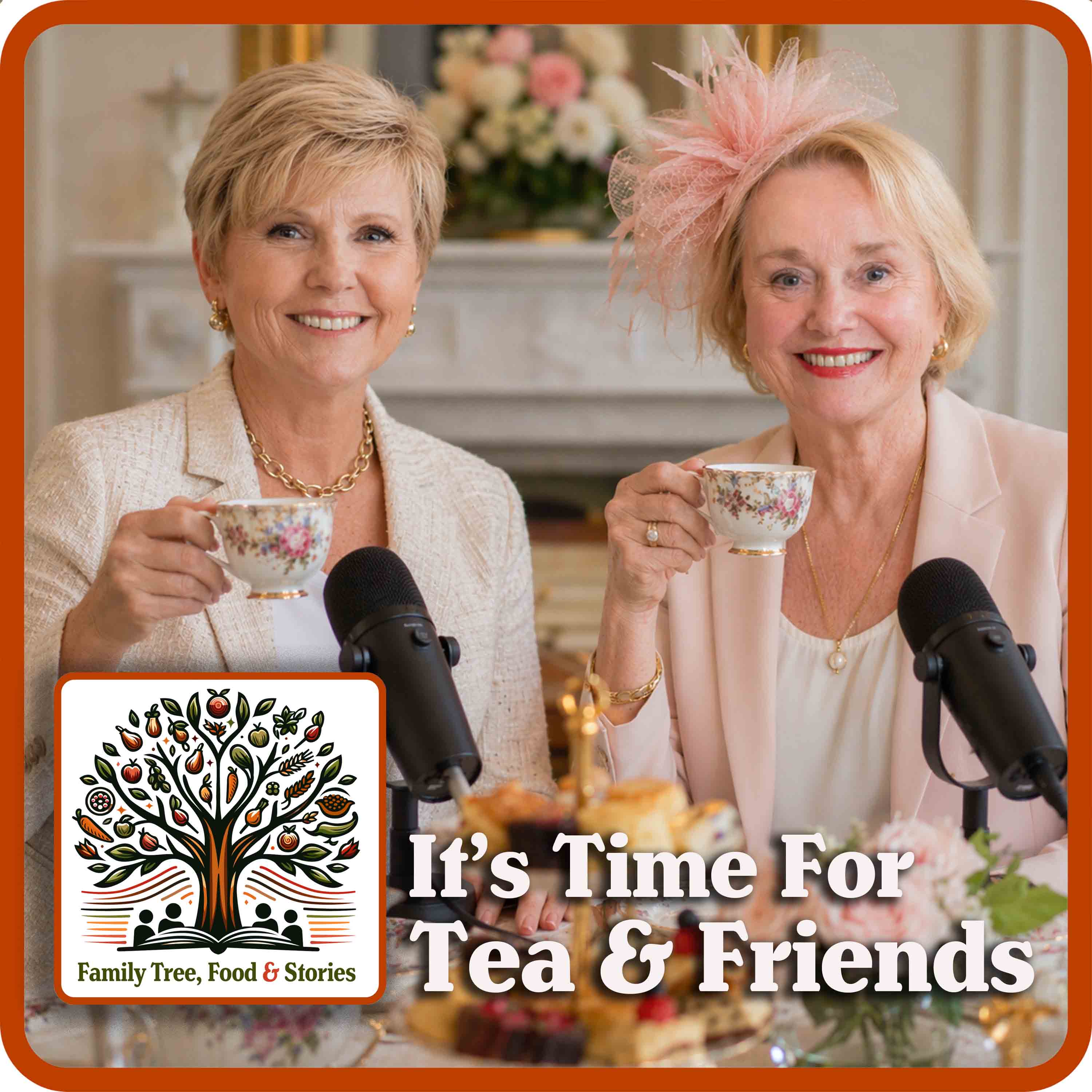
This week on Family Tree Food and Stories, Nancy May and Sylvia Lovely pour their own cuppa and take you straight into the rich, surprising cultural food history hiding inside your favorite cuppa. And if you think tea is simple, buckle up, because it turns out to be the second most consumed beverage on the planet and holds some of the best family food stories, heritage recipes, and generational traditions that you might not have known about.
From #EmperorShenNong accidentally inventing tea in ancient China, to scholar #LuYu loving tea so much that he wrote the world's very first book about it, to Anna, the #DuchessOfBedford, getting peckish between lunch and dinner and accidentally turning a personal snack into the institution of #British @AfternoonHighTea.
But wait, there's more! Sylvia shares her funny and somewhat uncomfortable experience of being exactly the right size for a traditional Japanese kimono during a tea ceremony. Then, Nancy digs into some really interesting stories about the @Boston #TeaParty, which brewed about 18 million cups of tea and sparked the @AmericanRevolution, and notes that this year marks our #250thAnniversary.
Then it's on to sweet tea's surprise American debut at the 1904 St. Louis World's Fair, the real tea sandwiches and #Benedictine spread served at #Louisville's legendary #Brown Hotel during Derby season, @PaulaDeen's Savannah kitchen and its place in Southern sweet tea culture, and why @Chick-fil-A's @Tetley blend has built the kind of devoted Southern following most brands only dream about. @Bigelow #ConstantComment, @Twinings Winter Spice, @RepublicOfTea, @HarneyAndSons Paris Tea, @Lipton, @Milo's, and @IGA all show up in this one. Yes, each one has a story attached that takes them all to a level that might be new to you. They're all worth sharing, too!
- Tea brick truth bomb: Those old tea bricks used as currency across Mongolia and Siberia? The binding ingredient is… truly disgusting!
- British tea rules (yes, they are serious): There’s a “correct” number of stirs, a strict milk-tea-sugar order, and one thing you’re probably doing that they call downright vulgar.
- Southern sweet tea line in the sand: There is exactly one right way to make it. No shortcuts. No substitutes. This episode spells it out—clear and unapologetic.
- What this season really reveals: From ancient tea routes to backyard brews, one truth keeps showing up—food stories aren’t about food. They’re about us.
What’s your tea story?
Join our Family Tree Food & Stories Facebook Group, and go to our Family Tree Food & Stories podcast page at: https://podcast.familytreefoodstories.com/ Hit subscribe, leave us all the stars, and share this with someone who takes their cup of tea seriously. You know who that is. Because every meal has a story, and every story is a feast.
Additional Links ❤️
- SURVEY: Please Help Us Learn How To Do More For You
- Book: My Family Tree, Food & Stories Journal Awarded #1 New Release on Amazon
- Instagram Story updates 📸
- Facebook Family Tree Food Stories GROUP👍
- TikTok: Family Tree Food Stories
- 👇Share Your Story With Nancy & Sylvia!: Leave us a voicemail
- You can send us a DM on Facebook.
About Your Award-Winning Hosts: Nancy May and Sylvia Lovely are the powerhouse team behind Family Tree, Food & Stories, a member of The Food Stories Media Network, which celebrates the rich traditions and connections everyone has around food, friends, and family meals. Nancy, an award-winning business leader, author, and podcaster, and Sylvia, a visionary author, lawyer, and former CEO, combine their expertise to bring captivating stories rooted in history, heritage, and food. Together, they weave stories that blend history, tradition, and the love of food, where generations connect and share intriguing mealtime stories and kitchen foibles.
If you missed the first time around... now's your time to listen to Family Tree Food & Stories and get inspired to make better use of what’s already in your kitchen. Then visit our page to share how you're using your leftovers this year. Waste less. Cook smarter. Tell the story behind your fridge.
"Every Meal Has a Story, and Every Story is a Feast." (tm) is a trademark of Family Tree Food & Stories podcast (c) copyright 2026, all US and International Rights Reserved.
@familytreefoodandstories @familytreefoodstories #foodie #tealover #tasseographer #tealeaves #TheClassicofTea #teabrick #plymouthmassachusettes @plymouthplantation ##DutchessOfBedford #MarthaStewart #smallbites @afternoontea #afternoontea @downtownabby @brownhotel #lexingtonKY #hotbrown #hotbrownsandwich #cucumbersandwich #englishtea #hightea #bostonteaparty @AmericanRevolution @teatlytea @lipton @biggelowtea #bigelow @drinkmilows @luzianne @iga @Chick-Fil-A @pannera @starbucks #mushroomcoffee #specialtycoffee @republicoftea #guyanateapot #greentea #oolongtea #listenerchallenge
hello everybody, it's Nancy May and Sylvia.
Nancy May:Lovely once again with another episode of Family Tree Food and Stories.
Nancy May:Before we start on this show, like we always say, every meal has a
Nancy May:story and every story is a feast and you can't have either without
Nancy May:liking and subscribing to this show.
Nancy May:So if you go to podcast, family tree, food stories.
Nancy May:Go to the top of the page.
Nancy May:There's a little button that says Review.
Nancy May:Like, subscribe, and you get all the information there.
Nancy May:. We release Thursday morning.
Nancy May:Of course you can listen to all the shows anytime, day or night that you'd
Nancy May:want, but we do hope that you listen on Thursdays and every day thereafter.
Nancy May:So on that note, let's get going with this show, Sylvia, because
Nancy May:we're talking about drinks.
Sylvia Lovely:Yeah.
Sylvia Lovely:Yeah.
Sylvia Lovely:Not maybe the fun.
Sylvia Lovely:Yeah, they're kind of fun, but they're more kind of the
Sylvia Lovely:one we're gonna talk about.
Sylvia Lovely:It's more to relax you, I think,
Sylvia Lovely:than it is to excite you and get you dancing
Nancy May:the most pot.
Nancy May:Potent, potent say that three times at best.
Nancy May:The more potent ones can also relax you in a different kind of
Sylvia Lovely:Mm-hmm.
Nancy May:But this one we're talking about rituals and the things that
Nancy May:belong in that category are tea.
Nancy May:not just the thirst quenching kind of tea, but the ones that make you
Nancy May:sort of slow down and relax at the end of the day, or maybe even get
Nancy May:up in the beginning of the day.
Nancy May:But I always think of tea more as an afternoon type of thing.
Nancy May:And my mom used to ask me when we were kids growing up, you wanna go for a Cup-a?
Nancy May:Well, I think we were probably teenagers at the time, and we'd go down to Alice's.
Nancy May:Which was the local general store and have a cuppa at the end of the day.
Nancy May:It was just our way of girl time, which I always enjoyed.
Sylvia Lovely:Yeah.
Nancy May:also, have you ever had your tea?
Nancy May:Tea leaves red,
Sylvia Lovely:I never have.
Sylvia Lovely:But that's a well saying you should get your tea leaves.
Sylvia Lovely:Uh, follow your tea leaves.
Sylvia Lovely:I mean, you know, it's well known.
Nancy May:I don't know what they're saying is, but the tea
Nancy May:leaves are read by a tasseographer.
Nancy May:I think that's how
Sylvia Lovely:Whoa, that's
Nancy May:And
Sylvia Lovely:impressive.
Nancy May:there's probably a better way to pronounce it, but it certainly is a $10
Nancy May:word and I'm pronouncing it in a $5 way,
Sylvia Lovely:It's better than a Dingleberry or something like that,
Nancy May:Right.
Nancy May:But tea gives us that permission to pause, to stay a while and chat and give
Nancy May:you a moment to slightly unwind and.
Nancy May:feel what's present at the moment?
Sylvia Lovely:Mm-hmm.
Sylvia Lovely:Oh yeah.
Sylvia Lovely:And it's exactly why we keep going back to the same vacation spot every year.
Sylvia Lovely:I don't know about you, but we relive those.
Sylvia Lovely:Scenes in our minds over and over, and that same way, celebrate
Sylvia Lovely:with the same meal and the same drinks, and it becomes ritual.
Sylvia Lovely:And, coffee, coffee's my habit.
Sylvia Lovely:And by the way, coffee's good for you again.
Nancy May:Right.
Sylvia Lovely:Flash.
Nancy May:The Coffee Association has told you
Sylvia Lovely:No, no, it was on the news and you know, I believe
Sylvia Lovely:everything I hear on the news.
Sylvia Lovely:But anyway, but coffee has its own devoted following, like me, but
Sylvia Lovely:not one quite as ancient as tea, which just intrigues me so much.
Sylvia Lovely:Coffee wakes you up, sends you out the door, but tea does something different.
Sylvia Lovely:even after researching all of this, it still intrigues me.
Sylvia Lovely:It pulls you in the opposite direction.
Sylvia Lovely:Invite you to sit down, to linger, to stay with something a little bit longer.
Sylvia Lovely:And today we're following that thread from ancient China where tea,
Sylvia Lovely:by the way, began as a medicine.
Sylvia Lovely:To British Afternoon Tea.
Sylvia Lovely:How proper, and you're kind of British, you know, to the front
Sylvia Lovely:porches of the American South.
Sylvia Lovely:I'm the Irish gal in this family.
Sylvia Lovely:and in the way we're going to ask what tea still offers us now.
Sylvia Lovely:Especially in a world that just won't stop moving and swirling
Sylvia Lovely:around here's a fun fact.
Sylvia Lovely:There are far more tea drinkers than coffee drinkers on the planet
Sylvia Lovely:And tea is the second most consumed beverage in the world after water.
Nancy May:That's amazing, right.
Sylvia Lovely:Yeah, But you think about it, for some reason, and, and
Sylvia Lovely:it may be the religions of the East, Buddhism, Hinduism, all of those
Sylvia Lovely:things are much more ritualistic.
Sylvia Lovely:I guess the Catholic church kind of is, but it may be what spread
Sylvia Lovely:that whole idea of tea, because that's kind of where it all started.
Sylvia Lovely:So tell us all about it.
Nancy May:Well, it's interesting when you look at tea, I don't know about you,
Nancy May:but I think of tea as like Chinese tea.
Nancy May:But it really is permeated throughout so many different cultures.
Nancy May:And as we were getting into the show, even Russia and Angolia and the British
Nancy May:of course, and well, we'll get into the US history 'cause there's a whole bunch
Nancy May:of history that we all know about that.
Nancy May:But even still, so let's go back to some of the ancient stories where it
Nancy May:starts with a legend this is kind of a fun and whimsical story, which I loved.
Nancy May:And around 2,700 BC there was an emperor by the name of Chen, and I'm
Nancy May:hoping pronouncing that with my Chinese
Nancy May:accent.
Sylvia Lovely:just let him get mad about it.
Nancy May:Right.
Nancy May:anyway, he's apparently sitting outdoors, boiling water and because then people
Nancy May:knew that raw water, I guess that's what you call unprocessed water of
Nancy May:today, uh, could have all sorts of contaminants and make you sick.
Nancy May:And that's why they were boiling the water.
Nancy May:But apparently some little leaf drifts from a nearby tree.
Nancy May:Whoa.
Nancy May:And there it pops into the pot.
Nancy May:And instead of fishing that leaf out, he decides to take a sip.
Nancy May:And something about the SIP has endured for 5,000 years.
Sylvia Lovely:Whoa,
Nancy May:Isn't that amazing?
Nancy May:What I find interesting is that tea didn't begin with a comfort drink.
Nancy May:It was kind of a, oops, get the fly out of my soup.
Nancy May:Good thing it wasn't a fly, right?
Sylvia Lovely:Mm-hmm.
Nancy May:But it's more of a functional thing, and it was used to create
Nancy May:clarity for healing to sharpen the mind.
Nancy May:Well before coffee, obviously, and the Chinese Buddhist monks, particularly
Nancy May:from the ninth century through the 12th century, embrace tea as part of
Nancy May:their meditation and spiritual ritual.
Nancy May:Spiritual ritual practices.
Nancy May:I'm gonna sound like Barbara Walters here.
Nancy May:Every secondary Barbara probably could have used some tea.
Nancy May:But, so I was fascinated in just how much tea was a part of helping
Nancy May:them deal with those long hours of contemplation and meditation and just
Nancy May:sort of taking that edge off.
Nancy May:You know, there was the Redding Center for Meditation, which was run
Nancy May:by a couple of Buddhist monks up in where we just moved down from a couple
Nancy May:years, actually it's been five years.
Nancy May:April 1st this year that we're down here being Gator girls,
Nancy May:or I am being a Gator girl.
Nancy May:And it was so interesting to see how the monks, the, the Buddhist
Nancy May:monks just were able to relax.
Nancy May:They always offered us tea as well during a meditation period.
Nancy May:It was
Nancy May:kind of, it was my way to, to chill out with another friend, although
Nancy May:I kind of lost a little bit of.
Nancy May:that too, but that's for another story.
Sylvia Lovely:Yeah.
Nancy May:But you have more information about this,
Sylvia Lovely:Yeah.
Sylvia Lovely:So, let's get into those old dynasties, how about the Tang Dynasty,
Sylvia Lovely:and I don't mean that drink that the
Nancy May:This space.
Sylvia Lovely:are Yeah, yeah.
Sylvia Lovely:I'm not, I'm not talking about that.
Sylvia Lovely:The Tang Dynasty, and that's roughly again, long time ago, six 18 to 9
Sylvia Lovely:0 7 AD is no longer just consumed.
Sylvia Lovely:It's, it becomes like.
Sylvia Lovely:A thing to be studied, written about, and it's a practice.
Sylvia Lovely:I think that's a distinguishing mark of tea.
Sylvia Lovely:You don't practice coffee, right?
Sylvia Lovely:You practice tea because of all the rituals that grew up around it.
Sylvia Lovely:A scholar named Lou UI love that.
Sylvia Lovely:Luu.
Sylvia Lovely:Hey, Luu.
Sylvia Lovely:I love that.
Sylvia Lovely:He's probably gonna throw spitballs at me.
Sylvia Lovely:, In space, even wrote that considers the world's first book entirely
Sylvia Lovely:about tea, called The Classic of Tea.
Sylvia Lovely:And it covered everything from the best water to the philosophy
Sylvia Lovely:behind the act of brewing.
Sylvia Lovely:So tea became a part of how people related to one another offering tea.
Sylvia Lovely:Became a gesture of respect of welcome acknowledgements.
Sylvia Lovely:Not the only drink that does, but it certainly had its kind of way of
Sylvia Lovely:putting it, a small cup place between two people, no rush, no urgency, and
Sylvia Lovely:with rules that we'll get into later.
Sylvia Lovely:But in that space, something opens up and tea becomes less about
Sylvia Lovely:what's in the cup and more about what's happening between the people
Sylvia Lovely:holding it and the discipline of tea.
Nancy May:I think it's kind of wild.
Nancy May:That we have these rituals that sprang up around tea like no other drink history.
Nancy May:And you've got the Japanese and the Chinese and the Moroccan, , Indian,
Nancy May:I mean, I shouldn't say this like, I'm gonna say it anyway,
Nancy May:like dot versus Feather Indian.
Nancy May:It's probably in, that's probably inappropriate.
Nancy May:Maybe I should edit that one out.
Nancy May:But anyway,
Nancy May:um, east African, Russian, and of course the British cultures that we know of.
Nancy May:High tea ceremonies, and they're not really ceremonies, but it's kind of a, a
Nancy May:process that you have and it's turned into a very artistic form of enjoying things.
Nancy May:But then you have the traditional Japanese ceremony that I think many people have
Nancy May:heard of, but may not know the details, of exactly what goes on during those.
Nancy May:Those include making sure that everything is natural, all the materials that
Nancy May:are from Tatami mats, to the precise size of those mats, to the entrance
Nancy May:into the tea room where you have to bend down to get into the door,
Nancy May:which is a bow or a sign of respect.
Nancy May:You had spent time in Japan.
Nancy May:Did you ever go through a tea ceremony?
Sylvia Lovely:Yes, I did.
Sylvia Lovely:it was really interesting, but by the way, you would have to bow,
Nancy May:Not you because you're like
Sylvia Lovely:I'm like two feet tall.
Sylvia Lovely:But anyway, so I would pretend to do that though.
Sylvia Lovely:, But that's not my favorite Japanese, that's another story.
Sylvia Lovely:But the day that they put me in a com.
Sylvia Lovely:kimono, And it was so tight I couldn't breathe.
Sylvia Lovely:And the family I, Liv was living with, they were so excited about
Sylvia Lovely:putting me in that thing and I was like, I can't breathe.
Sylvia Lovely:I really can't breathe.
Sylvia Lovely:And took me to a performance.
Nancy May:Oh, how
Sylvia Lovely:sit and, and what they loved about it.
Sylvia Lovely:Was that they're small people and I was small and she was so delighted
Sylvia Lovely:because I fit into her kimono.
Nancy May:Aw.
Sylvia Lovely:I nearly died.
Sylvia Lovely:anyway, they have a lot of rituals.
Sylvia Lovely:That's my point.
Sylvia Lovely:Tea and all of those things.
Sylvia Lovely:You dress in a certain way, you show reverence in a certain
Sylvia Lovely:way, and heaven forbid, wear, don't wear your shoes, you know?
Nancy May:Right.
Nancy May:Yeah.
Nancy May:My shoes my size.
Nancy May:10 shoes, no.
Nancy May:Yeah, they'd laugh at that one.
Nancy May:But there was sort of a humility about the the Japanese tea.
Nancy May:And each tea bowl has to be unique, often handmade.
Nancy May:Sometimes they're centuries old in the more traditional ancient types of
Nancy May:tea ceremonies that they have.
Nancy May:And everything is so precise.
Nancy May:But there's also something that people don't know.
Nancy May:Tea was once considered.
Nancy May:Valuable in Asia and it was so valuable that was pressed into
Nancy May:bricks and used as actual currency.
Nancy May:Now we have a brick of tea at home,
Sylvia Lovely:You do,
Nancy May:I do.
Nancy May:I, I haven't traded a horse for it and I haven't gone grocery shopping with it, so,
Sylvia Lovely:huh?
Sylvia Lovely:Wow.
Sylvia Lovely:You been holding out on me.
Nancy May:I know, I'm sorry.
Nancy May:I'm sorry.
Nancy May:But they, you were used as, currency really for trading horses in Mongolia
Nancy May:and across Siberia and other places to pay for wages and whatnot.
Nancy May:But we have this brick of tea that we got in Plymouth, Massachusetts,
Nancy May:one Thanksgiving, and we were just fascinated when we saw it.
Nancy May:It was beautiful the way he was pressed into things.
Nancy May:But the disgusting part, I have to say, which I didn't know about until
Nancy May:just now, I don't think they did it.
Nancy May:Up in Plymouth, but I could be wrong, at least from commercial in this
Nancy May:day and age, the way they pressed this, this tea together in this brick
Nancy May:was they either used dried blood,
Sylvia Lovely:Yeah.
Nancy May:right?
Nancy May:I can't imagine how that would've tasted in tea or flour.
Nancy May:So flour and water, I can act like a glue.
Nancy May:But, um, in any case, the tea bricks have been used for currency or were
Nancy May:used for currency, in Asia all the way through parts of World War ii, which
Nancy May:it is just amazing that tea still held that, that value over this time.
Nancy May:But.
Nancy May:I have to say though, we've also gotten these bricks and we like the flavor.
Nancy May:The taste of the tea was it's a black tea is so smooth and so delightful
Nancy May:that we got a bunch of them for friends and gave them away as gifts
Nancy May:and they all had the same experiences.
Nancy May:Like this is just so good
Sylvia Lovely:You mean the tea that you soak a brick
Nancy May:you don't put it, it's big.
Nancy May:It's like about five inches by eight
Sylvia Lovely:not won't fit in your wallet?
Sylvia Lovely:Right.
Nancy May:No, it won't be in your wallet or your ATM,
Sylvia Lovely:okay.
Sylvia Lovely:Hmm.
Nancy May:we just took a sledgehammer and a knife and, and chunked them off.
Nancy May:And,, so that's how we did it.
Nancy May:And then you steep it with a, in like a French press or some sort of tea,
Nancy May:steeper, but it's just, it's just, you don't need milk or anything, or sugar.
Nancy May:It's just delightful.
Sylvia Lovely:Yeah.
Sylvia Lovely:Until you find out anyway,
Nancy May:Until you find out it's soaked in blood.
Sylvia Lovely:Hey, by the way, I sometimes read books about the workplace
Sylvia Lovely:and what's happening in the workplace.
Sylvia Lovely:In some places they're bringing.
Sylvia Lovely:Back the tea ceremonies because of the discipline and all of that
Sylvia Lovely:and the relaxation, no anywhere.
Sylvia Lovely:it's just an interesting little thing, but it's pretty cool.
Sylvia Lovely:Yeah.
Sylvia Lovely:So, you know, tea woven into the very fabric of economies and cultures.
Sylvia Lovely:it wasn't a luxury like we think of, it was survival.
Sylvia Lovely:It was a social currency, a spiritual practice, all in one compressed brick
Sylvia Lovely:until you told me what it was made out of.
Sylvia Lovely:Tea found its way along the Silk Road, and here it came along ancient
Sylvia Lovely:trails and eventually across oceans.
Sylvia Lovely:And when it arrived in England, now they took an active interest.
Sylvia Lovely:yeah.
Sylvia Lovely:So tea makes its way to England and it crosses cultures.
Sylvia Lovely:It transforms.
Sylvia Lovely:And so by the mid 18 hundreds, a woman named Anna, the Duchess of Bedford
Sylvia Lovely:finds that that stretch between lunch and dinner is just a little bit too
Sylvia Lovely:long, and she's.
Sylvia Lovely:Hungry.
Sylvia Lovely:She is a little bored, so she asks for tea and a small
Sylvia Lovely:bite to eat in the afternoon.
Sylvia Lovely:Oh, how dainty.
Sylvia Lovely:It's a practical solution.
Sylvia Lovely:Nothing grand about it at first, but it catches on with her social circle.
Sylvia Lovely:And before long afternoon, tea becomes an institution.
Nancy May:Well, what?
Nancy May:An institution that's become British Afternoon tea.
Nancy May:You see it in the movies, some Victorian Elegance is going on.
Nancy May:you know, I have not watched, what's the, the big, there's a British show that has
Nancy May:no longer around, I'm trying to think of
Sylvia Lovely:Um, yeah, there's some pretty cool British shows.
Nancy May:They're cool, but there are lots of cool British shows.
Nancy May:But anyway, all this family in the Victorian period, somebody will
Nancy May:have to correct me on that one.
Nancy May:I can't think of it 'cause I didn't watch it.
Nancy May:But just the idea of drinking tea seems to be so
Nancy May:like.
Nancy May:Ladi da.
Nancy May:Right.
Nancy May:I just love it.
Nancy May:I love it.
Nancy May:But there are rules that are also fascinating, and I don't know about
Nancy May:you, but I've probably broken every single one and I have been to a number of
Nancy May:high teas with girlfriends in New York.
Nancy May:It was kind of a business thing.
Nancy May:So instead of going out and having a glass of wine, not all the
Nancy May:time, but with one or two other.
Nancy May:Businesswoman that I knew we'd go have high tea, which was always delightful.
Nancy May:But let me tell you how this high tea thing works.
Nancy May:In case you don't know, Sylvia,
Sylvia Lovely:Yeah.
Sylvia Lovely:Well, I'm taking notes,
Sylvia Lovely:of
Nancy May:do, please do from someone who's a rule breaker for sure.
Nancy May:First, the milk must go into the cup before the tea is poured.
Nancy May:That is non-negotiable.
Nancy May:You have to stir it.
Nancy May:Six to 12 times gently back and forth in the nice gentle swirls
Nancy May:with your little silver spoon.
Nancy May:Of course, everybody's got a silver spoon right
Nancy May:now.
Nancy May:You hold your cup with your thumb and your index finger and do not, do not
Nancy May:as I said, put that little pinky up.
Sylvia Lovely:Oh dear.
Nancy May:Because that.
Nancy May:yes, that's considered vulgar.
Nancy May:Now I have a pinky that was broken.
Nancy May:As a child that is perfectly c
Sylvia Lovely:You're all
Nancy May:would be perfect, right, darling, it can go up.
Nancy May:I have to keep it down.
Nancy May:Otherwise, I, it's probably like some four letter word in British style.
Sylvia Lovely:Mm-hmm.
Nancy May:Now when it comes to the food, you break scones with your hands.
Nancy May:Never a knife.
Nancy May:You never cut it.
Nancy May:The napkin goes on your lap properly.
Nancy May:Ladylike, of course, I don't think men have high five o'clock or high tea.
Nancy May:I don't know.
Nancy May:I've
Sylvia Lovely:Hmm.
Sylvia Lovely:Well, in movies, you see these guys sitting over tea negotiating,
Sylvia Lovely:you know,
Nancy May:dandies.
Nancy May:They called them the Danis back then,
Nancy May:and of course the napkin has never tucked in your collar or your belt or wherever.
Nancy May:But then there's also a process to how the tier of food are brought to you.
Nancy May:It's always in a three-tiered stand, which I think is so cool and elegant.
Nancy May:Anyway.
Sylvia Lovely:it's.
Nancy May:The bottom tier is for delicate finger sandwiches.
Nancy May:Gentlemen, did you ever see the commercial where the guys are sitting
Nancy May:around from like at t somewhere and they're all like burly guys?
Nancy May:Like, would you pass the finger sandwiches?
Nancy May:Gentlemen,
Sylvia Lovely:I've not seen that, but that's
Nancy May:I'll have to find that commercial and put it in one of our promos
Nancy May:anyway, so it's like cucumber sandwiches, smoked salmon cream cheese with a little
Nancy May:olive mixture, and of course the little crusts are cut off and they're small.
Nancy May:They're just bite size.
Nancy May:The middle tier is the scones and clotted, cream and jam.
Nancy May:A little savory, a little sweet, but certainly delicious.
Nancy May:And the top tier, my favorite petty fours, cakes, and pastries.
Nancy May:I am a petty four snob.
Nancy May:I have to tell you, I love petty fours.
Sylvia Lovely:Ah, yeah.
Sylvia Lovely:They're just those little tiny things.
Sylvia Lovely:They're icings, right?
Sylvia Lovely:Icing.
Nancy May:With a little cake.
Nancy May:And if they're not, made just right, I just Ooh,
Nancy May:this is not a petty four.
Nancy May:Yes, I am a petty four snob.
Nancy May:But anyway,
Sylvia Lovely:Do you make them?
Sylvia Lovely:Do you make them
Nancy May:No, no, no, no.
Nancy May:I, I, I,
Nancy May:don't even, it is too much work I would like to learn,
Nancy May:but I don't have the patience for that, so I'm not, I'll just, eat them by the
Nancy May:handful and be, go straight for the
Sylvia Lovely:Yeah.
Sylvia Lovely:Yeah.
Sylvia Lovely:'cause it doesn't feel like you're eating a whole piece of cake, right?
Sylvia Lovely:I play games.
Sylvia Lovely:Yeah.
Nancy May:Yeah.
Nancy May:I'll just sn those down at the top.
Sylvia Lovely:yeah.
Sylvia Lovely:So anyway, , but you know, I love, I love reading about it.
Sylvia Lovely:I don't think I would ever like, engage that seriously, but what I love
Sylvia Lovely:about the rules, and they're not just fussy for the sake of being fussy.
Sylvia Lovely:They're a framework actually.
Sylvia Lovely:You hear a lot about mindfulness, deliberate action, and paying attention.
Sylvia Lovely:Imagine, taking a room full of burly boys and teaching them a tea ceremony,
Nancy May:Oh my goodness.
Nancy May:No, I
Sylvia Lovely:right?
Sylvia Lovely:But I mean, But think of the discipline that it teaches people.
Sylvia Lovely:It says, I'm present, I'm here with you.
Sylvia Lovely:It's not a bad thing for people to do,
Nancy May:'cause you're in the south, you probably have the switch
Nancy May:in the back room waiting for those
Sylvia Lovely:Yeah.
Sylvia Lovely:Oh yeah.
Sylvia Lovely:Go.
Sylvia Lovely:You get that switch off the tree, the nearest tree, you let 'em pick it out.
Sylvia Lovely:That's even better.
Nancy May:Because that's not appropriate today.
Nancy May:Sorry.
Sylvia Lovely:But , here's another place that this, shows up in central Kentucky.
Sylvia Lovely:It's horse country, right?
Sylvia Lovely:Queen Elizabeth used to spend a lot of time here on some of
Sylvia Lovely:the more famous horse farms.
Sylvia Lovely:And, it's all about horse racing.
Sylvia Lovely:And it, it goes back to.
Sylvia Lovely:the royalty.
Sylvia Lovely:She was passionate about her horses.
Sylvia Lovely:Spent a lot of time here, went to the derby, went to
Sylvia Lovely:Keland.
Nancy May:Elizabeth.
Sylvia Lovely:Mean Elizabeth?
Sylvia Lovely:Oh yeah.
Sylvia Lovely:She was here all the time, she had some horses, Right.
Sylvia Lovely:They traditionally now have an afternoon tea built into pre derby festivities,
Sylvia Lovely:and this year it's happening at the Storied Brown Hotel in Louisville, which
Sylvia Lovely:is a beautiful place, uh, storied place.
Sylvia Lovely:It's where the Hot Brown was invented.
Sylvia Lovely:Which is that luscious, wonderful thing with bacon, ham bread, and Mornay sauce.
Sylvia Lovely:I mean,
Nancy May:Oh, I've never had a hot brown.
Nancy May:Didn't even hear about it till I met you.
Sylvia Lovely:it is So good.
Sylvia Lovely:And so they would have these sandwiches , with the tea, and they'll
Sylvia Lovely:have these cucumber sandwiches.
Sylvia Lovely:Benedictine spread.
Sylvia Lovely:Now that's like a Mayo kind of thing.
Sylvia Lovely:Chives, all of that.
Sylvia Lovely:It's named after.
Sylvia Lovely:It's a couple of theories.
Sylvia Lovely:Eggs Benedict.
Sylvia Lovely:Yeah, but it's also for the Benedictine monks probably.
Sylvia Lovely:there's a, a place where monks hang out
Sylvia Lovely:nearby yeah, Munkery, uh, and yeah, Benedictine monks used,
Sylvia Lovely:these little sandwiches and teas cut into little squares.
Sylvia Lovely:Like you said, the little rough edges are not on there.
Sylvia Lovely:and it's very simple.
Sylvia Lovely:Very elegant.
Sylvia Lovely:The ladies come in, all their finery and their hats that they're
Sylvia Lovely:getting ready to wear at Derby.
Sylvia Lovely:I mean, it's, wonderful.
Sylvia Lovely:It's, it's wonderful to behold.
Sylvia Lovely:And the Brown Hotel is a place to behold.
Nancy May:Well, we're gonna take a quick break, at the Brown Hotel and
Nancy May:Derby season is coming up, so if you are not aware, I think it's like the
Nancy May:first weekend in May or something like
Sylvia Lovely:Mm-hmm.
Sylvia Lovely:first first Saturday in May.
Nancy May:So , we're getting ready.
Nancy May:This is a perfect time to take a break so that you can get ready
Nancy May:and think about your Derby party.
Nancy May:We'll be right back.
Nancy May:So we're back from derby season, or maybe we're planning for Derby season,
Nancy May:and we're gonna talk about how tea crossed the pond as we'll say to the
Nancy May:Americas and transformed our lives yet again.
Nancy May:Which we've all probably heard about this story as kids.
Nancy May:Remember the Boston Tea Party December 16th, 1773?
Nancy May:A group of colonialists in Boston had simply had enough of British
Nancy May:taxation without representation.
Nancy May:You know, I think we haven't gotten too far from that.
Nancy May:Not to be a political activist today, but still, but I didn't realize exactly
Nancy May:how much tea was dumped, so it was over 90,000 pounds of the East Indian
Nancy May:Company tea that was dumped roughly 342 chest full of tea, which today
Nancy May:would've been about $1.7 million.
Nancy May:Is that amazing?
Nancy May:Talk
Sylvia Lovely:Oh, that
Nancy May:right?
Nancy May:Anyway, so they're dumped in the Boston Harbor and apparently they estimate
Nancy May:that that amount of tea could have brewed more than 18 million cups of tea.
Nancy May:I could see how the Brits really would've been totally P.O.ed over that.
Nancy May:That's a huge statement to make and one not to be ignored, but.
Nancy May:With all of that, of course it created the American Revolution
Nancy May:or started with the American Revolution, which we're coming up
Nancy May:on our 250th anniversary this year.
Nancy May:And besides that, US Americans, we can't stay angry for a long period of time.
Nancy May:We don't hold grudge in general, I don't think.
Nancy May:At least I don't,
Nancy May:but the Americans didn't stay angry tea for a long time.
Nancy May:And the colonial folks did not drink their tea iced.
Nancy May:Did you know that?
Sylvia Lovely:Yeah, I know, I
Sylvia Lovely:know, isn't
Nancy May:I
Nancy May:think that's interesting.
Nancy May:Ice tea became a thing, after it was introduced in the 1904
Nancy May:World's Fair in St. Louis,
Sylvia Lovely:Well, we had to be a little different, didn't we?
Nancy May:right, There's gonna be something that's always
Nancy May:introduced to the world fair.
Nancy May:I think it was Belgian waffles that were introduced in the New
Nancy May:York World's Fair in the sixties.
Nancy May:I remember smelling Bell Belgian waffles and doing that was delicious.
Nancy May:so There was a different story about exactly how this happened.
Nancy May:Some say that the tea merchants couldn't really get anyone to try hot
Nancy May:tea in the sweltering Missouri heat, as you would imagine in the summer
Sylvia Lovely:Right.
Sylvia Lovely:Right.
Sylvia Lovely:And they don't do that in England.
Nancy May:right, and, air conditioning's not so good.
Nancy May:So instead they decide to pour it over ice and see if that would work.
Nancy May:That is the origin story supposedly but.
Nancy May:I am, I'm just gonna say that it really happened, but iced tea
Nancy May:became what was thought to be a novelty stable, and was eventually
Nancy May:found in virtually every restaurant.
Nancy May:And in the south there's a big deal between sweet unsweetened,
Sylvia Lovely:Yeah, and the Southern Sweet Tea is legendary.
Sylvia Lovely:there's as many recipes for sweet Tea as there are great southern cooks and some
Sylvia Lovely:of the big names, of course, Paula Dean.
Sylvia Lovely:Made it part of her brand and she's out of Savannah.
Sylvia Lovely:We all know Paula Dean, many cookbooks, restaurants, and all of that.
Sylvia Lovely:And the help the movie, the help celebrated it as inseparable from
Sylvia Lovely:Southern Food and Culture, and it shows up in every family reunion, every
Sylvia Lovely:church supper, every porch gathering in.
Sylvia Lovely:Minnie always has her sweet tea, and she doesn't tell
Sylvia Lovely:anybody what's going on with it.
Sylvia Lovely:She, I'm gonna give you her recipe, but there are many, many of them.
Sylvia Lovely:but you know, sweet tea didn't begin.
Sylvia Lovely:As an everyday drink because tea, sugar, and ice were once
Sylvia Lovely:very individual luxuries, so you have all three in the same glass.
Sylvia Lovely:That was extravagant.
Sylvia Lovely:That was showing off baby.
Sylvia Lovely:But over time it became part of the democratization of.
Sylvia Lovely:Tea and people enjoy it.
Sylvia Lovely:Now, the brands like Lipton made tea widely accessible, and in the South you
Sylvia Lovely:hear names like Milo's or Lanne spoken with the kind of loyalty usually reserved
Sylvia Lovely:for their teams and their sports teams.
Sylvia Lovely:Even Piggly Wiggly, I love the name of that one.
Sylvia Lovely:And IGA helped put tea into every home.
Sylvia Lovely:So it was about anyone being able to sit down and share something really good.
Sylvia Lovely:But there's one non-negotiable rule,
Sylvia Lovely:Nancy, but it's like tea.
Sylvia Lovely:You know, tea and it's rules.
Sylvia Lovely:The sugar has to be dissolved while the tea is still hot.
Sylvia Lovely:Pour it over it and then cooled.
Sylvia Lovely:You cannot add sugar to cold tea and call it sweet tea,
Sylvia Lovely:and that's a requirement.
Nancy May:So you can't use a simple syrup.
Sylvia Lovely:Yeah, no, So.
Sylvia Lovely:This is real important for authenticity, but you can imagine,
Sylvia Lovely:like if you go into any restaurant today, they usually have two tanks.
Sylvia Lovely:One is sweetened tea and one is unsweetened tea.
Sylvia Lovely:And you know, it's become very ordinary.
Sylvia Lovely:I mean, sweet tea, is that really southern sweet tea?
Sylvia Lovely:Probably not.
Sylvia Lovely:That's probably just, something
Sylvia Lovely:ordinary.
Nancy May:a poor substitute, right?
Sylvia Lovely:yeah, yeah, yeah.
Sylvia Lovely:that's Bernie's drink, unsweetened iced tea.
Nancy May:Unsweetened iced tea?
Nancy May:Well, it's, healthier in fact, up north I never heard of sweet tea other
Nancy May:than it was sweetened tea, you know, tea with sugar versus unsweetened tea.
Nancy May:But A friend of mine , was a, an Alabama Bama boy originally, and he said he
Nancy May:nailed a job interview because he was interviewing down south and they
Nancy May:said, would, would you like to drink?
Nancy May:He said, I'll have sweet tea.
Nancy May:And the boss said.
Nancy May:You must be from the south.
Nancy May:And he said, I am.
Nancy May:He got hired.
Sylvia Lovely:Ah, yeah, there you go.
Sylvia Lovely:It's a strong bond.
Nancy May:so do you know that there are certain southern places that you don't
Nancy May:necessarily just serve it on the porch?
Nancy May:In fact, they don't serve it on the porch at all.
Nancy May:But Chick-fil-A has built a devouted following for its iced tea made with
Nancy May:Tetley blends some special seasonings, which I think that's rather interesting.
Nancy May:There are no one of the.
Nancy May:Chick-fil-A franchise owners here, I'm gonna have to ask 'em about it.
Nancy May:And Panera has some really delicious herbal teas, which they're not really
Nancy May:tead because they're herbal, but, anyway,
Sylvia Lovely:still fun to think of 'em and think about how we made them
Sylvia Lovely:into teas because of what tea means.
Sylvia Lovely:You know?
Sylvia Lovely:It means, sitting back, relaxing, taking your time.
Sylvia Lovely:but let's talk about tea versus coffee.
Sylvia Lovely:Let's get the.
Sylvia Lovely:fight started.
Sylvia Lovely:Put on the gloves.
Sylvia Lovely:they're in the similar spaces in our lives.
Sylvia Lovely:Morning drinks, I don't know that you have afternoon coffee.
Sylvia Lovely:I can't have,
Sylvia Lovely:afternoon coffee,
Nancy May:not, not often.
Nancy May:Yeah.
Sylvia Lovely:but they feel very different.
Sylvia Lovely:You know, it's, it's interesting 'cause I think I could drink afternoon
Sylvia Lovely:tea even though it too has caffeine.
Sylvia Lovely:It doesn't have as much, but still, it just feels different.
Sylvia Lovely:Coffee kinda.
Sylvia Lovely:signals motion.
Sylvia Lovely:It says get active, do something, get out the door.
Sylvia Lovely:So you grab it, you go, you stop by and stop one of these places
Sylvia Lovely:that sells stuff out the window.
Sylvia Lovely:there are little drive-throughs and all of that.
Sylvia Lovely:There's an urgency built into it, and that's kind of.
Sylvia Lovely:Interesting because you almost don't like that it's almost moves too fast for you.
Sylvia Lovely:But I relax with my coffee, but I can't imagine going to a Starbucks every day
Sylvia Lovely:and getting a coffee and all that stuff.
Sylvia Lovely:Besides that, it's expensive.
Nancy May:I know it's crazy.
Nancy May:coffee has become sort of like the special treat if we're and driving
Nancy May:around because $6 for a cup of coffee is like, really I'll just, I'll just
Nancy May:buy the beans and wait till I get home.
Sylvia Lovely:Yeah.
Nancy May:But anyway, there's nothing like a cup of hot tea
Nancy May:on a cold day, I have to say.
Nancy May:You just put that hot cup on the side of your face and it just
Nancy May:takes the chill away or just around your hands, and it just gives you
Nancy May:time to reflect a little bit more.
Nancy May:And we've seen all the news articles, right?
Nancy May:Where it says, coffee says super food, and you've got mushroom coffee and
Nancy May:everything but tea, tea gives you the chance to just sort of sit down and.
Nancy May:Deal with healthy issues like antioxidants, less caffeine, takes a
Nancy May:slight edge off on that hydration.
Nancy May:But honestly, at the end of the day, enjoying one cup to bring all those
Nancy May:matters down and just relax a little bit.
Nancy May:Bob and I have this ritual.
Nancy May:At the end of the day, it's really not at the end of the day, it's after dinner.
Nancy May:We have our tea.
Nancy May:And it's bringing it.
Nancy May:Yep.
Nancy May:it's not necessarily a sleepy time tea, but it's kind of like the end of day.
Nancy May:It's usually a non caffeine tea.
Nancy May:And I have a couple of favorites.
Nancy May:I have Twinings Winter Spice Tea that I found a couple years ago, which only
Nancy May:comes out in the wintertime, and so I have now ordered like 20 cartons
Nancy May:of it sitting in our tea closet.
Nancy May:And then I've got a fancy one from.
Nancy May:Harry and Sons called Paris Tea.
Nancy May:I have a, an interesting story for another time about the guy who owns
Nancy May:Harry and Sons, which I'm not a fan of him personally, but I like their tea
Nancy May:and Ginger Peach.
Nancy May:Yeah, Harry and David are kind of fancy.
Nancy May:They're in little silk bags and then ginger peach tea, which is called
Nancy May:Longevity Tea by the Republic of Tea.
Nancy May:They used to be all the rage.
Nancy May:I love those and the round little containers they're in.
Nancy May:So those are kind of my go-to teas.
Sylvia Lovely:Oh gosh.
Sylvia Lovely:I'm, I'm a coffee girl.
Sylvia Lovely:But you know it, that's pretty cool.
Nancy May:we have a tea closet, although I am a coffee person too.
Nancy May:We do have the tea closet.
Sylvia Lovely:yeah.
Sylvia Lovely:I love a tea closet.
Sylvia Lovely:Oh, you're so cool, Nancy.
Nancy May:Oh, and Cindy Bigelow, I have to tell you this one
Nancy May:little thing before we wrap up.
Nancy May:Cindy Biglow, Biglow Tea is from the New Haven, Connecticut area.
Nancy May:And it was her grandmother who started the tea company with constant comment tea.
Sylvia Lovely:Well, I've heard of it.
Nancy May:That was the fancy tea that my mom would always
Nancy May:break out every now and then.
Nancy May:And Cindy Biglow is the granddaughter who I've met a couple of times,
Nancy May:and Cindy's lovely and her sister have, over the years run and
Nancy May:built up Bigelow Tea t So it's
Sylvia Lovely:Yeah, there you go.
Sylvia Lovely:Hmm.
Sylvia Lovely:I love it.
Nancy May:Mm-hmm.
Sylvia Lovely:Bigelow, Tetley, lipton.
Sylvia Lovely:Well, there you go.
Sylvia Lovely:There you go.
Sylvia Lovely:spiked canned teas are making their way into the store shelves.
Sylvia Lovely:and it's interesting.
Sylvia Lovely:People are getting more interested just like they are in so many
Sylvia Lovely:things, artisan kinds of things.
Sylvia Lovely:with loose leaves, tea shops are popping up and I was looking for one the other day
Sylvia Lovely:and one of the reasons I was doing that.
Sylvia Lovely:Now they've, have you heard of bubble tea?
Nancy May:Yeah, I'm not a fan of it.
Sylvia Lovely:It doesn't sound good to me.
Sylvia Lovely:I won't even try it, but what I discovered, okay, I'm going tell this.
Sylvia Lovely:modern tea bags, some of the newer ones, especially those silky pyramid
Sylvia Lovely:styles that look so elegant, are actually made with plastics like nylon.
Sylvia Lovely:When you pour hot water over them, they can release microplastics into your cup.
Sylvia Lovely:No.
Sylvia Lovely:Thank you.
Sylvia Lovely:so I'm actually looking for a tea shop.
Sylvia Lovely:I've discovered one.
Sylvia Lovely:I just have to have time to get there actually get the loose tea and
Sylvia Lovely:then, you know, try to do more tea.
Sylvia Lovely:But I, I've kind of sworn off those little tea bags.
Nancy May:Oh, that's interesting.
Nancy May:'cause I'm looking at one right now and I thought they were silk, but they're not.
Nancy May:They're plastic.
Nancy May:I will, think twice about that.
Nancy May:But a French press is really great for using loose tea,
Nancy May:so you don't need one of those fancy tea things.
Nancy May:And of course, we have the olive trees, if you dry out olive leaves, which we do
Nancy May:in our oven, and you just turn the light on overnight, we make olive leaf tea.
Nancy May:It's really good and delicious for you.
Nancy May:So.
Sylvia Lovely:Well, those little boogers grew up, didn't they?
Nancy May:Right.
Nancy May:That's Right.
Nancy May:Forget the olives.
Nancy May:Like chuck the olives.
Nancy May:I'll take the leaves.
Sylvia Lovely:I love that.
Sylvia Lovely:I love that.
Sylvia Lovely:Okay, well that's kind of our story of tea, isn't it?
Nancy May:And and all the little special things that you make it in from French
Nancy May:presses to the, uh, they're called guyana, which is those Chinese iron cast pots to
Nancy May:the beautiful infusers that you can get.
Nancy May:I mean, it's just, they're absolutely teapots are also big collectible things.
Nancy May:And they're delicious.
Nancy May:No, they're deliciously, they're delicious to the eye, I should
Sylvia Lovely:Yeah, and now black tea is the most popular tea, but
Sylvia Lovely:there's different kinds in oolong is something, and I'm wondering in
Sylvia Lovely:a traditional, not a high end, but just a traditional Chinese, panda
Sylvia Lovely:something or other, whatever they call ' wonder what kind of tea they serve.
Sylvia Lovely:Is it oolong?
Sylvia Lovely:Is it black?
Nancy May:I don't know
Sylvia Lovely:Hmm, because I do, if I go to a Chinese restaurant,
Sylvia Lovely:that's the only time I'll drink tea.
Sylvia Lovely:just seems to go with Chinese food.
Nancy May:Green tea.
Nancy May:The green teas.
Nancy May:Yep.
Nancy May:Absolutely love them.
Nancy May:. We've got those too.
Nancy May:So.
Nancy May:From the Emperors Cup to the Duchess table to the southern front porch.
Nancy May:Tea has carried some of the most amazing flavors that we have.
Nancy May:Even fruit flavors that carries us over time and memories, and it's the
Nancy May:quieter moments, I would say, even in some of those more difficult times.
Nancy May:Tea is soothing.
Nancy May:It's known to be good for your health.
Nancy May:When you're not feeling well, there is nothing better than a little honey
Nancy May:and lemon in a cup of tea, just to make you feel like maybe mom's there
Nancy May:helping you out when you need it most,
Nancy May:even if mom's not there with you.
Nancy May:Right.
Sylvia Lovely:Yeah, it's, just sits there on the counter and says, oh,
Sylvia Lovely:you could take five more minutes
Nancy May:Right.
Sylvia Lovely:and just try it for a change.
Sylvia Lovely:You could pour tea and just try it out.
Sylvia Lovely:You know, that's what I'm trying to think about is tea might be kind of
Sylvia Lovely:a good thing to work into my system, and and to compliment my coffee.
Sylvia Lovely:But I'm gotta get to that tea shop.
Sylvia Lovely:That's what I gotta do.
Nancy May:So here's a challenge for you, our dear listeners this week.
Nancy May:First of all, we want you to subscribe to the show, please, if you haven't
Nancy May:already, and share it, which is well like sharing a cup of tea with a friend, and
Nancy May:if you would share your story of your favorite teas and what you do with them.
Nancy May:And never forget to go to Podcast Family Tree Food and Stories.
Nancy May:That's podcast Family Tree Food Stories.
Nancy May:If you have a story that you wanna share with us, there's a little tab on the
Nancy May:side of that page where you can actually record your story and just send it to us
Nancy May:or send us an email with your note at, podcast, family Tree, food and Stories.
Nancy May:Because every meal has a story and every story is a feast,
Nancy May:even if it is a cup of tea.
Nancy May:So from our table to yours, thank you for spending time with us sitting down and
Nancy May:having a cup or two, and we'll see you next time or we'll hear you next time.
Nancy May:Take care.
Nancy May:Bye-bye.
Sylvia Lovely:goodbye.