Why NASA Banned Bread (The Secret Life of Flour)


Flour History, Food Science, Kitchen Myths, Food Culture & The Hidden Story Behind Bread, Pasta, and Everyday Ingredients
In this episode of Family Tree Food & Stories, Nancy May and Sylvia Lovely start with a simple question, “what did you eat today?” Then dive into how little we know about even the simplest and most fundamental things in our pantry, which can turn into a fascinating science experiment as well as a lunch essential. We’re talking about flour!
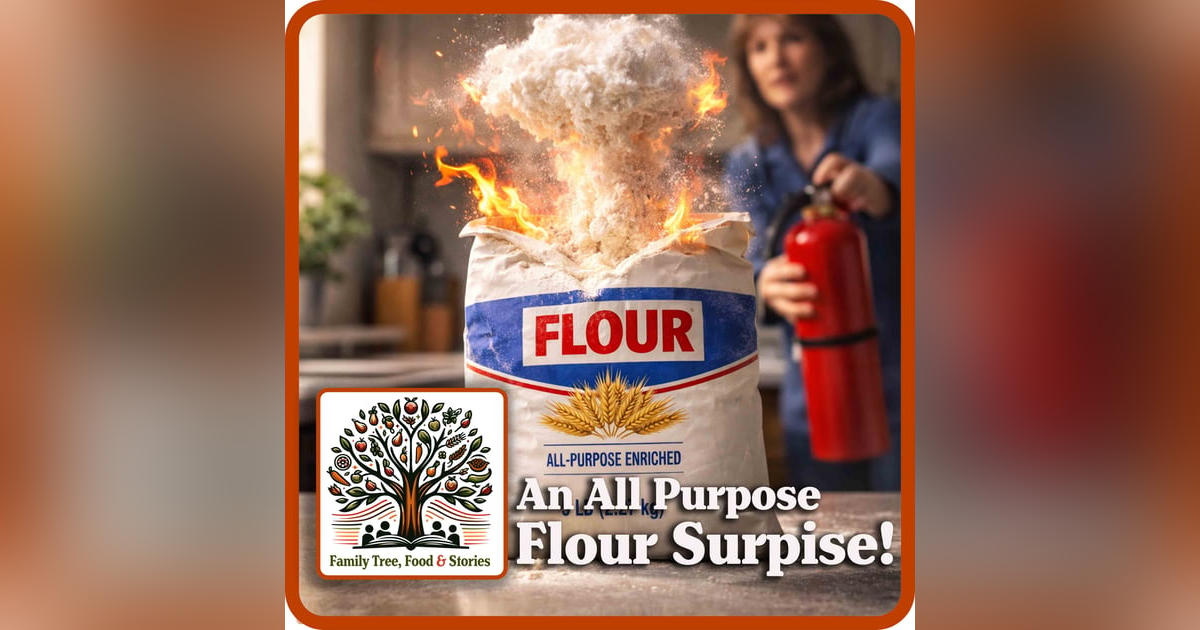
Did you know that flour isn’t just for baking stuff? It’s good to make muffins, for sure, but it’s also powerful enough to level buildings, important enough to shape entire cultures, can tell me where your great grandparents came from, and risky enough that NASA won’t allow it to go up in space!
With all that, we still take the lowly bag of flour for granted.
In this episode of Family Tree Food & Stories, Nancy & Sylvia open up and share the stories of what flour really is, where it came from, and why it still matters more than we realize. You might take a second look at all the flour options when you’re walking down the baking aisle in your grocery store this week.
Key Takeaways:
- The reason NASA banned bread (and what replaced it).
- How flour can be an adhesive that’s stronger than glue.
- The role flour played in building civilizations and even ending nomadic life.
- Your flour could tell me where your ancestors came from.
- What today’s flour labels really tell you, and what they don’t, including labels like organic, non-GMO, ancient grain, and more.
If you’ve ever grabbed a bag of flour without thinking twice. You might want to tune in and pause to take a better look at that bag, or sack, of flour in your pantry. It tells a pretty interesting story.
We promise that you won’t look at a slice of bread the same way again.
Nancy and Sylvia are pretty sure this episode of Family Tree Food & Stories will make you look at your dinner plate differently. That’s a good thing too, because it’s exactly what Family Tree Food & Stories is designed to do.
Here's what to do next:
Subscribe to Family Tree Food & Stories so you never miss an episode. You can find us on Apple Podcasts, Spotify, or listen directly at Podcast.FamilyTreeFoodandStories.com
⭐ Leave us a review: it takes 60 seconds and helps thousands of new listeners find us. (We read every single one, too! Promise)
📣 Share this episode with someone you love, a parent, a daughter, a friend going through a health journey. The food wisdom in this episode could genuinely change how they eat.
📋 Take our listener survey; there's a link in the show notes and at the top of our podcast page at Podcast.FamilyTreeFoodStories.com. Tell us what you want to learn and hear about next. We make a show just FOR you.
📖 Pick up our book, My Family Tree, Food and Stories, on Amazon. Because: Every meal has a story and every story is a feast.
Please remember, at the end of the day, the best thing you can do for the people you love, and even yourself, isn't a pill or a prescription.
It's a plate of food shared with a good story.
Episodes Mentioned and Shared:
Additional Links ❤️
- SURVEY: Please Help Us Learn How To Do More For You
- Book: My Family Tree, Food & Stories Journal Awarded #1 New Release on Amazon
- Instagram Story updates 📸
- Facebook Family Tree Food Stories GROUP👍
- TikTok: Family Tree Food Stories
- 👇Share Your Story With Nancy & Sylvia!: Leave us a voicemail
- You can send us a DM on Facebook.
About Your Award-Winning Hosts: Nancy May and Sylvia Lovely are the powerhouse team behind Family Tree, Food & Stories, a member of The Food Stories Media Network, which celebrates the rich traditions and connections everyone has around food, friends, and family meals. Nancy, an award-winning business leader, author, and podcaster, and Sylvia, a visionary author, lawyer, and former CEO, combine their expertise to bring captivating stories rooted in history, heritage, and food. Together, they weave stories that blend history, tradition, and the love of food, where generations connect and share intriguing mealtime stories and kitchen foibles.
If you missed the first time around... now's your time to listen to Family Tree Food & Stories and get inspired to make better use of what’s already in your kitchen. Then visit our page to share how you're using your leftovers this year. Waste less. Cook smarter. Tell the story behind your fridge.
"Every Meal Has a Story, and Every Story is a Feast." (tm) is a trademark of Family Tree Food & Stories podcast (c) copyright 2026, all US and International Rights Reserved.
@familytreefoodstories, #foodie #bonebroth, #sourdough #flour, #NASA #spacelaunch #organicflour #nonGMOfood #roundup #grainmills #homemilling #allpurposeflour #breadflous #podcastfinds #foodpodcast, #bestpodcast, #cookingculture, #foodstories, #foodhistory
Hello everybody.
Nancy May:It's another episode of Family Tree Food and Stories with Nancy May and Sylvia.
Nancy May:Lovely.
Nancy May:If you haven't heard our last show, we talked about roadside treasures,
Nancy May:you might wanna go back and take a listen to that one because
Nancy May:it's pretty fun and interesting.
Nancy May:And if you're not a subscriber, it's time to hit subscribe.
Nancy May:Go to podcast.family tree food stories.com on that main page.
Nancy May:You can go to any of your favorite podcast listening platforms, or
Nancy May:you can subscribe from there.
Nancy May:And also, one more question.
Nancy May:Good things come in threes as they say.
Nancy May:Right, Sylvia?
Sylvia Lovely:For sure.
Nancy May:please take a moment and just like us and give us a rating.
Nancy May:Let us know how we're doing.
Nancy May:We're also doing a, a listener survey, but we'll talk about that later on.
Nancy May:In any case, let's get on with the show.
Nancy May:Sylvia.
Nancy May:How's that?
Sylvia Lovely:What fun to take up flour today.
Nancy May:yeah, right now, so I've got a question for you to get started.
Nancy May:What did you eat today?
Sylvia Lovely:Uh oh.
Sylvia Lovely:You're always trying to catch me in the middle of something, so what is it?
Nancy May:Well, I'm gonna pretty much guarantee that you and everybody
Nancy May:else that's listening here today ate something with flour in it.
Nancy May:Now we're not talking garden flour.
Nancy May:I'm talking about sandwich flour.
Nancy May:The white flour that you get in the bags, and I'm gonna guess everybody
Nancy May:has in there, are pantry somewhere.
Nancy May:at least if you haven't eaten it today, you've probably eaten something, even
Nancy May:if you're gluten intolerant in the last.
Nancy May:Couple of days or so, like a sandwich or tortilla, maybe a
Nancy May:cookie or two or three or four.
Nancy May:Even a Girl Scout cookie.
Nancy May:'cause it's Girl Scout cookie season here.
Nancy May:seasoned buy
Sylvia Lovely:Oh yeah,
Sylvia Lovely:that's right.
Nancy May:do you know what kind of flour it was in that
Sylvia Lovely:Zing.
Sylvia Lovely:I gotcha.
Sylvia Lovely:Yeah.
Sylvia Lovely:Sourdough.
Nancy May:you got me?
Nancy May:Well, more often than not, we don't know the story of the flour behind
Nancy May:all the delicious things that we've eaten over the years and maybe
Nancy May:even just yesterday, including what grandmas and moms have cooked.
Nancy May:But over 30,000 years ago, We as humans started out grinding grain.
Nancy May:Now that isn't just suddenly over the top of, what we expected it
Nancy May:would be, but grinding green in like stone ground stuff, hard work.
Nancy May:And today we're back to grinding many of our own flours.
Sylvia Lovely:Yeah.
Sylvia Lovely:It seems like everything old is new again.
Sylvia Lovely:And I love that trend.
Sylvia Lovely:For some people.
Sylvia Lovely:I kind of like how tradition has gone and adopts almost any way
Sylvia Lovely:we do things now and that's good.
Sylvia Lovely:but the stories behind it all from stone slabs to industrial rollers.
Sylvia Lovely:Now back to the kitchen counter, which in most cases now we
Sylvia Lovely:know are stone slabs, right?
Sylvia Lovely:Granite.
Sylvia Lovely:Marble . but anyway, I have images of cave women, just like in the kitchen now.
Sylvia Lovely:And wouldn't they love it?
Sylvia Lovely:'cause even if they still made their own, they could make those choices.
Sylvia Lovely:Right.
Sylvia Lovely:I wonder if those women ever thought about what might happen with food ingredients
Sylvia Lovely:they used way back when and, well, in the early years, BC years, makes you
Sylvia Lovely:really wanna have a time capsule and just.
Sylvia Lovely:Go back.
Sylvia Lovely:Maybe the Flintstones will fly us there someday on one of their rock airplanes.
Sylvia Lovely:Right?
Nancy May:Right.
Nancy May:30,000 years ago, people were crushing wild seeds on rocks, like I said.
Nancy May:But I can't picture myself doing that.
Nancy May:Still people are doing it today and it kind of makes me think like like
Nancy May:my KitchenAid is a space age tool compared to some of those things.
Sylvia Lovely:Yeah.
Nancy May:but it's kind of a funny thing to even think that a KitchenAid could be
Nancy May:such a space age that I'm not gonna get that outright a space age kind of thing.
Nancy May:If you were even, you know, I would say 60 years ago or so.
Sylvia Lovely:Yeah.
Sylvia Lovely:You know, people made grain out of anything., We hear
Sylvia Lovely:about it today, people.
Sylvia Lovely:Picking stuff out of their yards.
Sylvia Lovely:Well, seriously, that's what people did.
Sylvia Lovely:Grain met survival, whatever it was, consisting of.
Sylvia Lovely:But I love this, the birthplace, the birthplace of agriculture is believed to
Sylvia Lovely:have taken place in the Fertile Crescent, which if you see it on a map, it really
Sylvia Lovely:literally is a big crescent that goes approximately, it's from the Nile Valley.
Sylvia Lovely:Through modern day Lebanon, Syria, and Iraq to the Persian Gulf.
Sylvia Lovely:And if you can visualize that, I think it's pretty interesting information.
Sylvia Lovely:And we don't typically even talk about this stuff it's not like
Sylvia Lovely:you go home and have dinner and, oh, honey, did you read about.
Sylvia Lovely:The fertile Crescent today, you know, but you don't.
Sylvia Lovely:but the important part to all of this is that flour allowed people
Sylvia Lovely:to stay put and not have to roam.
Sylvia Lovely:It was kind of the birth of the agricultural age,
Nancy May:it I just can't believe it's, it's so interesting that we're
Nancy May:actually going back to so many of those roots and it's, I guess it's really
Nancy May:more intentional than we realize.
Sylvia Lovely:Mm-hmm.
Sylvia Lovely:It is intentional mindfulness, people want transparency.
Sylvia Lovely:They wanna know what's in their stuff, when you grind your own
Sylvia Lovely:wheat berries at home, you see it, you smell it, you know what went in.
Sylvia Lovely:There's no mystery bag.
Sylvia Lovely:But then there's also stuff on the counter.
Sylvia Lovely:That you have learned to trust.
Sylvia Lovely:I mean, you can like research it now where they did the grinding, but
Sylvia Lovely:it doesn't have all the additives and all of that sort of thing.
Sylvia Lovely:So yeah, it's, good any way you look at it.
Nancy May:The, the mystery bag of flour, I'm gonna call it because I
Nancy May:have to tell you, I have tons of these different kinds of flour in my pantry.
Nancy May:I've got rice flour, I've got wheat flour, I've got oat flour.
Nancy May:I'm not even sure what to do with half of it other than the rice
Nancy May:flour's not supposed to make my bread stick to the counter, which
Nancy May:it doesn't because it doesn't have gluten in it, which is interesting.
Nancy May:But I have a neighbor who's gone back to grinding her own.
Nancy May:Bread flour and I looked into what it might, what I might actually
Nancy May:need to try and do this myself, and I found that I had all the tools.
Nancy May:Okay, we've got rocks.
Nancy May:I'm not going to do that one.
Nancy May:But all I needed really is a, an attachment for my KitchenAid, which
Nancy May:totally surprised me that I could do with something as simple as that.
Nancy May:But so many people who have gluten issues like Celiacs apparently are really
Nancy May:better off grinding their own grains from traditional or ancient grains because
Nancy May:then they'll know where it's coming from and all those extra little additives that
Nancy May:go in that are sort of less organic are not impacting the flour to make it more
Nancy May:difficult for the gut to actually digest.
Nancy May:But even just doing the grinding, I would imagine it
Nancy May:would be extremely relaxing and.
Nancy May:Somewhat satisfying for doing something from scratch.
Nancy May:I'll have to give it a try myself and report back
Sylvia Lovely:Yeah, well, you tell me all about it.
Sylvia Lovely:I mean, I like the fact that you can go to the shelf and you see all this stuff.
Sylvia Lovely:I mean, chickpea flour, oh my gosh, what is that right?
Nancy May:I wouldn't
Sylvia Lovely:Allmond flour, all, all of those things.
Sylvia Lovely:so I'm intrigued by it.
Sylvia Lovely:But did you know, and this is a little science experiment person
Sylvia Lovely:inside of me, that flour explodes.
Sylvia Lovely:And here's kind of the scientific process, very rudimentary, where it's
Sylvia Lovely:coming from me, but it's like flour has tiny, tiny, tiny particles and
Sylvia Lovely:when it spreads and there's some sort of combustion, 'cause it has carbs and
Sylvia Lovely:proteins and if it creates a dust cloud, it interacts with oxygen and boom.
Sylvia Lovely:Isn't that interesting?
Nancy May:knowing what's going on in the world today, I guess maybe
Nancy May:we could have the military call us for a little help along the way.
Nancy May:And I did know that flour combusted, and in 1878, the Washburn Flour Mill
Nancy May:in Minneapolis exploded when just like you said, flour particles were in the
Nancy May:air and ignited with a fire spark.
Nancy May:And I'm thinking, you know, some fat boss, of course, I've got this idea of
Nancy May:this fat Joe with a stogie cigar walking around telling us women what to do.
Nancy May:Not in my book, but in any case.
Nancy May:The sad part is that 18 people died from that explosion and in the
Nancy May:right conditions, like you said, it becomes industrial dynamite.
Sylvia Lovely:Yeah.
Sylvia Lovely:if we have any listeners from Min uh, Minnesota.
Sylvia Lovely:that's where those big wheat fields are all across the plains, and a
Sylvia Lovely:lot of it happened in Minneapolis.
Sylvia Lovely:And in fact, when I read, what you had written about this, I remembered going
Sylvia Lovely:to the flour Museum in Minneapolis.
Sylvia Lovely:And it's all about all of those interesting events that
Sylvia Lovely:led us to where we are today.
Nancy May:Who would've thought that flour played such a role in, our country.
Nancy May:But the interesting part is that the flour mill that we're talking
Nancy May:about, the Washburn flour mill, well, when it was rebuilt, it eventually
Nancy May:became known as General Mills.
Sylvia Lovely:THE General Mills.
Nancy May:Yep.
Nancy May:That General Mills, the very same, that the gold medal flour bag that your
Nancy May:grandmother or, uh, well, I have on my shelf as well, it's a direct descendant
Nancy May:of the mill that blew up in 1878.
Sylvia Lovely:Hmm.
Nancy May:it's a story that just, it turns from a dust disaster and becomes
Nancy May:the most interesting, recognizable brand that we have in America today.
Nancy May:And it's not a bad comeback story, I'd say.
Nancy May:Right.
Sylvia Lovely:So every time someone pulls out a bag of gold medal, they're
Sylvia Lovely:basically holding a little piece of Minneapolis history and history for us.
Sylvia Lovely:and that's one very dramatic origin story.
Nancy May:Or maybe a little dynamite, like be careful
Nancy May:kids, if you are listening,
Sylvia Lovely:Yeah.
Nancy May:before you open that bag of flour.
Nancy May:But anyway, flour really does have a big story in every bag,
Sylvia Lovely:Yeah, and we should also be more careful with
Sylvia Lovely:our kitchen adventures, right?
Sylvia Lovely:So
Sylvia Lovely:be careful.
Nancy May:I think.
Nancy May:I think so.
Nancy May:But speaking of flour, so this is kind of an interesting little tidbit.
Nancy May:Did you know that beyond the combustibility of flour, there's some
Nancy May:other reasons or there's some other issues around it of how it can be used?
Nancy May:And NASA does not allow flour bread products to go up in space.
Nancy May:Is that cool?
Sylvia Lovely:Hmm, no bread in space.
Sylvia Lovely:That does seem like cruel and unusual punishment.
Nancy May:Right, but think about it.
Nancy May:The crumbs are floating in the small little particle and granules, and they can
Nancy May:get stuck and trapped in all those high tech pieces of equipment and flour dust
Nancy May:in a contained, pressurized environment.
Nancy May:Well, there's your little scientific experiment, although I don't
Nancy May:think we want to try that one.
Nancy May:It could just be.
Nancy May:True and total mess.
Nancy May:I can't imagine that even our people in the Mills or the original
Nancy May:General Mills flour Place was even thinking about that at the time.
Sylvia Lovely:Yeah.
Sylvia Lovely:So, it's interesting, the most advanced humans on the planet have to find a
Sylvia Lovely:different way to have a sandwich, right?
Nancy May:yeah.
Nancy May:Not a traditional BLT or a ham and cheese, but or tortilla sandwich because
Nancy May:it's the tortillas that you can use.
Nancy May:They're soft.
Nancy May:They don't crumble.
Nancy May:They're flexible, and they stay intact.
Nancy May:And in 1985 tortillas became the preferred bread alternative for outer space.
Sylvia Lovely:All right.
Nancy May:Yeah.
Nancy May:Right.
Nancy May:Do you remember Tang?
Sylvia Lovely:Oh yeah.
Sylvia Lovely:Oh, I love that.
Sylvia Lovely:Have
Sylvia Lovely:a glass of
Sylvia Lovely:tang.
Nancy May:yep.
Nancy May:Tang was a breakfast drink of astronauts the slogan was for
Nancy May:spacemen and earthly families.
Nancy May:Although, I think, I have to say, I'm not sure, I'm kind of a feminist here.
Nancy May:I don't think we should say spacemen anymore for space women or maybe
Nancy May:space cadets and earthly families.
Sylvia Lovely:so the ancient flatbread, flour water heated on
Sylvia Lovely:a stone outlasted every innovation survived industrialization, and it is
Sylvia Lovely:now the choice of astronauts hurdling through orbit at 17 K miles per hour.
Sylvia Lovely:Ywe Ka.
Nancy May:I know it's hard to believe that it all started back three a
Nancy May:30,000, or maybe it's 30 million years ago, but a lot, a lot of years
Nancy May:ago when we were grinding seeds on rocks and now we're taking them into
Nancy May:space, which I think is so cool.
Nancy May:And that's a food story.
Nancy May:I mean, that's what we're about.
Nancy May:That's part of everything that we're talking about.
Nancy May:There's food and history and family and traditions, and it's from cavemen too.
Nancy May:Spacemen and women in
Sylvia Lovely:Yeah.
Sylvia Lovely:Yeah, you go girls, women started it and women are going to space.
Sylvia Lovely:I love it.
Nancy May:So let's talk about what's happening in the grocery stores because
Nancy May:flour used to just say all purpose, right?
Nancy May:the gold medal flour stuff, all the parents that our
Nancy May:parents used over the years.
Nancy May:Now, so many of those flour bags or sacks.
Nancy May:Now I have to ask you, do you call it a flour bag or do you call it a flour?
Sylvia Lovely:You know, I don't remember addressing it, but I
Sylvia Lovely:think, probably a flour bag.
Sylvia Lovely:But, I know you say bags, right?
Nancy May:I say bags, but I at West, I understand they say s
Sylvia Lovely:Yeah.
Sylvia Lovely:Interesting.
Sylvia Lovely:of course, you know, in my image, like of the museum, they
Sylvia Lovely:have these huge sour sacks.
Sylvia Lovely:They are like burlap sacks or something like that.
Sylvia Lovely:Something large.
Sylvia Lovely:where people really used flour probably a lot more than they do today, and
Sylvia Lovely:fed large families and all that kind of stuff, but we have all kinds
Sylvia Lovely:of different labels on them now.
Sylvia Lovely:We have organic.
Sylvia Lovely:I started noticing that, and I actually buy organic.
Sylvia Lovely:It's not that much more expensive and I'm not quite sure why, except
Sylvia Lovely:I feel like it's just more pure.
Sylvia Lovely:And, what about the non GMO thing and ancient grain?
Sylvia Lovely:Stone milled, regeneratively farmed.
Sylvia Lovely:I mean, you need a PhD in agriculture to get through this, don't you?
Sylvia Lovely:So let's make it easy.
Nancy May:Right.
Nancy May:It's like we have to learn a whole new language when we go to the grocery store,
Nancy May:or even if you're milling it yourself.
Nancy May:But that often gets confusing because the details behind these are.
Nancy May:Are always, well, they're not always what we think they are, and consumers
Nancy May:are asking, where is it all grown in?
Nancy May:What's it sprayed with and is it genetically modified?
Nancy May:Or how has it grown?
Nancy May:Or what does it even look like?
Nancy May:You know, I never saw a wheat field till we came down south.
Sylvia Lovely:I grew up around them.
Nancy May:Right.
Nancy May:Well, I, I certainly saw corn fields over the years, but
Nancy May:that was a little different.
Nancy May:But to see a wheat field if you've never seen one, it is absolutely beautiful when
Nancy May:it gets ripe and ready to be harvested.
Nancy May:But the term non GMO la labeling signifies, sort of a bigger
Nancy May:trust when you think about it.
Nancy May:And I'm not sure that's actually true.
Nancy May:However, maybe a false sense of security is a good thing to have sometimes.
Sylvia Lovely:yeah.
Sylvia Lovely:So the developing something bigger, trust.
Sylvia Lovely:and here's some details on why organic wheat avoids synthetic herbicides.
Sylvia Lovely:Like what is popularly known as Roundup and its technical name is
Sylvia Lovely:glyphosate to say that three times
Nancy May:Well wait a second.
Nancy May:Before you wait, before you go forward, I just wanna tell you this, and I don't know
Nancy May:it's true, but we had a fellow from the University of Florida come to our property
Nancy May:'cause we're looking at doing a Christmas
Nancy May:tree farm here.
Nancy May:And he's a PhD in plant science, and we have some invasive grass on our property.
Nancy May:And he said, oh, you need to get rid of that.
Nancy May:And he said, the only way to get rid of it, because it doesn't have seeds,
Nancy May:it's got rhizomes under the ground.
Nancy May:And that's how it, it multiplies.
Nancy May:He said, is to use Roundup.
Nancy May:I'm like, oh,
Sylvia Lovely:No.
Nancy May:Well, apparently, uh, now I don't know if this is true,
Nancy May:but I'm, I'm relying on the.
Nancy May:University of Florida, top guy, plant scientist for his information said that
Nancy May:Roundup used to be a safer product to use than it is today, that's because,
Nancy May:well, I guess it was during Vietnam, things got a little sketchy as far as the
Nancy May:quality of the herbicides, you know, to
Sylvia Lovely:clear the jungle
Sylvia Lovely:kind of thing.
Sylvia Lovely:Yeah.
Nancy May:And the type of roundup, which is basically what it was, the herbicide
Nancy May:that they used Agent Orange was filled with all sorts of other toxic chemicals.
Nancy May:'cause they didn't need to worry about purities.
Nancy May:And hence we don't necessarily know what's in our roundup today.
Nancy May:And that's
Nancy May:caused a lot of the problems.
Nancy May:Interesting.
Nancy May:Huh?
Sylvia Lovely:it was actually better before.
Nancy May:it was considered safe before Vietnam.
Nancy May:Yep.
Sylvia Lovely:take, uh, Erin Brockovich and ask her about that one.
Nancy May:I know, right?
Sylvia Lovely:Don't know that I believe it, but anyway, that's interesting.
Nancy May:But the debate on synthetic herbicides and everything, especially
Nancy May:like Roundup, has been, a question for many years in the US and Europe and
Nancy May:some countries have restricted more aggressively like other pesticides.
Nancy May:And you know, I didn't even consider or know that Europe was doing this more
Nancy May:aggressively than we were here in the states, but Bob and I learned about this
Nancy May:while we were raising bees because the type of chemicals that you can use on
Nancy May:bees to get rid of mites and other things.
Nancy May:Now I know this is not about flour, but in the long run it is because it's a plant
Nancy May:that needs, oh, flour doesn't pollinate by by bees, it pollinates by wind.
Nancy May:But anyway, it's still an interesting to understand that European flour
Nancy May:is still considered cleaner.
Nancy May:The perception of a better type of product has resulted going way back when
Sylvia Lovely:You know, some of the reason for that though is
Sylvia Lovely:people just think of Europe as being old, worldly and more traditional
Sylvia Lovely:and more artisanal and craft.
Sylvia Lovely:it seems smaller to us.
Sylvia Lovely:you think of Italian cooking, you always think of the little villages, right?
Sylvia Lovely:You don't think of big cities like we have, even though they have big cities.
Sylvia Lovely:So I think there's a lot of romanticism to Europe and Paris and places like that.
Sylvia Lovely:And so you think their products are better, I think there's some of
Nancy May:we're just the rugged haws out here in, in the states, but,
Sylvia Lovely:That's all.
Nancy May:but people are paying more attention to, getting back to
Nancy May:their own wheat and I am surprised it's such the trend that's such
Nancy May:how big of a trend it actually is that's happening here in the states.
Nancy May:So I did a little experiment.
Nancy May:Well, I did an do experiment.
Nancy May:I went doing a little research to see what a home mill would cost.
Sylvia Lovely:Mm-hmm.
Nancy May:They're crazy expensive.
Nancy May:So there's some teeny tiny ones that I, I probably get like a tablespoon
Nancy May:of wheat out of it at a time, which I wouldn't spend the time doing that.
Nancy May:But the average price of them for, for being able to do it yourself
Nancy May:are running anywhere from, let's say, $300 to $700 dollars.
Nancy May:I mean, that's a lot of flour you gotta do.
Nancy May:And one I found was $15,000, which would take up the entire
Nancy May:counter, or corner of my kitchen.
Nancy May:So I'm, I think I'm sticking to buying it in the grocery store right now.
Sylvia Lovely:You know, sometimes you wonder, you can buy stuff like the way I
Sylvia Lovely:do it, I'm not ever gonna grind my own.
Sylvia Lovely:but you can see organic like I go to Whole Foods and that
Sylvia Lovely:whole section of breads.
Nancy May:growing right.
Sylvia Lovely:Yeah.
Sylvia Lovely:I forget what they call some of those.
Sylvia Lovely:I should have written those down.
Sylvia Lovely:'cause I go them, I go to them and I buy them based on looks.
Sylvia Lovely:And some of 'em are this deep, dark, brown, nutty flavor
Sylvia Lovely:because they have nuts in 'em.
Sylvia Lovely:or the germ appears the germ of the wheat.
Sylvia Lovely:Appears to be more intact.
Sylvia Lovely:Now, I don't know the science behind that, but I suspect it's about grinding
Sylvia Lovely:and putting maybe some things like sunflour seeds back in and things.
Sylvia Lovely:'Cause there's some breads like that and I'll get those.
Sylvia Lovely:They're real thick and they taste really good, but wow, they
Sylvia Lovely:fill you up really fast too.
Sylvia Lovely:Then plain old Wonder Bread.
Sylvia Lovely:Remember Nancy, remember
Nancy May:Okay, wonderful.
Nancy May:Right, which, which, if you were a plumber, and even if you're
Nancy May:not, if you have a plumbing issue, you can actually use.
Nancy May:Roll the pieces of Wonderball Wonderball wonder, we're gonna call
Nancy May:it Wonderball Wonder Bread to plug up your pipes before you sweat them,
Nancy May:and they will dissolve later on.
Nancy May:So you don't need to worry about it.
Nancy May:But Wonder Bread is a plumbing tool
Nancy May:which makes you think about eating it.
Nancy May:Right?
Sylvia Lovely:and there's nothing to it.
Sylvia Lovely:It is squishy.
Sylvia Lovely:That's why you can make it up into balls.
Nancy May:Right.
Nancy May:it's fun to shoot across the table.
Sylvia Lovely:I thought you had a wonder ball story though.
Nancy May:actually, we have a Wonder ball story in our book.
Nancy May:Family Tree Food Stories,
Sylvia Lovely:where I saw it.
Sylvia Lovely:Yeah.
Nancy May:Anyway, Sylvia, we chatted earlier and you said flour
Nancy May:could tell you where I'm from.
Nancy May:I'm not convinced.
Nancy May:Feels kind of like flour's kind of neutral to everything, but especially now.
Sylvia Lovely:Yeah.
Sylvia Lovely:you know, that's a bold claim, but it's kind of historical fact, isn't it?
Nancy May:It is.
Nancy May:So if I looked at your grandmother's bread, I could probably tell you,
Nancy May:or guess where your family's from.
Sylvia Lovely:Well, you can go pretty fast to get there South,
Nancy May:Kentucky Beyond Kentucky, right?
Sylvia Lovely:either the backwoods,
Nancy May:So we did some episodes or past episodes.
Nancy May:Remember like the Italian show we did a few weeks back, and between 1880 and
Nancy May:1924, More than 20 million immigrants came through Ellis Island, they didn't
Nancy May:just bring trunks and their clothing and all their precious belongings, but
Nancy May:they brought the bread and the gravy and the soup traditions, and all of which
Nancy May:included flour in most of those recipes.
Nancy May:So Italian families tried to find the flour to make their rustic globes
Nancy May:of bread even richer than the bland stuff that we had here, and to make
Nancy May:them feel like they were back home.
Nancy May:Eastern European families, used a high gluten flour for rye bread.
Nancy May:and Kahala bread, especially during Sabbath and special holiday traditions
Nancy May:and the German and the Polish immigrants.
Nancy May:Now you were talking about seed breads.
Nancy May:We have a Polish restaurant by us that has this amazing seed bread.
Nancy May:That It feels like it weighs 20 pounds
Sylvia Lovely:It's
Nancy May:like.
Sylvia Lovely:Florida, in Brooksville.
Nancy May:it's, well, it's in Spring Hill, Florida.
Nancy May:It's called Cracovia, and the food there is excellent.
Nancy May:It's very homemade.
Nancy May:Although I have to, laugh.
Nancy May:There was a, there was a, a waitress there.
Nancy May:, One dinner that we had for a celebration.
Nancy May:Bob and I were celebrating an anniversary or birthday and she was Chinese,
Nancy May:so, not to discriminate Polish and Chinese, but I don't expect to have a
Nancy May:Chinese server at a Polish restaurant.
Nancy May:She was lovely though.
Nancy May:Her name was Mai and she was lovely.
Nancy May:But the Polish and the Germans were looking for more of a denser
Nancy May:type of rye with whole grain flours and seeds and others.
Nancy May:And those were, just part of the country and the regions that they brought here in
Nancy May:the tradition they brought to the state.
Nancy May:So flour is still important in family traditions and the connecting the
Nancy May:strength of who we are and where we came from even today, which.
Nancy May:I think we take for granted how those, specialty breads that are, you buy at
Nancy May:Whole Foods or Sprouts or other places are made and why, where they all came from.
Sylvia Lovely:Yeah, sure.
Sylvia Lovely:So flour is kind of like an edible passport, huh?
Nancy May:I think that's a pretty cool statement.
Sylvia Lovely:Thank you.
Nancy May:speaking of edible statements, let's take a quick break.
Nancy May:So, Sylvia, let's take a little step further back to our country,
Nancy May:back to the American South, which is your territory where,
Sylvia Lovely:Yeah, baby.
Nancy May:right?
Nancy May:Yep.
Nancy May:Where there's a softer.
Nancy May:Winter wheat that grows there and apparently it's, I
Nancy May:mean, you say it's beautiful.
Nancy May:I, the low grain, the less gluten and the results in a
Nancy May:tender sweet, delicious spread
Sylvia Lovely:And since you're talking Southern now, uh, move over.
Sylvia Lovely:Move over girl.
Sylvia Lovely:I'm taking over.
Nancy May:Yankee Nancy.
Nancy May:That's right.
Nancy May:You can have it.
Sylvia Lovely:Yankee, Nancy, p And now, here's where chemistry walks
Sylvia Lovely:into the kitchen before the mid 18 hundreds, if you want bread to rise.
Sylvia Lovely:What did you use?
Sylvia Lovely:You used yeast, right?
Sylvia Lovely:Which meant time.
Sylvia Lovely:Well, we never have enough of that, do we?
Sylvia Lovely:So there was, fermentation had to take place and the need to plan ahead.
Sylvia Lovely:A lot of the time that needed to let the bread rise can take up to several
Sylvia Lovely:hours, if not a full afternoon at times.
Sylvia Lovely:And so that's when baking powder arrives and everything speeds up.
Nancy May:Everything Okay.
Nancy May:Tell me more.
Sylvia Lovely:Okay.
Sylvia Lovely:baking powder is just chemistry waiting to happen and there's so much to baking.
Sylvia Lovely:That is chemistry, by the way.
Sylvia Lovely:And there's a base baking soda and acid like mono calcium phosphate
Sylvia Lovely:don't, I sound like a science guru and cornstalks to keep it dry.
Sylvia Lovely:And you add liquid and boom, carbon dioxide bubbles form, and takes over.
Sylvia Lovely:And that's your rise.
Sylvia Lovely:No yeast, no waiting.
Nancy May:So I'm gonna say that southern biscuits are really basically
Nancy May:an edible science experiment.
Sylvia Lovely:Yeah.
Nancy May:I'm gonna have to think about the next time Bob orders,
Nancy May:biscuits and gravy, because I am not a biscuits and gravy girl,
Sylvia Lovely:That is un-American, Nancy.
Sylvia Lovely:Alright, I'm ashamed of you.
Sylvia Lovely:Anyway, we'll let you get a pass.
Sylvia Lovely:This time you might say, you're not into it, but you're talking
Sylvia Lovely:about some delicious chemistry.
Sylvia Lovely:Eventually, manufacturers combine soft wheat flour, baking powder, and salt into
Sylvia Lovely:one product called self raising flour.
Sylvia Lovely:Yay.
Sylvia Lovely:Now biscuits could be on the table in 20 minutes, and that
Sylvia Lovely:shaped southern hospitality and dinner didn't require half a day.
Sylvia Lovely:and it was soft biscuits.
Sylvia Lovely:Those wonderful soft biscuits.
Sylvia Lovely:Now I like a little crusty on the outside, but I always remember, that's
Sylvia Lovely:my biggest memory of my grandmother was her baking biscuits she had on her apron
Sylvia Lovely:and she was always baking biscuits.
Sylvia Lovely:Do you wanna hear the most searing story that I remember of
Sylvia Lovely:my grandmother baking biscuits?
Sylvia Lovely:You probably don't wanna hear this,
Sylvia Lovely:and you okay?
Sylvia Lovely:You can cut it out if you want.
Sylvia Lovely:However, my grandmother accidentally baked a kitten.
Sylvia Lovely:The kitten had crawled into the oven, and I vivid memory as a child of watching
Sylvia Lovely:her weep for hours, Now there's a family story that's hard to tell.
Sylvia Lovely:But it's real.
Sylvia Lovely:Back in those days, animals, were cold they just like, they'd crawl into car
Sylvia Lovely:motors, they would crawl into ovens.
Sylvia Lovely:So check your oven if you got any cats around.
Sylvia Lovely:Anyway, that was my vision of my grandmother making biscuts
Nancy May:I can't imagine.
Nancy May:Oh my goodness.
Nancy May:Oh, that's so sad.
Sylvia Lovely:She was heartbroken.
Nancy May:But, so I'm, like I said, I'm never gonna think about a biscuit
Nancy May:quite the same again, but I, think it's a fascinating about self-rising flour.
Nancy May:Now I know a little bit more about it because gluten development really is
Nancy May:real, I, I've made biscuits and I've tried, I guess I'm just not a southern
Nancy May:cook, but I did try to make biscuits the first time we were down here.
Nancy May:my sister makes biscuits like to die for.
Nancy May:She's down out in Oklahoma
Nancy May:I don't, I don't know how she learned it, but
Sylvia Lovely:Can I ask a question about that?
Sylvia Lovely:Does she use self-rising flour?
Sylvia Lovely:Do you
Nancy May:I believe so.
Nancy May:It was whatever was in the kitchen when she came to
Nancy May:visit one day and she made them for biscuits and gravy.
Nancy May:She made for the aides that were taking care of mom and dad.
Nancy May:And they all said, when Cindy comes back, the first thing we want her
Nancy May:to do is make biscuits and gravy.
Sylvia Lovely:Really well.
Sylvia Lovely:I'm just wondering about that.
Sylvia Lovely:Maybe you can find out sometime, because I always stay away from self-rising flour.
Sylvia Lovely:I always use all purpose, but I don't know why.
Sylvia Lovely:Now
Sylvia Lovely:that I've
Nancy May:know.
Sylvia Lovely:learned about all of this, I'm
Nancy May:I wonder whether all purpose is the same as self-rising.
Nancy May:I never even thought about it.
Sylvia Lovely:You have to add baking soda.
Sylvia Lovely:I mean, and you have to add baking powder if you're gonna make biscuits.
Sylvia Lovely:I don't, do that all the time, but I would think, and so maybe I, you
Sylvia Lovely:know, I just always stayed away from self-rising, but now that I've
Sylvia Lovely:looked at this, maybe I shouldn't, I
Nancy May:Yeah.
Sylvia Lovely:don't know.
Nancy May:I've made a couple of biscuit sinkers.
Nancy May:I've tried, they're not fluffy, they're not pretty, but maybe I should have
Nancy May:made bagels instead of biscuits.
Nancy May:'cause I
Sylvia Lovely:Yeah.
Sylvia Lovely:Chewy.
Sylvia Lovely:Very chewy.
Sylvia Lovely:Mm-hmm.
Nancy May:a little bagels and locks or biscuits and locks.
Nancy May:Might have tried that one instead of biscuits and gravy,
Sylvia Lovely:Mm-hmm.
Nancy May:but.
Sylvia Lovely:We have many talents.
Sylvia Lovely:Each person has their talents, so don't worry about it.
Nancy May:But did you know that, flour also has a different kind of
Nancy May:history beyond an explosion, beyond going up into space, beyond being
Nancy May:self-rising and making biscuits?
Nancy May:There's another flour identity that we can't forget, and that's during
Nancy May:World War I and World War ii, where American families were encouraged
Nancy May:to observe wheat list Wednesdays.
Nancy May:Now say that three times fast, right?
Nancy May:Because the more wheat we could get to our soldiers overseas to feed them.
Nancy May:The better off we were as a country and grandmothers adjusted.
Nancy May:The recipes and the flour became a way to show their pledge of support to
Nancy May:the country and to be more patriotic.
Nancy May:Now I have to say, we did a show on, um.
Nancy May:on cookbooks a couple of weeks ago, and in one of the cookbooks that I found not
Nancy May:too long ago, I found it was fascinating.
Nancy May:It was from the late thirties, early forties, so somewhere around our
Nancy May:entry into World War ii, the recipe actually talks about flour
Nancy May:rationing for the war effort.
Nancy May:Fascinating.
Sylvia Lovely:with a lot of other things.
Nancy May:Right, so next time you're in a junk shop or an antique store,
Nancy May:take a look at some of the old antique cookbooks that are there, because I
Nancy May:think they tell a story about what's gone on in our country as well,
Sylvia Lovely:and speaking of things that travel through generations,
Sylvia Lovely:why don't we talk about one of your favorites, sourdough and
Nancy May:sourdough.
Nancy May:Absolutely.
Nancy May:That is one of my favorites.
Sylvia Lovely:And you know, sourdough starter is a living culture.
Sylvia Lovely:Wild yeast and bacteria that you feed, maintain, keep alive, and families have.
Sylvia Lovely:We've done shows on this, have starters that are well over a hundred
Sylvia Lovely:years old and have passed down like jewelry or a good cast iron pan.
Nancy May:Yeah, There are documented starters from the Gold Rush era in
Nancy May:Alaska that date back to the 1890s that are still alive and bubbling today.
Nancy May:And miners back then were so dependent on their starters as a food source
Nancy May:because that kept them going when they couldn't find anything else, they kept
Nancy May:those vials of the starter wrapped around their neck like a piece of jewelry.
Nancy May:So we did an episode on.
Nancy May:Sourdough back in July of last year, and I'll put that in the show
Nancy May:notes, but I can't imagine a gold miner or even a cowboy out west
Nancy May:with sleeping with his starter.
Nancy May:I think that's kind of creepy.
Sylvia Lovely:little weird, but you know it worked.
Nancy May:Right.
Nancy May:And it kind of reminds me of, you know, Billy Bob Thornton, the guy who's so
Nancy May:famous now for Landman on the show again.
Nancy May:Right.
Nancy May:I love him.
Nancy May:He's such a great
Nancy May:character.
Sylvia Lovely:He is a character.
Nancy May:Right, and his, well his wife, I think he's been married like
Nancy May:about six or seven times, but his former wife, Angelina Jolie, they kept vials of
Nancy May:their own blood around each other's neck.
Nancy May:So it's not necessarily a flour story, but maybe it is.
Nancy May:I don't know.
Sylvia Lovely:well, you know.
Sylvia Lovely:could start a trend.
Nancy May:I know.
Nancy May:Yeah.
Nancy May:I'm not gonna keep my flour start my flour dough starter around my neck.
Nancy May:Sylvia, next time you see me for sure.
Sylvia Lovely:Yeah.
Sylvia Lovely:They'll stick to the sourdough.
Sylvia Lovely:Don't put that other stuff in
Nancy May:I know.
Nancy May:I know.
Nancy May:But it might be a little bit more romantic to have the blood around
Nancy May:your neck, I guess, than flour stove.
Nancy May:Flower dough starter,
Sylvia Lovely:and he'll bring you down from the ledge.
Nancy May:right?
Nancy May:I think so.
Nancy May:But at least it lasted a little longer than the Hollywood relationship.
Nancy May:So we know today, still.
Sylvia Lovely:Oh really?
Sylvia Lovely:Uh, and the point is a sourdough starter is a living family
Sylvia Lovely:loo made from flour and water.
Sylvia Lovely:You couldn't get more basic than that, and you're literally tasting and eating
Sylvia Lovely:history will and gram a flour at a time.
Nancy May:Well, and that's what Family Tree food his stories is about.
Nancy May:It's a story in the history of the rich bag of flour, and depending
Nancy May:upon where you are in the country, whether it's a bag or a sack.
Sylvia Lovely:I have to ask you.
Sylvia Lovely:Is home milling realistic or is it just for bread nerds?
Nancy May:Well, you know, maybe a little bit of both.
Nancy May:those of us who still wanna experiment just a teeny bit in the kitchen, but
Nancy May:it is still growing in popularity.
Nancy May:The whole wheat berries you can find online in Amazon, you can buy
Nancy May:them by like bushels full or bags full freshly milled flour contains
Nancy May:a lot of oils and nutrients.
Nancy May:In fact, I asked Sharon, our neighbor about this, I said,
Nancy May:so Why do you do it and why does it, does it really taste better?
Nancy May:And she goes, oh, absolutely.
Nancy May:It's healthier for you.
Nancy May:It doesn't quite have the gluten that you would necessarily have
Nancy May:like at least a higher source of gluten and it tastes nutty.
Nancy May:she says there's a significant flavor difference from the organic.
Nancy May:Heirloom types of seeds that she uses and a more noticeably richer and, stronger
Nancy May:flavor in the sourdough that she's making.
Nancy May:So it's kind of interesting to see how this mills aren't necessarily as monstrous
Nancy May:and outrageous as we think they are.
Sylvia Lovely:Sit on the counter
Nancy May:Yeah, they can actually sit on the counter.
Nancy May:It's not, I think of the old grinding mills.
Nancy May:There was a, a town up north that we visited when kids in Tarrytown,
Nancy May:New York, and they showed the stones, the stone grinding mills.
Nancy May:I don't know, they must have those in, down in, the south when you were a kid.
Nancy May:The big round stones that they would
Nancy May:grind the flour and the watermills that did things.
Nancy May:So we've come, we've come a long way since
Sylvia Lovely:Pretty far.
Sylvia Lovely:Yeah.
Sylvia Lovely:we went from that to.
Sylvia Lovely:To industrialization for convenience, and now we're slowing down on purpose
Sylvia Lovely:or deconstructing everything again.
Sylvia Lovely:And you know, that's okay.
Sylvia Lovely:I think the beauty is there's choices.
Sylvia Lovely:You can do those things if you have time and, and just into it and don't have to
Sylvia Lovely:be, but um, I think it's kind of cool.
Sylvia Lovely:Yeah.
Sylvia Lovely:Kind of cool.
Sylvia Lovely:It shouldn't be feel guilted if you don't.
Nancy May:No, absolutely not.
Nancy May:And in fact, I think it's fun to, if you had a chance to try it,
Nancy May:to do it, maybe get your kids involved or grandkids and see if.
Nancy May:This is something that you can try making something from and if it tastes better
Nancy May:than Wonder Bread or something else.
Nancy May:so there's a real history lesson in flour, which I find fascinating,
Nancy May:there's a history lesson in just about everything we eat.
Nancy May:So I hope listeners, that when you walk down the baking aisle the
Nancy May:next time in your grocery store.
Nancy May:That you realize or just think about the history lesson that flour tells us when
Nancy May:you're looking at the gold medal or the, there's the there's a Bob's flour that's
Nancy May:out there and all of flour tradition.
Nancy May:Oh, white lily.
Nancy May:That's another one that's big
Nancy May:down
Sylvia Lovely:yeah, that's a Southern
Nancy May:Mm-hmm.
Nancy May:Yep.
Sylvia Lovely:Lilly.
Nancy May:So it's part of our heritage and culture and tradition, and
Sylvia Lovely:And.
Nancy May:different way of looking at the baking aisle.
Sylvia Lovely:So we've gone from stones to factories and now back to the kitchen.
Sylvia Lovely:We've almost gone full circle.
Sylvia Lovely:'cause flour tells us where we came from, what our soil could grow, what
Sylvia Lovely:our families valued, and sometimes how fast we needed dinner on the table.
Sylvia Lovely:Now that's reality and practical.
Sylvia Lovely:And that's not Neutral.
Sylvia Lovely:That's identity in a mixing bowl.
Nancy May:That's kind of a cool thing when you think about it, right?
Nancy May:And it's even more delicious and rich.
Nancy May:Pun intended.
Nancy May:So if you haven't listened to last week's episode, please go to podcast
Nancy May:at Family Tree Food and Stories.
Nancy May:There's a link in the show notes, which is at the bottom of this episode.
Nancy May:You'll go down and just, if you don't know how to do that, just scroll down
Nancy May:beyond the listening part, and there's all sorts of additional information in there.
Nancy May:The link to their book, the link to the other episodes, and some interesting
Nancy May:facts about flour that you can maybe use at your next dinner time conversation.
Sylvia Lovely:Yeah, sounds good.
Nancy May:So a quiz.
Nancy May:I'm wondering, are you gonna give this quiz, like, where did flour come from with
Nancy May:your grandkids next time you see them?
Sylvia Lovely:I have, Jack, who is at that curious age.
Sylvia Lovely:He's 10, so he and I have fun together.
Sylvia Lovely:I'm might have to mention it to him.
Sylvia Lovely:He's also, these kids cook now,
Sylvia Lovely:they cooking classes.
Nancy May:I love that the kids do this because it also teaches them self survival
Nancy May:or, or self-sufficiency in so many ways.
Nancy May:But, I know too many people who don't know how to cook, maybe it's
Nancy May:a quiz you could put out on the tables at Azure patio and restaurant,
Sylvia Lovely:Yeah.
Sylvia Lovely:There you go.
Sylvia Lovely:Actually, we are looking at some of those kinds of things that would be simple, like
Sylvia Lovely:or sauerkraut or something like that, you
Nancy May:Right.
Nancy May:Where did your food come from?
Nancy May:Beyond the kitchen, behind
Sylvia Lovely:Yeah.
Nancy May:with your fabulous chef, who is
Nancy May:terrific, but.
Sylvia Lovely:take up chicken fingers for now though.
Nancy May:Well, you can wrap those in a flour tortilla.
Nancy May:So
Nancy May:there you go.
Sylvia Lovely:Stay hidden from you.
Nancy May:please tune in every Thursday because every meal has a
Nancy May:story and every story is a feast.
Nancy May:Remember, podcast DOT family tree, food and story.
Nancy May:It's time to go.
Nancy May:Maybe bake something.
Nancy May:I'm gonna go stir up some flour or maybe grind some flour.
Nancy May:we'll see you later and take care.
Nancy May:Cheers.


