The Secret History of Mayonnaise: From Military Victory to Your Fridge
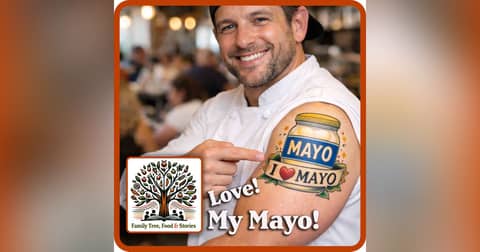



What nobody told you about mayonnaise: the wartime origin, the brand rivalry, and the Hellmann's love story you've held in your hands, and never knew about.
You've probably never thought twice about that jar of mayonnaise in your fridge. You open it, you use it, you put it back. But that jar has a story that you likely don’t know, one that starts with a military victory, and with a love story.
In this episode of Family Tree Food & Stories, Nancy May and Sylvia Lovely take you inside the interesting stories and history of mayonnaise. From the French chef who accidentally created it after a battle, and the fancy European kitchens where it was once considered a “fine-dining must have”, to how it became a key staple in your home today.
Nancy and Sylvia share the ribbon story behind the Hellmann’s brand, which will have you remembering that story the next time you open a jar to make a tuna or chicken salad.
There are also some true confessions in this show, where Nancy gets personal and confesses her lifelong mayo addiction. Think of bread and mayo sandwiches! Or just cheese and mayo. For real! Sylvia believes that mayo has been the unsung hero of every church picnic, potato salad, and deviled egg platter your family has ever made.
Then, there’s the great Mayo brand standoff, which has divided American households for generations. That key question is…. are you a #Duke's or #Hellmann's devotee?
You'll also find out why the French have been eating their fries with mayo instead of ketchup this whole time (and why once you try it, just ask Bob, you're probably not going back). How homemade mayo takes just five minutes and three ingredients, and other intriguing stories that will have you looking at your fridge just a little differently, the next time you open the door.
If you've ever stood in a grocery aisle and questioned your mayo choice, tune in to this episode and listen to why mayo is a brain teaser.
KEY TAKEAWAYS:
- Your mayo has a military origin story you've never been told. The most widely accepted history traces mayonnaise to 1756, after a French military victory at the port of Mahón on the island of Menorca. A chef created the sauce from eggs and oil; it was refined in European courts, eventually brought to the US, and somehow landed in your fridge. Now you’ll know the rest of that story.
- The blue ribbon on your Hellmann's jar really is a love story. In the early 1900s, Richard Hellmann sold his wife's homemade mayo at his New York deli with a blue ribbon tied around every jar. Customers couldn't get enough. That ribbon is still on the label today! The next time you pick up a jar of Hellmann’s, take a good look at the label and share the story with someone who’s making a mayo selection and standing next to you.
- You're five minutes away from making your own mayo. Egg yolks. Oil. Vinegar, a little mustard, and lemon juice if you want, too. A slow drizzle of oil into a blender. That's it. Try using other oils for a different flavor. Once you've made your own, you'll understand why chefs still treat mayonnaise as a craft… It’s fun. Give it a try. And you'll wonder why you waited so long to try it.
- Your mayo brand says more about you than you think. Duke's or Hellmann's isn't a preference; it tells you where you're from, North vs. South. In some families, switching brands could mean expulsion from your next holiday gathering. If you know, you know!
Next Steps:
So here's our question: What’s your brand? Duke's? Hellmann's? Something your grandmother made that no one really knows the true recipe for?
We want to hear it. Drop your story, your recipe, or your hottest mayo take in our Facebook Group: Family Tree Food & Stories. There’s a link in the notes below, too.
And if this episode made you look at that jar a little differently, please do us a favor: hit subscribe and share this with the one person in your life who loves mayo too.
Because every meal has a story, and every story is a feast. (TM)
Additional Links ❤️
- SURVEY: Please Help Us Learn How To Do More For You
- Book: My Family Tree, Food & Stories Journal Awarded #1 New Release on Amazon
- Instagram Story updates 📸
- Facebook Family Tree Food Stories GROUP👍
- TikTok: Family Tree Food Stories
- 👇Share Your Story With Nancy & Sylvia!: Leave us a voicemail
- You can send us a DM on Facebook.
About Your Award-Winning Hosts: Nancy May and Sylvia Lovely are the powerhouse team behind Family Tree, Food & Stories, a member of The Food Stories Media Network, which celebrates the rich traditions and connections everyone has around food, friends, and family meals. Nancy, an award-winning business leader, author, and podcaster, and Sylvia, a visionary author, lawyer, and former CEO, combine their expertise to bring captivating stories rooted in history, heritage, and food. Together, they weave stories that blend history, tradition, and the love of food, where generations connect and share intriguing mealtime stories and kitchen foibles.
If you missed the first time around... now's your time to listen to Family Tree Food & Stories and get inspired to make better use of what’s already in your kitchen. Then visit our page to share how you're using your leftovers this year. Waste less. Cook smarter. Tell the story behind your fridge.
"Every Meal Has a Story, and Every Story is a Feast." (tm) is a trademark of Family Tree Food & Stories podcast (c) copyright 2026, all US and International Rights Reserved.
@familytreefoodstories, #foodie #dukesmayonnaise #dukesmayo # houseoftwang #mayonanaiserecipes @dukesmayo #dukescountry #southernmayo #dukescountry #hellmannsmayonnaise @hellmanns #welcometohellmanns #hellmannsblueribbon #realmayonnaise #frenchmayonnaise #mayonnaisedressing #deviledeggs #chickensalad #podcastfinds #foodpodcast, #bestpodcast, #cookingculture, #foodstories, #foodhistory #familytraditions #keepfamilyreal
Hey everybody.
Nancy May:It's Nancy and Sylvia once again with Family Tree Food and Stories,
Nancy May:and here we are exploring all sorts of dishes and ingredients and
Nancy May:traditions that shape our lives.
Nancy May:But before we get going, please go to Podcast Family Tree Food and Stories
Nancy May:and subscribe and like the show and share your comments with us too.
Nancy May:There's a little button at the top of that page.
Nancy May:Again, it's.
Nancy May:Podcast, family Tree Food Stories, and it says review.
Nancy May:So if you'd give us a review, a star, lots of stars because we are pretty
Nancy May:starry-eyed and Stary delicious.
Nancy May:And also there is a survey that we're doing, so at the bottom of the show notes,
Nancy May:we'll have a link to the survey and if you'd be kind enough to fill that out
Nancy May:and share your ideas with us so that we can come up with more delicious shows.
Nancy May:And whatnot for you.
Nancy May:Anyway, this show, we're talking about something that's familiar to everybody,
Nancy May:that we can hardly not think about it at some point in the course of a day or
Nancy May:a week, and it shows up in our kitchens across the country and has for many
Nancy May:generations, and that's mayonnaise.
Nancy May:But Sylvia, before we start, I have a question for you
Sylvia Lovely:Sure.
Nancy May:actually.
Nancy May:It's not a question, it's a confession.
Sylvia Lovely:I love
Sylvia Lovely:that.
Sylvia Lovely:Yeah.
Nancy May:Sunday, it's Thursday, but maybe we should call it confession.
Nancy May:Thursday.
Nancy May:So I have had an addiction to mayonnaise over my life.
Nancy May:I love
Sylvia Lovely:that's a good thing.
Nancy May:mayonnaise, sandwiches, just like May bread and mayonnaise.
Nancy May:I
Sylvia Lovely:Oh, that's weird.
Sylvia Lovely:No.
Sylvia Lovely:yeah, Now you're
Nancy May:do two pieces of cheese and mayonnaise.
Nancy May:I could do Mayo Cucumber.
Nancy May:I could do May on a salad, I could do Mayo mixed with anything.
Nancy May:You can add Chipotle with it, so you get Mayo sauce.
Nancy May:And my dad loved Miracle Whip, which I liked as a kid, but I think now is
Sylvia Lovely:Yeah.
Sylvia Lovely:Oh
Nancy May:thing ever.
Sylvia Lovely:Yeah, I agree with you.
Sylvia Lovely:Well, you'll be forgiven,
Nancy May:Thank you.
Sylvia Lovely:that, that, thank you for the confession, though.
Sylvia Lovely:You're an addict and you know, we'll help you in your recovery.
Nancy May:Sister Sylvia, thank you.
Sylvia Lovely:keep eating it.
Sylvia Lovely:Hey, uh, yeah, let's talk Mayo.
Sylvia Lovely:have you ever held your ear up to the refrigerator door and listened in
Sylvia Lovely:on the great condiment triumvirate?
Nancy May:Not really, no.
Sylvia Lovely:go.
Sylvia Lovely:Okay.
Sylvia Lovely:Well try it sometimes because right in the door, probably behind the pickles will
Sylvia Lovely:be the three ketchup, mustard and mayo.
Sylvia Lovely:And I bet they talk to each other
Nancy May:It's like the Trinity, right?
Sylvia Lovely:Yeah, it's like the Trinity.
Sylvia Lovely:yeah, if you open refrigerators across America, chances are those three jars
Sylvia Lovely:are sitting there like old friends who have known each other for decades, and
Sylvia Lovely:it is almost like they're talking because they're such a part of our lives as.
Sylvia Lovely:You confessed.
Sylvia Lovely:but lately, you know what, Mayo has been getting a little bit of a bad
Sylvia Lovely:reputation and we all know that health trends come and go and suddenly people
Sylvia Lovely:say they're abandoning mayo in favor of olive oil or vinegarette, poor mayo.
Sylvia Lovely:It's gone from staple to suspect almost overnight.
Sylvia Lovely:And so maybe in this episode we can help kind of rehab it a
Sylvia Lovely:little bit, cause it's kind of an important element of our food stuff.
Nancy May:I agree with you, and it's so interesting when we think
Nancy May:about the essentials of Manis.
Nancy May:On everything from generations, right?
Nancy May:And on a burger, on a ham sandwich.
Nancy May:ham, Swiss cheese, mayo, oh, and mayonnaise has got to be
Nancy May:incorporated in cole slaw.
Nancy May:Lots of it, right?
Nancy May:And potato
Sylvia Lovely:Mm-hmm.
Nancy May:I don't know how the world got along without mayonnaise.
Nancy May:It's the quiet ingredient that has made so many dishes work, and I
Nancy May:think they even put mayonnaise in.
Nancy May:Wasn't there a recipe for mayonnaise in like a, a jello salad at some point
Sylvia Lovely:Oh yeah.
Sylvia Lovely:I think there is.
Nancy May:kind of somewhere weird along the
Nancy May:way,
Sylvia Lovely:pretty, much a staple in those picnics.
Nancy May:Right.
Nancy May:So how do mayonnaise become so deeply woven into the American
Nancy May:food tradition in the first place?
Nancy May:You know that story?
Sylvia Lovely:I will, uh, also say that sometimes there's
Sylvia Lovely:a marriage that takes place.
Sylvia Lovely:Like I like Michael Coleslaw with mayo and mustard.
Sylvia Lovely:Ah.
Nancy May:Oh yeah.
Nancy May:A little bit of zing or
Nancy May:wasabi.
Nancy May:Yeah, wasabi is good too.
Sylvia Lovely:well, you realize Mayo is just more than a condiment.
Sylvia Lovely:It's the backbone of dishes.
Sylvia Lovely:It shows up at family gatherings, community events, and, deviled
Sylvia Lovely:eggs were coming up on the season.
Sylvia Lovely:I love it.
Sylvia Lovely:potato salad at summer picnics.
Sylvia Lovely:Yes.
Sylvia Lovely:And again, coleslaw beside a barbecue plate, nothing
Sylvia Lovely:better is there to have that.
Sylvia Lovely:Coleslaw sitting there, kind of rub your meat into that
Sylvia Lovely:and eat them in one big bite.
Sylvia Lovely:It's the ingredient that really pulls it all together.
Sylvia Lovely:and along the way we're gonna talk about this, it has sparked some surprisingly
Sylvia Lovely:strong brand loyalties, and we'll talk a little bit about that too.
Sylvia Lovely:But we're gonna talk about the history first.
Nancy May:Absolutely.
Nancy May:So understand that mayonnaise, we have to start first with a little kitchen science.
Nancy May:What makes mayonnaise possible is something called emulsion, which is
Nancy May:simply mean a combining of two ingredients that normally refuse to mix together
Nancy May:like oil and water, or water separates from just about anything that's greasy.
Nancy May:I don't say greasy because oil isn't necessarily greasy,
Nancy May:it's just kind of oily.
Sylvia Lovely:Oily.
Sylvia Lovely:Yeah.
Nancy May:Egg yolks that contain an emulsifier that
Nancy May:allow them to come together.
Nancy May:So bill Knight, the science guy, we should probably have him on sometime,
Sylvia Lovely:Oh, I love
Nancy May:right?
Nancy May:Or beaker, the test tube character with the Muppets, right?
Nancy May:But when you whisk these two together, the oil slowly.
Nancy May:And the egg yolk and the vinegar, little lemon juice, and of course some mustard.
Nancy May:You get a little either wet mustard, it's Dijon mustard or dry mustard, and then all
Nancy May:of a sudden with these ingredients come together magically and make mayonnaise.
Nancy May:Have you ever made your own mayonnaise?
Sylvia Lovely:No, I've tried to make my own vinegarette and I always
Sylvia Lovely:go back to the cream-based ones.
Sylvia Lovely:I don't know why I try to eat just some of them, but that's also kind of a myth
Sylvia Lovely:if you consider the elements of Mayo, it's really not that bad if you think about it.
Sylvia Lovely:I mean, I think everybody just, it's got a bad wrap, it's full
Sylvia Lovely:of fat, that kind of thing, and
Nancy May:Well, I think what's happened is the commercial brands become a little,
Nancy May:I wouldn't say less healthy 'cause I wanna give them a bad rap on that,
Nancy May:but it's all the extra chemicals that make itself shelf, shelf stabilized.
Nancy May:But there is nothing more satisfying, I'd say, than making your own
Nancy May:mayonnaise because it's really very easy to do and it's kind of fun to
Nancy May:see how they all come together and whip up and then it's never white.
Nancy May:It's kind of a creamy, yellowy
Sylvia Lovely:Yeah,
Sylvia Lovely:Yeah.
Sylvia Lovely:You lose me on that.
Sylvia Lovely:Okay.
Sylvia Lovely:I'm the convenience gal in the family.
Sylvia Lovely:Alright.
Sylvia Lovely:But anyway, lemme tell you a little bit about the history.
Sylvia Lovely:We think, and there's a lot of myth that grew up around Mayo, which most important
Sylvia Lovely:things have myths growing up around them.
Sylvia Lovely:it approached in the 18th century Europe, most likely in France or
Sylvia Lovely:Spain, and there's a popular story, connects it to the port city of
Sylvia Lovely:Mayon on the island of Menorca.
Sylvia Lovely:Have you been there?
Sylvia Lovely:I
Nancy May:No, but it sounds wonderful.
Sylvia Lovely:does does sound wonderful.
Sylvia Lovely:After a French military victory there in 1756, a chef.
Sylvia Lovely:Created that sauce made from eggs and oil and it became known as mahona,
Sylvia Lovely:M-A-H-O-N-N-A-I-S-E, which later became mayonnaise and now, you know,
Sylvia Lovely:I don't care if it's true or not.
Sylvia Lovely:That's kind of a cool story.
Sylvia Lovely:I'll go with it.
Sylvia Lovely:But it spread throughout Europe's cooking during that period.
Nancy May:You know, I wonder whether Holland's has
Nancy May:anything to do with mayonnaise
Sylvia Lovely:Well, I looked a little bit into that Holland days and a lot
Sylvia Lovely:of these sauces have more mayo than maybe we know chefs may not confess.
Sylvia Lovely:And if you think about it, they're cream base, so why not, but again,
Sylvia Lovely:Mayo kinda lost its vaulted, place in the world of being fine dining.
Sylvia Lovely:' Nancy May: Right, and you think of Mayo as de class.
Sylvia Lovely:I I would even say that probably some chefs consider mayonnaise if
Sylvia Lovely:you ask for mayonnaise on things
Sylvia Lovely:Oh yeah.
Sylvia Lovely:As
Nancy May:like asking for ketchup.
Sylvia Lovely:yeah, that's right.
Nancy May:mayonnaise was considered to be a fairly refined sauce, something
Nancy May:that you might see in elegant kitchens.
Nancy May:Rather than the everyday m But when it crossed the Atlantic Cross the
Nancy May:pond, darling, its role changed dramatically instead of remaining
Nancy May:a fancy accomplishment, to meets or an accompaniment, I should say, not
Nancy May:an accomplishment, an accompaniment.
Nancy May:To meats and fishes.
Nancy May:It became the foundation of a whole series of family dishes that American
Nancy May:cooks began using in salads, like you said, potato salad, chicken salad.
Nancy May:Oh, like one of the best chicken salads I've ever made was a recipe
Nancy May:that came from my mom's best friend who's a southern girl, Southern
Nancy May:Pines, I think it's North Carolina.
Nancy May:she told us to put chunks of pineapple in your chicken salad.
Sylvia Lovely:Oh yeah.
Sylvia Lovely:Yeah.
Nancy May:Right.
Nancy May:That's not a northern thing.
Nancy May:Yeah.
Nancy May:And also a little walnuts like a Waldorf
Nancy May:salad.
Sylvia Lovely:perfect.
Nancy May:Delicious.
Sylvia Lovely:Just perfect.
Nancy May:and you can't forget putting a little bit of mustard in there for a
Nancy May:little est zing, but eggs, and then all of a sudden this suddenly the mayonnaise
Nancy May:just became, wasn't just a sauce, it was an ingredient that defined entire recipes.
Nancy May:I
Sylvia Lovely:Yeah, and it was kind of the democratization.
Sylvia Lovely:Of mayonnaise.
Sylvia Lovely:And when it became just what all of us have in our refrigerator, I guess it
Sylvia Lovely:lost a little bit of that esteem that it
Sylvia Lovely:held.
Sylvia Lovely:Um, yeah, it kind of became, if everybody has it, But
Sylvia Lovely:I think we're changing that.
Sylvia Lovely:We'll talk about that a little bit later.
Sylvia Lovely:cause there's starting to be a real wars over mayo, but, , making it from scratch
Sylvia Lovely:and even under this earlier, takes a lot of patience and careful whisking.
Sylvia Lovely:I don't have the patience.
Nancy May:Well, that's, if you're doing it by hand,
Sylvia Lovely:Oh, you've got a blender
Nancy May:I have the
Sylvia Lovely:are so smart.
Sylvia Lovely:You are so
Sylvia Lovely:smart.
Sylvia Lovely:But you had to add the oil slowly.
Sylvia Lovely:I don't know if you do.
Sylvia Lovely:If it's a blender sometimes.
Sylvia Lovely:Yeah.
Sylvia Lovely:Literally drop by drop or the mister would break and separate, and not
Sylvia Lovely:everybody wanted to spend that kind of time before preparing dinner.
Sylvia Lovely:That challenge opened the door for one of the most important developments
Sylvia Lovely:in the story of Mayo, the jar.
Nancy May:Well, I have to say there is something , again, when you're making
Nancy May:mayonnaise from scratch, putting it in the kewpiesinart or whatever fast
Nancy May:blender you have, I was always told it's a very thin little ribbon of oil.
Nancy May:And I'm gonna give you a tip since you haven't made mayonnaise, and I
Nancy May:think you should actually try, it'll take you maybe five to eight minutes
Nancy May:at most to make your own homemade mayonnaise, you little ribbon of oil.
Nancy May:But if you change the oil from like olive oil to corn oil, or even
Nancy May:avocado oil, the flavor of your mayonnaise changes dramatically.
Sylvia Lovely:Hmm.
Nancy May:careful.
Sylvia Lovely:All right.
Sylvia Lovely:Well, I'll put that on my to-do list of life.
Nancy May:But the jar, the rise of the mayonnaise jar, uh, you can
Nancy May:use the mayonnaise jar for just about anything after the fact,
Sylvia Lovely:Sure.
Sylvia Lovely:Yeah.
Sylvia Lovely:Yeah.
Nancy May:but one of the earliest and most successful commercial
Nancy May:mayonnaise brands came from a New York deli owner named Richard Hellman.
Nancy May:Surprise, I love Hellman's Mayonnaise.
Nancy May:yes.
Nancy May:Anyway, my
Nancy May:Hellman's mayonnaise sandwiches in the early 19 hundreds, he
Nancy May:began selling jars of his wife's homemade mayonnaise in his store.
Nancy May:Delis have the best stuff.
Nancy May:I gotta tell you, I've got deli stories up the yin yang.
Nancy May:But anyway, customers loved it so much that he started packaging it with a
Nancy May:little blue ribbon tied around the jar.
Nancy May:That's kind of ladi off for a, a deli of those days.
Nancy May:And the ribbon eventually, however, became part of the label
Nancy May:that we now know today as the blue on the Hellman's mayonnaise jar.
Sylvia Lovely:Yeah.
Sylvia Lovely:So, you know, interestingly enough, now I know some of the newest, there are
Sylvia Lovely:squeeze bottles now of mayo and all of
Sylvia Lovely:that stuff.
Sylvia Lovely:Well it's interesting 'cause you never see, now Dijon mustard is in a jar.
Sylvia Lovely:Uh, it's just kind of interesting, isn't it?
Sylvia Lovely:But to, I love the name Otto Helman from Germany.
Sylvia Lovely:Of course he was from Germany
Nancy May:Well, what about Richard?
Nancy May:I thought it was Richard Hellman.
Sylvia Lovely:Oh, Otto.
Sylvia Lovely:I think Otto was in there.
Sylvia Lovely:Oh, Richard versus Otto.
Nancy May:That was my dog, Otto,
Sylvia Lovely:I loved Otto because it was so German.
Sylvia Lovely:Okay.
Sylvia Lovely:All right.
Sylvia Lovely:Note to self, Richard.
Sylvia Lovely:He may have Americanized his name, but let's go on.
Sylvia Lovely:once Mayo became available in jars, , it quickly spread into American kitchens.
Sylvia Lovely:Everybody could make potato salad or chicken salad
Sylvia Lovely:without that delicate process.
Sylvia Lovely:I'd rather focus on that.
Sylvia Lovely:and it firmly established itself as a refrigerator staple along
Sylvia Lovely:with its brothers and its sisters.
Sylvia Lovely:and as the jars multiplied, so did the brands competing for loyalty.
Sylvia Lovely:just like so many turns to home preparation for the reasons of knowing.
Sylvia Lovely:Where your ingredients are and the stick of your hands taking part in creation,
Sylvia Lovely:people are preparing their mayo.
Sylvia Lovely:And I, I say that's great, Nancy.
Sylvia Lovely:I, I give you all the credit in the world.
Sylvia Lovely:no matter the trouble that we're doing everything else, aren't we?
Sylvia Lovely:We make our own beer.
Sylvia Lovely:We firm at our food, we can and freeze for the winter, our produce and our veggies.
Sylvia Lovely:So it's a natural thing that people would start making our.
Sylvia Lovely:Condiments as well.
Sylvia Lovely:And I know a lot of people are making their own vinegarette and their
Sylvia Lovely:own dressings, solid dressings.
Sylvia Lovely:And a lot of people will say, make your own.
Sylvia Lovely:It's not that hard and you don't, and you don't get all the, uh, other stuff that,
Sylvia Lovely:you know goes into it for preservatives
Nancy May:Not all of us have a restaurant to go to, to have dinner and have our
Nancy May:own personal chef make a meal for us.
Nancy May:But, so I, there's a little, little thing that I wanna share about mayonnaise.
Nancy May:I'll take a step back on that.
Nancy May:It's kind of interesting to taste mayonnaise from different
Nancy May:parts of the country and even different parts of the world.
Nancy May:So a number of years ago.
Nancy May:Bob and I had been in Paris and we had to try a McDonald's.
Nancy May:Oh, I didn't have to try the McDonald's, but Bob had to try the McDonald's
Nancy May:and so we ordered the french fries there was no ketchup, but they had
Nancy May:the little mayonnaise package, French mayonnaise packages from McDonald's.
Sylvia Lovely:Cute.
Nancy May:will not eat french fries now without mayonnaise.
Sylvia Lovely:Ah,
Nancy May:And the McDonald's mayonnaise was really good.
Nancy May:There was some sort of other herb in it that wasn't,
Sylvia Lovely:huh.
Nancy May:that wasn't just plain mayonnaise, it was a
Nancy May:little green something in it.
Nancy May:So it was, but I guess it was French, so it was Herb Darling as opposed to Herb.
Sylvia Lovely:yeah,
Sylvia Lovely:yeah, yeah, yeah.
Sylvia Lovely:Well, truffle fi fries have some version, uh, sometimes of mayo in it.
Sylvia Lovely:I know that.
Sylvia Lovely:so, you know, yeah.
Sylvia Lovely:It's, it's used in a lot of ways
Sylvia Lovely:and so it's good.
Sylvia Lovely:Yeah.
Sylvia Lovely:Okay.
Nancy May:But here's another surprise.
Nancy May:Along with the spread of home kitchens mayonnaise is still kind of the
Nancy May:silent ingredient that we use in so many different things that we said.
Nancy May:However, earlier.
Nancy May:Mayo was first used in elegant kitchens, like the French cooking, and it's instant
Nancy May:to be rumored and to be loved as bechamel.
Sylvia Lovely:Ooh.
Nancy May:but I thought bechamel was something else.
Nancy May:I thought it was a whole different thing.
Nancy May:I guess you're gonna have to educate me on that because you were the
Nancy May:restaurateur, but maybe, maybe not.
Sylvia Lovely:Yeah.
Nancy May:Since I'm the maker of the mayonnaise.
Nancy May:But there is some controversy as so whether it brings a more creaminess,
Nancy May:creaminess to an aioli, or a remoulade, or a tartar sauce, tartar sauce,
Nancy May:you know what tartar sauce is.
Sylvia Lovely:Well, I like it.
Sylvia Lovely:What is it?
Nancy May:It's nothing more than mayonnaise and relish.
Nancy May:I think that's pretty much it, right?
Sylvia Lovely:and I, a lot of times, uh, I'll use just, mayo for things.
Sylvia Lovely:I would like fish.
Sylvia Lovely:I'll just spread a little mayo on my fish as opposed to worrying about
Sylvia Lovely:the tartar part of it, I guess.
Nancy May:And fancy names like aioli, uh, are a or
Nancy May:ramalad.
Nancy May:I mean, you're just putting, I shouldn't say garbage.
Nancy May:I say you put crap in, crap in mayonnaise.
Nancy May:I'll be very refined about this.
Nancy May:But even still, it takes all those basic ingredients, the vinegar, the lemon juice.
Nancy May:Lemon juice really is surprising in what they put in.
Nancy May:I never even thought that lemon juice was in mayonnaise till I started to make it.
Nancy May:And not to mention all the other
Nancy May:creamy salt blue cheese can go into it.
Nancy May:Green goddess dressings, everybody's gotta get into the act even some of the fancy
Nancy May:chefs who are now doing their own thing.
Nancy May:Oh, I think some of the chefs now were branding their own.
Nancy May:Restaurant mayonnaise as to the style and flavor
Sylvia Lovely:Mm-hmm.
Sylvia Lovely:Yeah, sure.
Sylvia Lovely:I'm giving it its own kinda brand, you
Sylvia Lovely:know?
Sylvia Lovely:so yeah.
Sylvia Lovely:Yeah.
Sylvia Lovely:And then we have brand rivalries.
Sylvia Lovely:Now
Sylvia Lovely:my chef.
Sylvia Lovely:oh.
Sylvia Lovely:He is in love with Duke's mayonnaise to the point where
Sylvia Lovely:he has a Duke's jar tattoo.
Nancy May:No way.
Nancy May:Really.
Sylvia Lovely:Yeah, he showed it off to me the other day.
Nancy May:Oh, that's ATM I. Too much information
Sylvia Lovely:Oh, he is a warrior for the dudes.
Nancy May:voyeur for Dukes.
Nancy May:I'll have to tell a friend of mine who knows the Dukes folks.
Sylvia Lovely:Mm-hmm.
Sylvia Lovely:He is a warrior.
Sylvia Lovely:Yeah.
Sylvia Lovely:So tell me about Dukes.
Nancy May:the Duke story began in 1917 with a woman named.
Nancy May:Eugenia, . Eugenia Duke in Greenville, South Carolina, where during World
Nancy May:War I, she began selling homemade sandwiches to soldiers stationed nearby.
Nancy May:I love that story.
Nancy May:You know, it's like a mom packaging sandwich for the kids,
Sylvia Lovely:Yeah, but she was an entrepreneur.
Sylvia Lovely:she charged for it too.
Nancy May:Right, but make sure they had a taste of home before they went anywhere.
Nancy May:Anyway, the sandwiches became so popular that people began asking about the
Nancy May:mayonnaise that she used, that made it so delicious and homey, and she was making
Nancy May:then and selling the mayonnaise herself.
Sylvia Lovely:And Duke's developed a distinctive flavor
Sylvia Lovely:that people talk about and it's why there's such an adherence to it.
Sylvia Lovely:slightly higher proportion of egg yolks than many other brands, which gives an.
Sylvia Lovely:A very rich texture.
Sylvia Lovely:It also contains knowhow to sugar.
Sylvia Lovely:Yay.
Sylvia Lovely:Something that Duke's fans mentioned immediately when describing why they
Sylvia Lovely:prefer it, and the result is a tangy rich flavor that many people think
Sylvia Lovely:works really well in southern recipes
Nancy May:Well, you know, I never heard of Dukes until we came down south
Sylvia Lovely:yeah, it's a southern thing
Nancy May:when I saw it,
Nancy May:on the shelf and it was on sale, I said, we'll have to
Nancy May:try Dukes instead of Hellman's.
Nancy May:And I am now a Dukes fan.
Nancy May:like you said, predominantly because it doesn't have any sugar,
Nancy May:I was surprised at really how much sugar was in all the other brands.
Nancy May:So we're eliminating sugar, and I don't put it in when I make
Nancy May:it myself, but it's really good.
Nancy May:So let's stop for a second and take a quick break because there are so
Nancy May:many other brands that are good and healthy and some favorites along the
Nancy May:way that you might be surprised about.
Nancy May:So we'll be right back.
Nancy May:So Sylvia, we're back to mayonnaise.
Nancy May:Just slathered on, oh my God.
Nancy May:I could probably eat it by the spoonful
Sylvia Lovely:Can I tell you just a quick, review just so people can know
Sylvia Lovely:this, just a little bit more about the difference between Dukes and Hillman's.
Nancy May:Please, please.
Sylvia Lovely:Dukes has more fat, so it's thicker.
Sylvia Lovely:It's richer, and it's made to.
Sylvia Lovely:Eat with fried foods, like I guess a fried fish sandwich would have.
Sylvia Lovely:you mentioned McDonald's I think when we were talking earlier and I can
Sylvia Lovely:imagine that there's a lot of it of it.
Sylvia Lovely:Maybe it's tartar sauce on their fish sandwich, but it's really good
Sylvia Lovely:and they use vinegar and it's tan.
Sylvia Lovely:For that reason.
Sylvia Lovely:And then Hellman's is milder and it's lower in fat and uses distilled
Sylvia Lovely:vinegar that makes a difference in lemon and it tastes lighter.
Sylvia Lovely:So it's good in baking more so than Dukes, cause I guess the high fat content.
Sylvia Lovely:I don't know.
Nancy May:and I have a little trick for mayonnaise.
Nancy May:Something that most people don't realize that the commercial burger
Nancy May:places, you know, the fast food places will use, most of them have
Nancy May:like the special sauce or whatever it is that they'll put on the bun.
Nancy May:And the reason why they put it on the bun before you get to the burger where
Nancy May:the burger doesn't touch the bun.
Nancy May:Is because all the juices don't soak into the bun.
Nancy May:It creates kind of like a barrier so the bread doesn't get soggy.
Sylvia Lovely:that's interesting.
Nancy May:A little science, mad science with mayonnaise again.
Sylvia Lovely:Hmm., I like a burger if I'm eating one out
Sylvia Lovely:where you get your mayo on it.
Sylvia Lovely:And I try to be careful not to use too much mayo, but I can't resist
Sylvia Lovely:when I go get a five guy's hamburger.
Sylvia Lovely:I gotta have
Sylvia Lovely:mayo.
Nancy May:God.
Nancy May:Those will
Sylvia Lovely:And, and yeah, a week.
Sylvia Lovely:And I like it when you envelop it completely with the foil and by
Sylvia Lovely:the time they get it to you, it's been in the foil for a few minutes
Sylvia Lovely:and that just makes all the flavors
Sylvia Lovely:permeate throughout the whole sandwich.
Sylvia Lovely:And I don't normally eat a whole hamburger ever, but if I go to
Sylvia Lovely:five guys, I eat the whole thing.
Sylvia Lovely:Even though it's like, I can't believe I ate the whole thing.
Sylvia Lovely:I
Nancy May:Well, and, and this is slightly off topic, but I should say,
Nancy May:Bob investigated and researched the correct way to eat a burger on a bun.
Sylvia Lovely:How
Nancy May:so you put the mayonnaise on your bun and then you put the bun top
Nancy May:on top of the burger, and then you turn the sandwich or the burger upside down
Nancy May:so that again, the mayonnaise holds the juices and it doesn't get into the top
Nancy May:and it doesn't get all cookie over where the bottom of the bun will get gookie.
Nancy May:But you don't wanna do that.
Nancy May:So apparently you eat
Nancy May:the burger upside down.
Nancy May:With the mayonnaise, protecting all that delicious brioche buns that you
Nancy May:have.
Sylvia Lovely:Yeah.
Sylvia Lovely:You know, we have all these new kinds of mayo.
Sylvia Lovely:You might even say Mayo substitutes,
Sylvia Lovely:right?
Sylvia Lovely:I go to Whole Foods and there's a whole, whole area full and,
Sylvia Lovely:increasingly at the more mainstream grocery stores too organic.
Sylvia Lovely:There's vegan.
Sylvia Lovely:Vegan.
Sylvia Lovely:I guess vegan wouldn't have eggs, would it?
Sylvia Lovely:Would it is vegan eggs.
Nancy May:Well, I guess a pescatarian is a fish, eater only, but
Sylvia Lovely:I
Sylvia Lovely:think vegan is, you don't eat any dairy or eggs or any of that, I think
Nancy May:there's a hardcore vegan versus a soft core
Sylvia Lovely:But I know, but you run into 'em all the time.
Sylvia Lovely:But they plant-based for vegans, dips and they're spicy, Chipotle, all of
Sylvia Lovely:those things use mayo as a. Right.
Sylvia Lovely:And then have you ever been in a, a test, a great Mayo swap test?
Nancy May:I have not been a great, no, I have not gone there.
Sylvia Lovely:Yeah, it might be kind of interesting sometime to do that.
Sylvia Lovely:and they say it's kind of like if you try to fool somebody with decaf
Sylvia Lovely:coffee versus coffee, real coffee, that they'll know immediately.
Sylvia Lovely:Although I've done that experiment before.
Sylvia Lovely:How cruel of me, right?
Sylvia Lovely:And the person didn't know.
Sylvia Lovely:Isn't that
Sylvia Lovely:mean?
Sylvia Lovely:Think about how mean that was.
Nancy May:I can't tell the difference.
Nancy May:Sorry.
Sylvia Lovely:Somebody asked for decaf and I gave them real coffee just
Sylvia Lovely:so I could see what their reaction
Sylvia Lovely:was.
Nancy May:yeah,
Sylvia Lovely:I'm a bad girl, but anyway, most people will say there is
Sylvia Lovely:an actual taste difference and I hadn't thought about it till I did this research.
Sylvia Lovely:I mean, it's kind of interesting,
Nancy May:Well, I can taste the difference in certain
Nancy May:mayonnaises for sure.
Nancy May:I was a Hellman snob and now I am pretty much close to 90.
Nancy May:5% Duke snob,
Sylvia Lovely:Ooh.
Sylvia Lovely:I love that.
Sylvia Lovely:I love
Sylvia Lovely:that we've converted you.
Nancy May:right.
Nancy May:Yes.
Nancy May:You have converted me.
Nancy May:I'm, becoming the Gator girl as I call myself down south.
Nancy May:'cause I've gone from Nutmeger to Gator girl in Florida.
Sylvia Lovely:I love that.
Sylvia Lovely:. Nancy May: So we are talking about taste testing and have you ever heard of Kewpie
Sylvia Lovely:No kewpie dolls.
Sylvia Lovely:I've heard of
Nancy May:Right.
Nancy May:The kewpie mayonaise is, this is a big thing down south.
Nancy May:I haven't seen it up north at all, and it, you've got a picture of the little kewpie
Nancy May:doll on it, and it's a squeeze bottle.
Nancy May:You can turn it upside down.
Nancy May:That apparently is one of the top.
Nancy May:Mayonnaises in the May.
Nancy May:I don't know if that's
Nancy May:the
Nancy May:correct word, main eye, right.
Nancy May:We'll have to ask Ms. Manners or or whoever for the correct pronunciations of
Nancy May:mayonnaise or mayonnaises or main eyes.
Nancy May:But eventually cooks have admitted their secrets and
Nancy May:they've switched brands over time.
Nancy May:Yep.
Nancy May:You switched
Sylvia Lovely:I
Nancy May:switched brands, yes.
Sylvia Lovely:Okay, I just came up with it.
Sylvia Lovely:Oh, Okay.
Sylvia Lovely:The next time you decide to change careers from being a famous podcaster
Sylvia Lovely:and you decide to go to chef school,
Sylvia Lovely:do you know what the first test they'll give you is?
Nancy May:How to make mayonnaise
Sylvia Lovely:No.
Sylvia Lovely:Your palate, are you a super taster or are you not?
Sylvia Lovely:And it makes a difference.
Sylvia Lovely:As a chef, you've got to be able to taste all these nuances of food, right?
Nancy May:I
Nancy May:am
Nancy May:gobble and gulp.
Sylvia Lovely:I don't think I would be one, but my former chef was a super
Sylvia Lovely:high taster, and you could tell when he would talk about food, he knew all
Sylvia Lovely:these notes and the nuances and all that.
Sylvia Lovely:It's just fascinating to me
Nancy May:You know, I think you can, you can learn to teach or
Nancy May:train your palate to do that.
Nancy May:I have a friend who was a, a trader on the floor, a financial trader.
Nancy May:And she quit her job to become, not sommelier, but what they call a
Nancy May:wine expert, which is way, level over the, we'll have to have her on
Nancy May:as a guest or something sometime.
Nancy May:And she enjoyed wine, but she actually trained her palate to taste the
Nancy May:subtleties in very tiny little subtleties.
Nancy May:And we had wine together one night before.
Nancy May:I moved and she moved out to California.
Nancy May:And she orders a, a glass of wine that I think was like a hundred dollars
Nancy May:for a glass of wine, and I thought that better be a really good glass.
Nancy May:She could tell that the wine had been the day before.
Sylvia Lovely:Wow.
Nancy May:I was impressed.
Nancy May:Yes.
Sylvia Lovely:impressive.
Sylvia Lovely:I remember the show Frazier.
Sylvia Lovely:he and his brother were a wine taster extraordinaire.
Sylvia Lovely:You know, it was interesting.
Sylvia Lovely:hey, but this next thing is gonna be something you would
Sylvia Lovely:eat a southern tomato sandwich.
Nancy May:I would eat a southern tomato sandwich.
Nancy May:Yep.
Nancy May:I would do with, mayonnaise of course.
Sylvia Lovely:Mm,
Nancy May:And maybe I think you can we make aioli and mayonnaise?
Nancy May:Sandwiches?
Nancy May:I don't know.
Nancy May:We think we should try it with a little wine in
Sylvia Lovely:Yeah.
Nancy May:Wine sandwiches.
Nancy May:Right.
Sylvia Lovely:But
Sylvia Lovely:the key is the tomato.
Sylvia Lovely:when garden tomatoes arrive in July and August, I don't know about Florida,
Sylvia Lovely:you must have 'em all year round, but
Nancy May:We have to big tomato patches down by south, south of Tampa.
Nancy May:Big area.
Nancy May:Yep.
Sylvia Lovely:But here, the very best tomatoes are July and August when
Sylvia Lovely:they're just falling off the vine.
Sylvia Lovely:And you can, you can, oh you, they're just good.
Sylvia Lovely:I don't know what they are, but you could like take one and eat it like an apple.
Sylvia Lovely:I mean, that's how good it is.
Sylvia Lovely:And tomato pie is one of the very best things, and it uses some mayo too.
Sylvia Lovely:Tomato pies are delicious.
Nancy May:Does it use mayonnaise, tomato
Nancy May:pie?
Sylvia Lovely:sure.
Sylvia Lovely:I'd have to
Nancy May:I learned what a tomato pie was when it came down here.
Nancy May:They are delicious.
Nancy May:It's something that us northerners really don't know anything
Nancy May:about tomato pies, but they are
Sylvia Lovely:Oh, they're really,
Sylvia Lovely:good.
Sylvia Lovely:And I think if you think about it, just because the sandwich is so popular,
Sylvia Lovely:there's some kind of ingredients in the mayo that marries the richness of
Sylvia Lovely:that tomato, and they go together like.
Sylvia Lovely:whatever
Sylvia Lovely:and
Sylvia Lovely:whatever.
Sylvia Lovely:Yeah.
Sylvia Lovely:P, B and J, I mean,, with another interloper
Nancy May:I think you have to be careful on the type of mayonnaise
Nancy May:that you use because have you ever put some mayonnaise on tomato
Nancy May:and the mayonnaise just kind of slides off?
Sylvia Lovely:Mm-hmm.
Nancy May:So I think it's maybe either the timing of the to tomato that you buy
Nancy May:it and you cut it and you slice it versus maybe the type of mayonnaise that you use.
Nancy May:But I would agree.
Nancy May:And, uh, cucumber mayonnaise and cucumber sandwiches, little
Nancy May:tea sandwiches, darling, for
Sylvia Lovely:Yeah, I forget that the Derby sandwich, um, Ben Betine,
Sylvia Lovely:uh, ah, can't come up with it or served at Derby parties up here.
Sylvia Lovely:Um.
Sylvia Lovely:Little, you know, cucumbers and mayo.
Sylvia Lovely:and they're just real simple.
Sylvia Lovely:Now, I don't even think they have that in a little tiny little white bread.
Sylvia Lovely:This is on white bread, you know.
Sylvia Lovely:but uh, Dukes fans insist that the tangy flavor balances
Sylvia Lovely:the sweetness of the tomato.
Sylvia Lovely:So they vote for Dukes, of course.
Nancy May:I could see that.
Nancy May:it's so subtle.
Nancy May:I wouldn't say.
Nancy May:I'm, so this is the deuce debate.
Nancy May:I'm not sure it's tangy versus sweet, but I don't know exactly.
Nancy May:My palate needs to be refined and trained.
Sylvia Lovely:Mm-hmm.
Sylvia Lovely:Well.
Sylvia Lovely:Work on that before you go to chef school.
Sylvia Lovely:Okay.
Sylvia Lovely:Um,
Nancy May:Mm-hmm.
Sylvia Lovely:anyway, I think like many food traditions though, everything tastes
Sylvia Lovely:better at a certain time of the year.
Sylvia Lovely:And tomato sandwich in the summertime, you're sitting there with a, iced
Sylvia Lovely:tea
Nancy May:sandwiches.
Nancy May:Oh my god.
Sylvia Lovely:Oh, bologna sandwich
Sylvia Lovely:on white bread.
Sylvia Lovely:Nothing any better.
Sylvia Lovely:carries that taste of the time.
Sylvia Lovely:It's being prepared and eaten.
Sylvia Lovely:I mean, it's just wonderful.
Sylvia Lovely:Wonderful.
Nancy May:but tomato, it's a potato salad, represents summer, and
Nancy May:then of course you have mayonnaise and oh, and macaroni salad.
Nancy May:Macaroni, church picnics, family reunions, neighborhood potlucks, mayonnaise.
Nancy May:You can't, you have to buy mayonnaise by like the, you have
Nancy May:to go to Costco to buy mayonnaise.
Nancy May:That's it for these things.
Nancy May:When the summertime comes,
Nancy May:Costco or Sam's Club or someplace big where you get the big, I don't know what
Nancy May:they call 'em, 10 Callen jars by then, but yeah, certain kind of bowls of food.
Nancy May:Just have to start with mayonnaise before you put anything else in it.
Sylvia Lovely:Yeah, I guess you gotta be more careful too with picnics.
Sylvia Lovely:I know a lot of people won't eat.
Sylvia Lovely:Very much of that.
Sylvia Lovely:If it's out in a picnic style,
Nancy May:You know, I think they put so much stabilizer in it.
Nancy May:I haven't died from a or gotten sick on a bad mayonnaise sandwich yet, so
Sylvia Lovely:Yeah.
Nancy May:I'm the iron queen.
Sylvia Lovely:Well I, I just talked to someone once who had a bad experience,
Sylvia Lovely:I guess, where a buffet was left out for too long and they got sick.
Sylvia Lovely:Whether it was that or whether it was just, you know,
Nancy May:I've had that without mayonnaise.
Nancy May:I think it's a fish that you have to worry about.
Nancy May:But anyway, you, so you can add celery and other chopped pickles.
Nancy May:We talked about that.
Nancy May:Oh, was it?
Nancy May:Uh, pineapple or grapes and mustard.
Nancy May:And if you wanna get, if you wanna get really fancy, you can add wasabi.
Nancy May:That's
Nancy May:really good.
Sylvia Lovely:spicy, isn't it?
Sylvia Lovely:I don't know.
Nancy May:Not when you have mayonnaise in it.
Nancy May:Sort of.
Nancy May:yeah.
Nancy May:It calms it down, but almost any version relies on mayonnaise.
Nancy May:It doesn't matter what it is.
Nancy May:Right.
Nancy May:Any, well, I'll say German potato salad doesn't rely on mayonnaise.
Nancy May:I don't think so.
Nancy May:I think we're fair there.
Sylvia Lovely:Anyway, that's mayonnaise.
Nancy May:So when you think about mayonnaise, well, I think we should
Nancy May:become the mayonnaise, the wain eighth.
Nancy May:Do I say mayonnaise three times fast with your tongue full
Nancy May:anyway, but we should become the mayonnaise whisper.
Nancy May:Or maybe you can do that with your mouthful of mayonnaise and Margaret's
Nancy May:potato salad one day or another.
Sylvia Lovely:Yeah.
Sylvia Lovely:Meredith's into that sort of stuff, so we'll ask her
Nancy May:Right.
Nancy May:Meredith actually sent, I have to say in her thank you note because she
Nancy May:sent me a recipe of chicken salad, her mom's chicken salad, which was
Nancy May:very sweet, all handwritten note.
Nancy May:so I can put it in my book, in somebody else's handwriting,
Nancy May:which I thought was just
Sylvia Lovely:Hmm.
Sylvia Lovely:Yeah.
Sylvia Lovely:Community
Nancy May:community and sharing.
Nancy May:Yep.
Nancy May:So mayonnaise, it may not be as simple as you think.
Nancy May:A little bit more complex, and when you understand the story behind that
Nancy May:jar, the blue jar or the yellow lid, or maybe the cupid do that's on your
Nancy May:mayonnaise jars, think twice about the story behind it and really how fancy it
Nancy May:started out in European kitchens, darling.
Nancy May:And yes, maybe it's, it's something that Julia had in her cookbook,
Nancy May:you know, art of French Cooking.
Sylvia Lovely:Mm-hmm.
Sylvia Lovely:there you go.
Sylvia Lovely:I'm gonna have to try Dukes.
Nancy May:You are.
Nancy May:So on that note, next time you open a jar of mayonnaise, please think
Nancy May:of family tree, food and stories and share your story with us.
Nancy May:Maybe a recipe of how you use your mayonnaise or don't use your mayonnaise.
Nancy May:Or maybe, make your own with a little dash of something delicious like wine.
Sylvia Lovely:Oh wow.
Nancy May:Because every meal has a story and every story has a feast.
Nancy May:Please share and like the show with your friends and family and
Nancy May:come on forward with your new
Sylvia Lovely:Mm-hmm.
Nancy May:stories or different mayonnaise stories because
Nancy May:we'd like to hear yours too.
Sylvia Lovely:And everything goes better with wine.
Sylvia Lovely:There you go.
Nancy May:But I'll have a mayonnaise sandwich with a bottle of wine.
Nancy May:We're done.
Sylvia Lovely:Ing,
Nancy May:I'll be seeing double in the mayonnaise jars
Nancy May:on that note, please take care.
Nancy May:We'll see you soon and we'll hear you soon.
Nancy May:Bye-bye.



