Rules: Table Manners 201 - Traditions, Origins, and OMG I Didn't Know That!
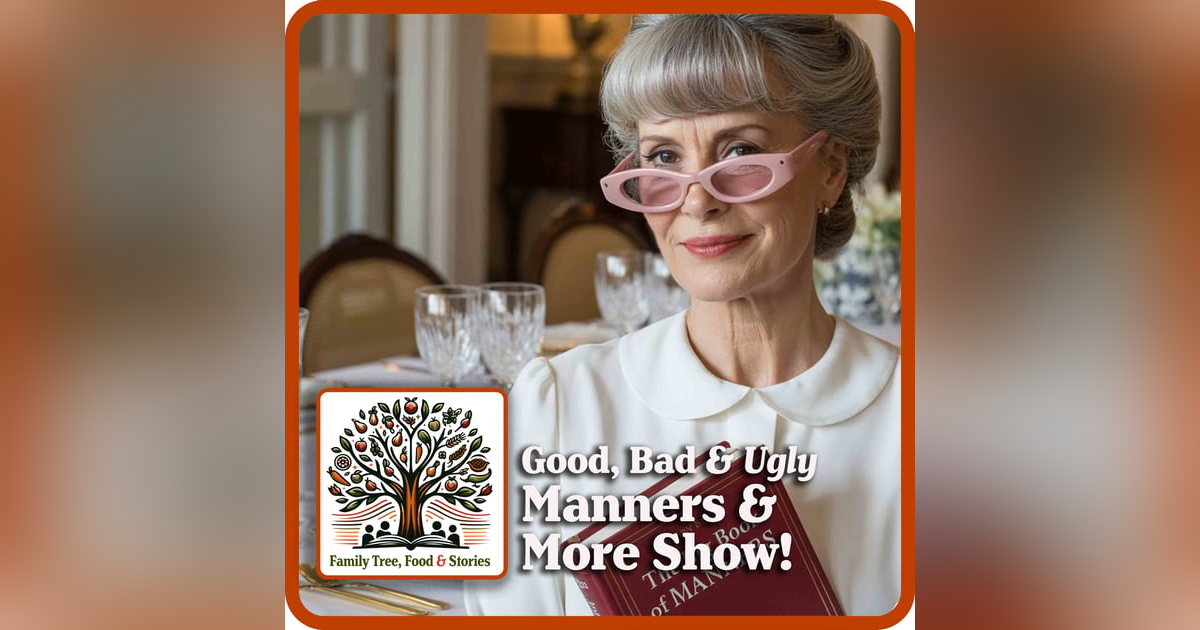



Why do some manners survive for centuries while others disappear overnight? And which one still matters today?
In this episode of Family Tree Food & Stories, Nancy May and Sylvia Lovely uncover the surprising truths behind the rules we follow, the ones we break, and the embarrassing moments we all secretly Google.
From medieval knife etiquette and Victorian orange-cutting rules to restaurant dilemmas, awkward check battles, and the lesser-known rules of modern hosting, this episode reveals how manners have evolved — and why they’re more important today than ever.
A mix of cultural style, history, and real-life stories, Nancy and Sylvia share how etiquette shapes our relationships, our confidence, our friendships, and even tells others who we are at the table. If you’ve ever wondered, “Am I doing this right?”, this episode of Family Tree Food & Stories has answers to the questions you might be too embarrassed to ask out loud — but still should know.
This is not your grandmother’s etiquette talk, but instead something you can put to use tomorrow..
🔑 Key Takeaways:
- The Easy Bread Plate Hack Everyone Should Know About: The “B” and “D” hand trick doesn’t just save embarrassment — it’s one of the most-searched etiquette questions worth learning.
- History Behind the Rules We Follow Without Thinking, And Why: Did you know that Medieval danger signals, Victorian pamphlets, and ancient dining rituals still influence how we sit, eat, serve, and host today?
- The Check-Dance Ritual, And Who Pays? From the guy with “alligator arms” and the host rule to power plays disguised as politeness, the debate over who pays is one of the most revealing etiquette moments in our professional and personal lives, and it's worth learning how to do it right.
- Toasting: Trust, Poison, and a Loud Clink: Did you know that the glass clink isn’t just for celebration—historically, it was a way to prove you weren’t poisoning your neighbor. (And yes, how high your glass, or goblet, was filled mattered!)
🎧 What You Can Do Next:
If this episode made you rethink even one habit, hit follow, share it with a friend, and send us your funniest or most unforgettable etiquette story. Join us, Nancy and Sylvia, in future stories at Family Tree Food & Stories, where we explore the traditions, quirks, and conversations that shape how we eat, gather, and connect — because. . .
Every meal has a story, and every story is a feast.
Additional Links ❤️
- Book: My Family Tree, Food & Stories Journal Awarded #1 New Release on Amazon
- Instagram Story updates 📸
- Facebook Family Tree Food Stories GROUP👍
- TikTok: Family Tree Food Stories
- 👇Share Your Story With Nancy & Sylvia!: Leave us a voicemail
- You can send us a DM on Facebook.
- 🎧 Subscribe now and never miss a bite or a good story.
About Your Award-Winning Hosts: Nancy May and Sylvia Lovely are the powerhouse team behind Family Tree, Food & Stories, a member of The Food Stories Media Network, which celebrates the rich traditions and connections everyone has around food, friends, and family meals. Nancy, an award-winning business leader, author, and podcaster, and Sylvia, a visionary author, lawyer, and former CEO, combine their expertise to bring captivating stories rooted in history, heritage, and food. Together, they weave stories that blend history, tradition, and the love of food, where generations connect and share intriguing mealtime stories and kitchen foibles.
"Every Meal Has a Story and Every Story is a Feast." (tm) is a trademark of Family Tree Food & Stories podcast and the hosts.
@familytreefoodstories, #tablemanners101, #manners #holidaygifts, #everydaymanners #dinningetiquette #holidayhostingtips #tablemanners #mannermatter #goodmanner #breadandbutterdish #whichsideismydrink on #familytraditions #holidaypodcast #familypotcast #learningmanners #etiquettepodcast #toprankingpodcast
Hey everybody, it's Nancy and Sylvia once Again, from
Nancy May:Family Tree Food and Stories, and this show is a little different.
Nancy May:Well, I think they're all different actually, don't you, Sylvia?
Sylvia Lovely:Oh yeah, but they all go back to one place.
Sylvia Lovely:It's called Family Traditions, Family Tree Food & Stories.
Sylvia Lovely:That's what we're all about.
Sylvia Lovely:So grappling with all the many subjects that can go down, all kinds
Sylvia Lovely:of rabbit holes on behalf of that theme.
Nancy May:They are endless.
Nancy May:And this one is, , something that your mother probably told you
Nancy May:about we're talking about manners.
Nancy May:Kind of like, remember Ms. Manners of the day and age, and
Nancy May:I think she's still around
Sylvia Lovely:Well, I know she was really big in the seventies and, what
Sylvia Lovely:was really interesting about Ms. Manners, who was, , actually Judith Martin.
Sylvia Lovely:And, at her prime, she was in like 200 newspapers across the country.
Sylvia Lovely:Sort like a dear Abby kind of thing, you know.
Sylvia Lovely:And, , what was interesting about her is that she came after the.
Sylvia Lovely:Tumultuous sixties now that we're in the sixties.
Sylvia Lovely:I was old enough to be in the sixties.
Sylvia Lovely:I don't know about anybody else out there, but manners sort of like were.
Sylvia Lovely:, It was counterculture.
Sylvia Lovely:It was a time where you know, love everybody and do anything you want.
Sylvia Lovely:, It was that kind of society.
Sylvia Lovely:So she reigned it all in and became Miss Manners.
Sylvia Lovely:However, she did bring a sense of flexibility and I remembered a
Sylvia Lovely:story and you got time for a story
Nancy May:Sure that time for a story?
Nancy May:Sure, do it!
Sylvia Lovely:Belksville Kentucky is down on the Cumberland River, which is in
Sylvia Lovely:southern Kentucky on the Tennessee border.
Sylvia Lovely:And.
Sylvia Lovely:Cumberland River flows right through it.
Sylvia Lovely:, My mentor was the mayor of Belksville, Kentucky, 1600 souls.
Sylvia Lovely:He was so smart.
Sylvia Lovely:He was a, retired general who moved back home to take care of his aging
Sylvia Lovely:mother, who was also really smart.
Sylvia Lovely:one day I asked him.
Sylvia Lovely:I said, Paul, why is it that there's so many like, , if you look at the
Sylvia Lovely:stats on Belksville, above average schooling, all that kinda stuff,
Sylvia Lovely:it was a finishing school kind of place for the Rich Easterners that
Sylvia Lovely:would float down the rivers that ran, , in this part of the country.
Sylvia Lovely:And they would come here and.
Sylvia Lovely:Women that, it was girls and it was very strict stuff, and they would intermarry
Sylvia Lovely:with , the natives of Southern Kentucky.
Sylvia Lovely:I just thought that was really interesting because it got me into
Sylvia Lovely:what finishing schools were at the time for upper class young women
Sylvia Lovely:who were taught a very serious.
Sylvia Lovely:Way to behave and to act and,
Nancy May:In society
Sylvia Lovely:In society.
Sylvia Lovely:and , so then you had the sixties, and I know I'm overgeneralizing, but you
Sylvia Lovely:had that kind of throw all that away and then Miss Manners came back to kind
Sylvia Lovely:of bring it all together to the middle, with some flexibility unlike, , some
Sylvia Lovely:of the other kinds of finishing school or the Victorian age and all those
Sylvia Lovely:things where everything just had to be.
Sylvia Lovely:Perfect.
Sylvia Lovely:Or Martha Stewart, right?
Nancy May:Right, right.
Nancy May:Martha from Nutley, New Jersey.
Nancy May:I love
Sylvia Lovely:Yes.
Sylvia Lovely:That is interesting.
Nancy May:Not from Westport.
Nancy May:Well, she is from Westport.
Nancy May:But anyway, but it's interesting to look at how all these
Nancy May:manner things, came about.
Nancy May:And you've been watching The Crown.
Nancy May:I know.
Sylvia Lovely:I love it.
Nancy May:But it I mean it's well before all of that, I wonder
Nancy May:if the cavemen actually, and Cavewomen had manner processes.
Nancy May:, We didn't have napkins and forks and knives, but there was probably like,
Nancy May:you don't hit , , my lady over the head with a club to take her home to your
Nancy May:cave and have dinner with her when I'm having dinner with her kind of thing.
Nancy May:But sure, there's something else.
Nancy May:But also we had the the middle evil times.
Nancy May:Which I find is rather interesting on how people became, more civilized,
Sylvia Lovely:sure.
Sylvia Lovely:Well, don't you think if you read back in ancient history, people
Sylvia Lovely:were a pretty violent bunch, in the medieval times they were just pigs.
Sylvia Lovely:I am just gonna
Sylvia Lovely:say it.
Sylvia Lovely:There's none of them alive to protest.
Nancy May:pigs compared to we are today at
Sylvia Lovely:That's what I would think.
Nancy May:Well, some people I know are pigs, but that's besides the point.
Sylvia Lovely:no, but that's not the standard.
Sylvia Lovely:The standard is you don't do that.
Sylvia Lovely:like forks were considered effeminate or too refined.
Sylvia Lovely:people ate with their hands.
Sylvia Lovely:And another funny story is I took a group of mayors to a Moroccan
Sylvia Lovely:restaurant, I think it was in Las Vegas, and 'cause different cultures
Sylvia Lovely:look at stuff even today differently.
Sylvia Lovely:And , they brought a whole chicken and your job was to grab a piece of chicken.
Sylvia Lovely:Off of that chicken.
Sylvia Lovely:And they
Sylvia Lovely:were outraged.
Sylvia Lovely:Yes.
Sylvia Lovely:With your hands.
Sylvia Lovely:They were outraged.
Sylvia Lovely:The mayors were outraged.
Sylvia Lovely:They were like, oh, I can't eat at a place where somebody else, had their hands.
Sylvia Lovely:Is that interesting though?
Sylvia Lovely:But that was a common, apparently it was a very authentic restaurant.
Sylvia Lovely:and then don't you have some knife things?
Sylvia Lovely:Because they
Nancy May:Oh, there's a whole bunch of interesting things on how place
Nancy May:settings are, so I don't know about you, but I know the basics of where
Nancy May:your forks and knives go on a place.
Nancy May:Settings.
Nancy May:And the red wine.
Nancy May:And the white wine and the bread.
Nancy May:I, you know.
Nancy May:The biggest challenge that I think most people have, especially at an
Nancy May:event, is, which is your bread plate versus somebody ed else's bread plate?
Nancy May:Well, you know the best way to solve that problem and remember it, you put , your
Nancy May:hands up and make , the okay sign, and one is a B and one is a D, and the bread
Nancy May:side is the one that has the B side.
Nancy May:, And the drink side is where you've got the drink where your coffee cup is.
Nancy May:So that's kind of, I don't know if , that portrays well in audio
Nancy May:connection, but I think you get the idea., the the A. Okay sign.
Nancy May:And , when you've got your fingers up, it's like A, okay, B and D.
Sylvia Lovely:I don't know if you'll ever break me from just
Sylvia Lovely:saying, Hey Bernie, this is mine,
Nancy May:Is it B okay or D. Okay.
Sylvia Lovely:Oh, , now I grew up largely without, I'm gonna say, this is so funny.
Sylvia Lovely:My parents will turn over in their grave without manners.
Nancy May:Oh,
Sylvia Lovely:Oh, okay.
Sylvia Lovely:No.
Sylvia Lovely:Now I'm gonna explain.
Sylvia Lovely:. We really never had people over to dinner.
Sylvia Lovely:We were a very reclusive family.
Sylvia Lovely:Out on a farm, happy family, but.
Sylvia Lovely:Very reclusive.
Sylvia Lovely:So, , we ate with, , forks and stuff like that, and obviously weren't
Sylvia Lovely:the pigs of the medieval age.
Nancy May:you didn't always use your hands.
Sylvia Lovely:No, not always, but, and we weren't feral people, , but , so
Sylvia Lovely:I remember, and this is not manners exactly, but it actually could
Sylvia Lovely:be my first date, the guy takes me to a diner and I must have been 16.
Sylvia Lovely:I don't know how old I was, never eaten out.
Sylvia Lovely:Except when we were on vacation occasionally and he took me to dinner
Sylvia Lovely:and I decided the best manners I could show was not to open my mouth,
Sylvia Lovely:which I didn't, I didn't talk to him.
Sylvia Lovely:I didn't say a word.
Sylvia Lovely:Kinda along the lines, don't open my mouth.
Sylvia Lovely:And the event that, you
Nancy May:Don't chew with your mouth open, right?
Nancy May:Yeah.
Nancy May:So don't talk.
Sylvia Lovely:anyway, that was my version of, of manners.
Sylvia Lovely:. Nancy May: So you weren't exactly a hot date that night.
Sylvia Lovely:I take it.
Sylvia Lovely:No, he never asked me out again.
Sylvia Lovely:Imagine that.
Sylvia Lovely:I kind of thought he'd like a silent date.
Nancy May:That is, funny.
Nancy May:so but it's interesting to look at the placement of forks
Nancy May:and knives on the place set.
Nancy May:Did you know that how a knife is set on the table actually
Nancy May:goes back to medieval times?
Sylvia Lovely:no.
Sylvia Lovely:Tell me about it.
Nancy May:Yeah, so here's what happened.
Nancy May:the knife was a double-edged kind of knife used as weapon originally.
Nancy May:And the blade was, facing inwards towards your plate, if there was a
Nancy May:plate or a piece of wood or whatever they used, signaled trust to, the
Nancy May:people around the table with you,
Sylvia Lovely:Yeah.
Nancy May:if the bla right, exactly.
Nancy May:Because you're not gonna like whack somebody off
Sylvia Lovely:We are a barbaric barbarian
Nancy May:whacking somebody else off is a different story, a different
Sylvia Lovely:Yeah.
Sylvia Lovely:Yeah.
Sylvia Lovely:Oh yeah.
Sylvia Lovely:Oh, okay.
Nancy May:But if the blade is turned outwards, that's considered, rather.
Nancy May:Threatening to somebody else,
Sylvia Lovely:that makes sense.
Nancy May:and is also a hospitality thing now, so it's been carried forward.
Nancy May:When you put a place sitting, the knife blade is always set towards
Nancy May:your plate, not away from it, whether it's blunt or a hunting knife.
Nancy May:My dad taught me that growing up.
Nancy May:Isn't that interesting?
Sylvia Lovely:but that's a good one.
Sylvia Lovely:You know, king Louis the 14th banned a pointed knives to discourage violence.
Sylvia Lovely:Okay.
Sylvia Lovely:Don't mess with that crowd.
Sylvia Lovely:, And so the origin of the table knife, I don't know what that means
Sylvia Lovely:exactly, but , king Louis was the father of Royal Risk Management.
Nancy May:Oh, I love it.. and then the French, the
Nancy May:French, they are funny people.
Nancy May:We love them, especially their food, but the knife was, displayed
Nancy May:wherever the family crest was.
Nancy May:So if the blade was on the facing outwards and their family crest was
Nancy May:on the upside, it kind of was important to let people know your status.
Nancy May:So.
Sylvia Lovely:Yeah.
Nancy May:The knife showed your ranking, which I thought was rather interesting.
Sylvia Lovely:Well, you can see where royalty like in The Crown.
Sylvia Lovely:I'm so fascinated by how everybody's seated in a certain
Sylvia Lovely:place and, it's so formal.
Sylvia Lovely:And of course, throughout the entire series, which is huge.
Sylvia Lovely:, There.
Sylvia Lovely:Being pressured as modern living comes along to change all those things, and
Sylvia Lovely:yet they hold onto it because it is the etiquette that has sustained them
Sylvia Lovely:and has developed over time and it's really hard for them to give it up.
Sylvia Lovely:And , Diana.
Sylvia Lovely:Kind of played around with them, didn't she?
Sylvia Lovely:And she kind of got her way,
Sylvia Lovely:they She better not be nasty to Diana that they were.
Nancy May:No, But but placing where people are placed.
Nancy May:Especially in an event is very important.
Nancy May:Or even a family, , the head of the table is always the position power.
Nancy May:And my dad would sit at the front of the table, it.
Nancy May:Holidays or my grandmother would actually, no, dad would always sit at the front of
Nancy May:the table 'cause he would carve the Turkey and my grandmother always sat to the right
Nancy May:side, which was her position of power.
Nancy May:So , us.
Nancy May:Kids would always sit on the sides, it didn't matter.
Nancy May:But even at home, it was probably not intentional yet.
Nancy May:There were still those levels of, I don't
Sylvia Lovely:Hierarchy.
Sylvia Lovely:And formality.
Sylvia Lovely:Now this is all really interesting and I know you may have a different opinion, but
Nancy May:Go ahead.
Sylvia Lovely:Old Martha,
Nancy May:Oh,
Nancy May:, Sylvia Lovely: Martha's book is coming out and I swore I was
Nancy May:gonna find the name of it, but,
Nancy May:, Let see.
Nancy May:No, no, no.
Nancy May:It's a reissuance of an old book,
Nancy May:Ah,
Nancy May:entertainment.
Nancy May:Anyway, it was
Nancy May:when she was
Nancy May:Entertainment.
Nancy May:I think that was one of her original ones.
Sylvia Lovely:Yeah, it was, and very young.
Sylvia Lovely:Very young, Martha.
Sylvia Lovely:And, , her book was controversial at the time because she advocated perfection.
Sylvia Lovely:And then the reason it was controversial is that, I mean, she was wealthy.
Sylvia Lovely:She could afford to spend endless time and days putting together the perfect table
Sylvia Lovely:and manners and all of that kind of stuff.
Sylvia Lovely:So.
Sylvia Lovely:I think it was interesting 'cause at least it democratized, so I'm gonna use
Sylvia Lovely:that word again with as, , with miss manners that everybody could make their
Sylvia Lovely:house a home and, , to lesser degrees people worried about how things were
Sylvia Lovely:set up and all of that kind of thing.
Sylvia Lovely:Now that may not be manners as much as it's just the overall
Sylvia Lovely:look of a table and all of that kind of stuff, sort of decorating.
Sylvia Lovely:, Nancy May: We talked about that in, in a previous show, decorating,
Sylvia Lovely:but still I think manners go.
Sylvia Lovely:A long way on, many different levels.
Sylvia Lovely:One, if you are, maybe the hostess is not the right word, but if you invite
Sylvia Lovely:friends and other family members into your home, especially now around
Sylvia Lovely:the holidays, you wanna make them feel comfortable around their table.
Sylvia Lovely:And even if they don't have the best manners, not to necessarily
Sylvia Lovely:call them out on it, but hopefully show them by example.
Sylvia Lovely:My mom , had a story that she told us time and time again when we were kids.
Sylvia Lovely:She was so concerned that we wouldn't know how to handle ourselves as
Sylvia Lovely:adults at somebody else's table.
Sylvia Lovely:I don't know why, because they drill it into us as kids, how to properly
Sylvia Lovely:eat with a fork and knife and make sure that we didn't embarrass ourselves or
Sylvia Lovely:somebody else or that we were with.
Sylvia Lovely:Especially if it's like, well, a date we learn to talk still.
Sylvia Lovely:Yeah, please
Nancy May:But my mom did not know how to eat a chicken with a fork, a knife,
Nancy May:chicken on the bone , as a teenager.
Nancy May:' cause they were like, it's not that they were manners were bad, I think at home.
Nancy May:It's just that they never did it.
Nancy May:They picked up the chicken with her hands and, that kind of thing.
Nancy May:Well, my mom was.
Nancy May:Totally embarrassed not knowing how to do this, but made sure that she
Nancy May:delicately took the chicken off the bone at her boyfriend's house and at the
Nancy May:end of the meal, her boyfriend's mother came to her quietly and said, I have
Nancy May:never seen anybody with such impeccable manners on how do you eat a chicken
Nancy May:with a bone with your fork and knife,
Sylvia Lovely:Interesting.
Nancy May:Mom drill that one into me really well.
Nancy May:I still don't like getting my fingers sticky on chicken.
Sylvia Lovely:Ladies in the Victorian age had to use a fork
Sylvia Lovely:and knife to cut an orange.
Sylvia Lovely:Pamphlets were developed on proper orange eating protocol.
Nancy May:Isn't that interesting?
Nancy May:Oh my goodness.
Nancy May:Or what about grace and, blessings.
Nancy May:I think those are really, not in, I say , in style today.
Nancy May:Although yeah, I have had friends who said, would you mind if we say Grace?
Nancy May:No, go right ahead.
Nancy May:that works and we've got, we've got a Grace in our book, family
Nancy May:Tree, food and Stories right
Nancy May:in the back.
Nancy May:If you don't have
Nancy May:one,
Sylvia Lovely:I.
Nancy May:got one for you.
Sylvia Lovely:I think they're on the upswing.
Sylvia Lovely:I know when I go to lunch and I, and we frequently go to lunch together,
Sylvia Lovely:Frida a frequent contributor and I always start eating.
Sylvia Lovely:You know, the other thing is you wait till the other person gets
Sylvia Lovely:their meal right before you.
Sylvia Lovely:Dig in.
Sylvia Lovely:And that's kind of ingrained in all of us.
Sylvia Lovely:And so as soon as the food arrives, I'm like, I pick up my fork.
Sylvia Lovely:Do you mind if I say grace?
Sylvia Lovely:I'm like, oh shoot.
Sylvia Lovely:When will I ever ingrain that in my head?
Sylvia Lovely:It's a good idea.
Nancy May:Wasn't your grandfather or somebody a preacher too
Sylvia Lovely:oh yeah.
Sylvia Lovely:Bernie's dad was, and so
Sylvia Lovely:you knew you were gonna say Grace before, all of that, before
Nancy May:Well, and then there's so many other things.
Nancy May:, Napkin, I wouldn't say napkins, but, , we'll get to napkins, but bad manners.
Nancy May:There was, I'm gonna say it was probably the early eighties that
Nancy May:corporations were hiring etiquette trainers to teach their young recruits.
Nancy May:How to behave at a table because they were coming to the corporate world with
Nancy May:no manners, which I find rather sad at the same time as as interesting.
Nancy May:But things as simple as where do you place your napkin?
Nancy May:Do you even use a napkin?
Nancy May:Which I think is really, I mean, alright, maybe it's a
Sylvia Lovely:So you don't use shirt sleeves?
Sylvia Lovely:Are you
Nancy May:No, no, or, or you.
Nancy May:You don't tuck it into the top of your shirt unless you're eating lobster, and
Nancy May:then you're usually given a bit, and that's a whole nother type of thing.
Nancy May:But the napkin always goes on your lap and yeah, it doesn't tuck into
Nancy May:your pants or anything like that.
Nancy May:You guys always have an issue with ties, right?
Nancy May:So maybe they just wipe their mouths with their ties, or never
Nancy May:speaking with your mouth full.
Nancy May:Now, these things are really kind of obvious, I think, in many
Nancy May:cases, yet I see so many people.
Nancy May:Just not doing them.
Nancy May:Just stop, take small bites of food, chew, or, , here's another one.
Nancy May:When you have bread , on your bread plate, if you're at a
Nancy May:restaurant , you don't cut the thing in half and slather butter on it.
Nancy May:You're supposed to take just a small little piece and then butter
Nancy May:it or do whatever you're doing with it or dip it in oil and eat
Nancy May:the piece, not the whole chunk.
Nancy May:Don't bite into it.
Nancy May:So that's
Sylvia Lovely:Yeah.
Sylvia Lovely:at one time, only the host could break bread.
Sylvia Lovely:If you reached for it too early, you were challenging authority.
Sylvia Lovely:Yikes.
Nancy May:I love the concept of just breaking bread because
Nancy May:it means you're sitting down
Nancy May:with people that you are coming to the table for,
Sylvia Lovely:here's an interesting thing, whether
Sylvia Lovely:it's manners or whatever it is.
Sylvia Lovely:, I have seen increasingly now if you're at a high level business,
Sylvia Lovely:dinner, breakfast or lunch or dinner, and , it has kind of been.
Sylvia Lovely:Tradition that men pick up the check.
Sylvia Lovely:And frequently they do, And that's kind of a tradition.
Sylvia Lovely:Men take care of women.
Sylvia Lovely:Right.
Sylvia Lovely:But today's world is really different.
Sylvia Lovely:And I'm just wondering, , I typically do coffee meetings outside of my home.
Sylvia Lovely:I work from home and.
Sylvia Lovely:That is kind of easier because you go, you just go up to a
Sylvia Lovely:counter and you order that.
Sylvia Lovely:Plus, you know, I've always had to be real honest with you, I've always
Sylvia Lovely:had issues with what do you order if you're in a business meeting because
Sylvia Lovely:you don't want something like, oh, I'll tell you, the worst thing to
Sylvia Lovely:order is, uh, French onion soup
Sylvia Lovely:with the gooey cheese.
Sylvia Lovely:And the fear that you're gonna have these big strings of
Sylvia Lovely:cheese hanging down your chin.
Sylvia Lovely:I mean, I still no.
Nancy May:can always use a knife to cut the strings of cheese.
Nancy May:That's, I've done that before.
Sylvia Lovely:Well, you can do all of that, but I just avoid it
Sylvia Lovely:when I do have lunch with people.
Sylvia Lovely:And then, in today's world, what do you do?
Sylvia Lovely:Do you,
Nancy May:Well , let's come back because we're gonna take a quick
Nancy May:break and we're gonna come back and talk about who picks up the check.
Nancy May:That's an interesting one, so stay tuned.
Nancy May:We'll be right back.
Nancy May:. All right, so we are back and we're picking up on this one, pun
Nancy May:intended, on checks at the table for restaurants, and whether it's business
Nancy May:or friendship or whatever that is.
Nancy May:And who picks up the check?
Nancy May:let me start with, we've got the husband of a friend who we love
Nancy May:dearly, who my friend says, well, my husband has alligator arms.
Nancy May:You know what that is?
Nancy May:You can't reach the check all the time.
Nancy May:And we have other friends who went out to dinner with, well, they, they're no
Nancy May:longer close friends, which is really sad because this woman, not that it
Nancy May:matters, but extremely wealthy, always let somebody else pick up the check.
Nancy May:She would find some excuse to leave early or I gotta go and just.
Sylvia Lovely:Oh no.
Nancy May:Disappear, which is probably why she was wealthy,
Nancy May:but, or one of the reasons.
Nancy May:Right?
Nancy May:But here's my theory on picking up the check.
Nancy May:If you are the one that has done the inviting, inviting somebody
Nancy May:out, and you are the host,
Sylvia Lovely:Yes,
Nancy May:you pick up the check
Sylvia Lovely:that's what I think.
Nancy May:men or women.
Nancy May:However, I have been in those situations where typically it's an older gentleman
Nancy May:will insist that they pick up the check.
Nancy May:and if I say, no, I've invited you out, you're my guest.
Nancy May:If they, I don't wanna say, if they can be gr can't be gracious enough to
Nancy May:say thank you, then, then, , I just, the term gracious, that's kind of rude.
Nancy May:That does not give me very good manners.
Nancy May:But if they really wanna do that,
Nancy May:that's fine and I will find some other way to thank them
Nancy May:or.
Nancy May:show my, appreciation a, in a different way.
Nancy May:You
Nancy May:can also always ask to offer to pick up the, tip, right?
Sylvia Lovely:yeah, yeah.
Sylvia Lovely:No, I agree with you because I really believe sometimes, particularly an older
Sylvia Lovely:generation person wants to have that sense of power, and that's okay with me.
Sylvia Lovely:, I'm fine with that because I understand it
Sylvia Lovely:, Nancy May: If it's a power play, I am like, eh, yeah.
Sylvia Lovely:I'm not wild about that.
Sylvia Lovely:There's not too many older than me now, you know?
Nancy May:Well, if it's done, as a politeness versus a power
Nancy May:play, that's a whole nother story.
Nancy May:So
Sylvia Lovely:Okay.
Sylvia Lovely:Well we can agree to disagree on that 'cause we don't know what power is, do we?
Sylvia Lovely:There's many different meanings of power.
Nancy May:that, I would agree with.
Nancy May:yeah.
Nancy May:I can think of power as being obnoxious, you know,
Sylvia Lovely:Uh, no, I, I believe, uh, my husband has a really hard time
Sylvia Lovely:accepting gifts from people, and I'm like, no, people feel really good
Sylvia Lovely:sometimes about feeling like they were able to do something for you.
Nancy May:I agree with you.
Sylvia Lovely:So if that's power, then I'm all for it.
Sylvia Lovely:So anyway.
Nancy May:consider that power.
Nancy May:I just think that's being gracious
Sylvia Lovely:Okay.
Sylvia Lovely:Difference of opinions, but, I just, what, how you define power.
Nancy May:agree.
Nancy May:I.
Sylvia Lovely:Anyway., Just another thing, chopsticks, don't sit them upright.
Sylvia Lovely:It's a bad omen.
Nancy May:I think that's pretty funny.
Nancy May:Well, and speaking of, chopsticks or just even sitting at the table,
Nancy May:really waiting for doing anything before your guests or other family
Nancy May:members sit down at the table.
Nancy May:You don't eat before somebody else, right?
Nancy May:You wait.
Nancy May:You wait till they're served, even if it takes forever.
Nancy May:However, if your guest says, or the other person at the table
Nancy May:says, please go ahead and eat,
Nancy May:then you have
Sylvia Lovely:that's right.
Nancy May:the, approval to do so.
Nancy May:I still feel uncomfortable doing that, especially if people
Nancy May:are waiting forever and just as
Nancy May:bad service at a restaurant.
Nancy May:, I feel bad for doing that.
Sylvia Lovely:Uh, I do too.
Sylvia Lovely:Did you know that in Japan, I was in Japan?
Sylvia Lovely:It was really hard.
Sylvia Lovely:I told you I grew up without manners.
Sylvia Lovely:No, I didn't grow up without manners.
Sylvia Lovely:I just not refined ones, but it was really hard to sloop slurp my noodles.
Nancy May:Oh yeah, that's a big thing.
Nancy May:It a slurping is considered an etiquette thing, right?
Sylvia Lovely:That was fun.
Sylvia Lovely:do you wanna hear about some holiday things?
Nancy May:Oh, I wanna hear holiday things.
Nancy May:Absolutely.
Sylvia Lovely:Okay.
Sylvia Lovely:Now these aren't like different things.
Sylvia Lovely:They're just more intense at holiday time.
Sylvia Lovely:Everybody's busy, right?
Sylvia Lovely:You gotta get to that party, that five to seven thing, but you gotta go do some
Sylvia Lovely:Christmas shopping and then the other trick that people do is they all RSVP.
Sylvia Lovely:This happens to a restaurant all the time.
Sylvia Lovely:RSVP.
Sylvia Lovely:Yes, we're coming.
Sylvia Lovely:And
Sylvia Lovely:then, and then they don't Now on a restaurant that happens.
Sylvia Lovely:That really does happen.
Sylvia Lovely:And it's so irritating.
Sylvia Lovely:'cause what happens, particularly at Derby time and , other times they'll
Sylvia Lovely:call two or three places for 16 people and then they don't show up at yours.
Sylvia Lovely:And
Sylvia Lovely:that is.
Nancy May:them.
Nancy May:Yeah, I'd charge 'em a book.
Sylvia Lovely:We have started getting credit card numbers, but
Sylvia Lovely:anyway, it brings me to RSVP.
Sylvia Lovely:RSVP quickly when you get an invitation
Nancy May:absolutely.
Sylvia Lovely:on time.
Nancy May:Well, okay.
Nancy May:I have, a caveat to that one.
Nancy May:So not to RSVPing.
Nancy May:' cause we've sent out invitations to parties in years past.
Nancy May:We do a big Christmas party and there are people who just
Nancy May:don't know how to respond yet.
Nancy May:I know they're coming.
Nancy May:I.
Sylvia Lovely:Yeah.
Nancy May:I don't know how much food to cook.
Nancy May:I don't know if you're gonna be there.
Nancy May:It's a disappointment if you're not there.
Nancy May:just be kind enough to, to say that you'll be there, especially if it's a home party.
Sylvia Lovely:Yeah, but
Nancy May:you're on my, , you know, S**T list.
Nancy May:If you don't
Sylvia Lovely:Mm-hmm.
Nancy May:on my side,
Sylvia Lovely:Although I think what people do, this is not good.
Sylvia Lovely:They hedge their bets, you know?
Nancy May:that they're gonna get to a better party
Sylvia Lovely:Oh, a better party, or they don't have that last
Sylvia Lovely:minute gift they have to get, or, they're gonna like keep it open.
Sylvia Lovely:But I, I just, I disagree with that.
Sylvia Lovely:I think that's bad.
Sylvia Lovely:So you wanna hear this one?
Sylvia Lovely:This one's fine.
Nancy May:Yeah, go ahead.
Sylvia Lovely:This is one of the biggest complaints about Facebook in general.
Sylvia Lovely:Don't post pictures of your fancy gifts.
Nancy May:Oh, that's funny.
Nancy May:That's funny.
Nancy May:My gift is better than yours.
Nancy May:Or better yet, you go to one of those parties after Christmas and I forget
Nancy May:what they call it, but you bring the gift that you don't like your worst
Nancy May:gift and you exchange it with others.
Nancy May:So , you draw numbers and say Who gets the worst gift?
Sylvia Lovely:Oh, that's hilarious.
Nancy May:a bad, it's like a bad gift swap.
Nancy May:It's really pretty funny.
Nancy May:I would never put a picture of that.
Nancy May:Like, 'cause all of a sudden my gift got on the bad swap
Sylvia Lovely:Well, that actually happened to me once.
Sylvia Lovely:I shouldn't even, I
Nancy May:oh.
Nancy May:Uh
Sylvia Lovely:should not even admit it.
Sylvia Lovely:Somebody got me a gift and I thought it was from someone else, and the person
Sylvia Lovely:standing there was the person, and I was like, oh, why would I ever do with this?
Nancy May:oh no.
Sylvia Lovely:Found out later that he had given it to me and I didn't know that
Sylvia Lovely:it was I tell you what it was, it was a disc of the movie.
Sylvia Lovely:It's a wonderful life, and I never thought I'd enjoy that movie,
Sylvia Lovely:but I actually later watched it.
Sylvia Lovely:I mean, that just
Nancy May:I. Think it's depressing.
Nancy May:I can't watch it.
Sylvia Lovely:Well, yeah.
Sylvia Lovely:You Yeah.
Sylvia Lovely:Well, it has to have a ending.
Sylvia Lovely:Right.
Sylvia Lovely:But anyway.
Nancy May:Go ahead.
Sylvia Lovely:So that's, just tacky to put your, , super gold
Sylvia Lovely:earrings, on display for the world and probably not safe because
Sylvia Lovely:somebody will come and get 'em.
Nancy May:So I, have something really quickly.
Nancy May:So if somebody's having a house party and they, and you offered to bring something.
Sylvia Lovely:Yeah.
Nancy May:The rule is ask the hostess what it is that she needs that you
Nancy May:can bring, because you don't wanna all of a sudden bring something now
Nancy May:, she's got too many desserts, or too many appetizers, or whatever it is.
Nancy May:Ask where she needs the help, and then make sure you stick to
Nancy May:what it is that you could bring.
Nancy May:You bring something else as well, but it could ruin their whole plans, and
Sylvia Lovely:Oh sure.
Sylvia Lovely:Oh no, that's good.
Sylvia Lovely:That's good.
Sylvia Lovely:Okay.
Sylvia Lovely:There's one time of the year that you can easily bring tacky gifts
Sylvia Lovely:for
Sylvia Lovely:people.
Nancy May:Yeah,
Sylvia Lovely:Ugly Christmas sweaters.
Nancy May:ugly Christmas sweaters or bring the fruitcake
Nancy May:with the ugly Christmas sweater.
Nancy May:Although I love fruitcakes,
Sylvia Lovely:you know, I don't, but yeah, my dad did.
Sylvia Lovely:tacky Christmas sweater.
Sylvia Lovely:People have even cra tacky Christmas sweater parties,
Sylvia Lovely:, okay, here's, another one.
Sylvia Lovely:' cause um, people do this secret Santa and they set a price limit
Nancy May:Mm-hmm.
Sylvia Lovely:and Mary exceeds the price limit.
Nancy May:Oh.
Nancy May:no.
Nancy May:Oh, no.
Nancy May:No.
Nancy May:Yeah, not that's not, that's good.
Nancy May:Right?
Nancy May:It's $10 and all of a sudden then if somebody got $50 get, there's no way
Nancy May:they're getting those slippers for $10.
Nancy May:Right.
Sylvia Lovely:Oh gosh.
Sylvia Lovely:, Oh, I've got a note here that I can't even think.
Nancy May:toasting?
Nancy May:toasting?
Nancy May:Has all sorts of interesting sort of etiquette and things around it.
Nancy May:It's
Sylvia Lovely:yeah.
Sylvia Lovely:Yep.
Sylvia Lovely:Here's some, here's something really funny about it.
Sylvia Lovely:Many ways to prove that you're not trying to kill the other person
Nancy May:in a toast.
Sylvia Lovely:a toast.
Sylvia Lovely:A theory is that if you click another loud enough, , they say that in ancient times.
Sylvia Lovely:That was one of the ways to prove you're not trying to kill the other
Sylvia Lovely:one because you clink the glass, right?
Sylvia Lovely:and I guess that works, but another thing.
Nancy May:it was something splashes into their glass
Sylvia Lovely:Well that, uh, yeah.
Sylvia Lovely:And then, , that assures the other person that there's no poison.
Sylvia Lovely:I mean, it's hard to believe this is actually true stuff.
Sylvia Lovely:And the louder the click, the greater the trust in an age of sheer
Sylvia Lovely:paranoia, in how did it, we evolve into no hands for eating actually.
Sylvia Lovely:It grew out of a fear of gluttony.
Sylvia Lovely:Uh, and oh, I love this etiquette books.
Sylvia Lovely:At the time, this was a long time ago, um, it probably in the 18 hundreds
Sylvia Lovely:or something, but etiquette books instructed not to use all 10 fingers ever.
Sylvia Lovely:You were told to eat with the three fingers on the right
Sylvia Lovely:hand symbolizing Trinity.
Nancy May:So three fingers on the right hand while you're
Nancy May:eating with your hands as opposed
Sylvia Lovely:I don't know , not sure if Matt holding your utensils
Sylvia Lovely:with these fingers or what, but I guess at one time, you hold your fork.
Sylvia Lovely:I mean, you don't just grab your fork and your
Sylvia Lovely:Oh, and put your whole hand around it.
Nancy May:Well, some people do.
Nancy May:So that's another thing, how you hold your fork and knife when you're eating.
Nancy May:Like some people grab it , like grabbing a stick and , my folks used
Nancy May:to call it, you don't shovel your food.
Nancy May:Yeah, number of times.
Sylvia Lovely:That's right, that's good.
Sylvia Lovely:That's good.
Nancy May:Yeah.
Nancy May:so.
Sylvia Lovely:so.
Nancy May:or washing your hands before meals.
Nancy May:Goodness gracious.
Nancy May:Who would've think that that was partially, that was
Nancy May:actually an etiquette thing.
Nancy May:That seems just like a sanitary thing, but it's actually, part
Nancy May:of a, . The medieval feast.
Nancy May:You have to wash your hands before, although.
Nancy May:Wait a second.
Nancy May:The Japanese, when you go to a Japanese restaurant, don't they give you a warm
Nancy May:cloth that you just wanna bathe in?
Nancy May:Right?
Nancy May:Because it feels so good.
Nancy May:So there is something about this purification, but a, it's a ritual.
Nancy May:I, it's, well, , it's manners and a ritual, I guess, all at the same time.
Nancy May:We'll talk about rituals at other time, but there's something that's very
Nancy May:interesting and I don't know how much your waiters and waitresses look at this.
Nancy May:But when somebody is done eating and how many people do it as a guess, how
Nancy May:you place your fork and your knife on your plate is signaling whether you're
Nancy May:not done eating or you are done eating.
Nancy May:And I, I can't tell you how many times I've been to a restaurant
Nancy May:and I have, And they don't know.
Nancy May:Right.
Nancy May:And they just want to, take away the plate of somebody who's done eating
Nancy May:while somebody else is still eating.
Sylvia Lovely:Yeah, I know.
Sylvia Lovely:I
Sylvia Lovely:know.
Sylvia Lovely:Now I
Sylvia Lovely:Don't know that our wait staff were very careful about taking
Sylvia Lovely:plates away, , too quickly.
Sylvia Lovely:But, um, Bernie actually knew that I was like, I'm proud of him.
Nancy May:Yeah.
Nancy May:Well, and it, makes me feel like you don't want me there If you take my
Nancy May:plate away and you wanna see, you know, hurry up, hurry up, hurry up.
Sylvia Lovely:Oh no.
Sylvia Lovely:We are very careful about that.
Sylvia Lovely:How about , eating one piece at a time and avoid cutting all
Sylvia Lovely:your food into pieces in advance?
Sylvia Lovely:Is that something.
Nancy May:you're a child,
Nancy May:, Sylvia Lovely: Mm-hmm.
Nancy May:a little kid
Sylvia Lovely:Yeah.
Sylvia Lovely:But an adult should not do that.
Nancy May:Never do that.
Nancy May:It's like cutting up your, your bread and doing this.
Nancy May:And I wonder whether there's anything to do with dessert.
Nancy May:Are there any ritual?
Nancy May:I wish there were any manners on desserts.
Nancy May:I don't know.
Sylvia Lovely:I don't know either.
Sylvia Lovely:That's interesting.
Sylvia Lovely:I
Sylvia Lovely:do know you had one on your list.
Sylvia Lovely:Okay.
Sylvia Lovely:I'm just gonna say, if you got little kids in your family and you want peace at the
Sylvia Lovely:table, you are gonna give 'em that iPad.
Nancy May:Oh yeah, no electronic gadgets at the table.
Nancy May:Although I think that it's really important for children to learn how
Nancy May:to sit and behave properly at a table.
Nancy May:Now again, you've got a restaurant, so you probably see families come
Nancy May:in with their kids and you, any kid that has unruly, have you ever asked
Nancy May:a family to leave because is unruley?
Sylvia Lovely:Oh, no.
Sylvia Lovely:Oh
Nancy May:I've actually seen some restaurants tell
Sylvia Lovely:yeah.
Nancy May:people to leave because their, their kids are so bad,
Sylvia Lovely:I suppose if we ever had that.
Sylvia Lovely:I've just never remembered that ever happening, and I have 10 grandchildren
Sylvia Lovely:ranging from little to big.
Sylvia Lovely:Oh.
Sylvia Lovely:There are times when they're kids and they don't, I mean, we try to reel them in and
Sylvia Lovely:tell them that they can't run around and be crazy or send them up to the gardens.
Sylvia Lovely:We have gardens associated with our restaurant.
Nancy May:and that, , that makes sense.
Nancy May:But,, there are some parents who just don't care and they
Nancy May:let their kids run around and
Nancy May:figure it's a time for mom and dad to be out and just not let
Nancy May:somebody else baby set the, kids.
Nancy May:then I guess, well, How do you show, respect and appreciation to your host or
Nancy May:hostess at, at a, at a meal or, other than paying for, I mean if you're out together,
Nancy May:but do you bring a gift as a hostess gift?
Sylvia Lovely:Yeah.
Nancy May:What kind of hostess gifts do you bring?
Sylvia Lovely:Bottle of wine.
Nancy May:Okay.
Nancy May:I'm wondering if there are anything else that people bring.
Nancy May:But , food is typically a gift that people bring, , wine or something, cookies or
Nancy May:something that they could appreciate later on, especially on holiday times.
Sylvia Lovely:Yeah, I would never cook cookies for anybody else but, , wine
Sylvia Lovely:or, , something that's like really specially made like, not a dish, but
Sylvia Lovely:like maybe a special, I forget what my neighbor brought over some kind of s
Sylvia Lovely:spat bread or something from Germany.
Sylvia Lovely:And brought that as a little not, , it wasn't, it was a Christmas gift actually,
Sylvia Lovely:but which are probably easier because you can bring any number of things.
Sylvia Lovely:But if you're coming to an eating event,
Nancy May:Yeah.
Sylvia Lovely:wine is your safest bet.
Sylvia Lovely:, Nancy May: I think it certainly is, but , there's so many different ways,
Sylvia Lovely:to deal with manners in etiquette.
Sylvia Lovely:And I think , the best way is ultimately be gracious.
Sylvia Lovely:Be comfortable in your own skin and be appreciative of the other people
Sylvia Lovely:that are around you, whether it's at a meal or at a party, or it could be an
Sylvia Lovely:interview over a dinner that somebody has taken you out to, and then ultimately
Sylvia Lovely:know how to say thank you at the end.
Sylvia Lovely:So
Sylvia Lovely:Oh yeah.
Nancy May:with that, we'd like to say thank you for being here
Nancy May:for Family Tree Food and Stories.
Nancy May:If you haven't listened to previous shows, we've just done one on oatmeal.
Nancy May:If you don't know where the Scotts hide their oatmeal and days gone by,
Nancy May:you might wanna check on that or other holiday tips and tricks.
Nancy May:Just delicious treats along the way.
Nancy May:listen in to podcast at Family Tree Food and Stories and share it
Nancy May:with friends and family members.
Nancy May:And don't forget, you can get your own book at Amazon at My Family
Nancy May:Tree Food and Stories, because as we like to say, Sylvia, what is it?
Nancy May:Every meal has a story and every story has a feast.
Sylvia Lovely:dag gone, right?
Nancy May:Take care.
Nancy May:We'll see you soon, hopefully at our table,
Sylvia Lovely:Okay.



