Is Your Old Rolling Pin Worth Money? 5 Ways to Tell
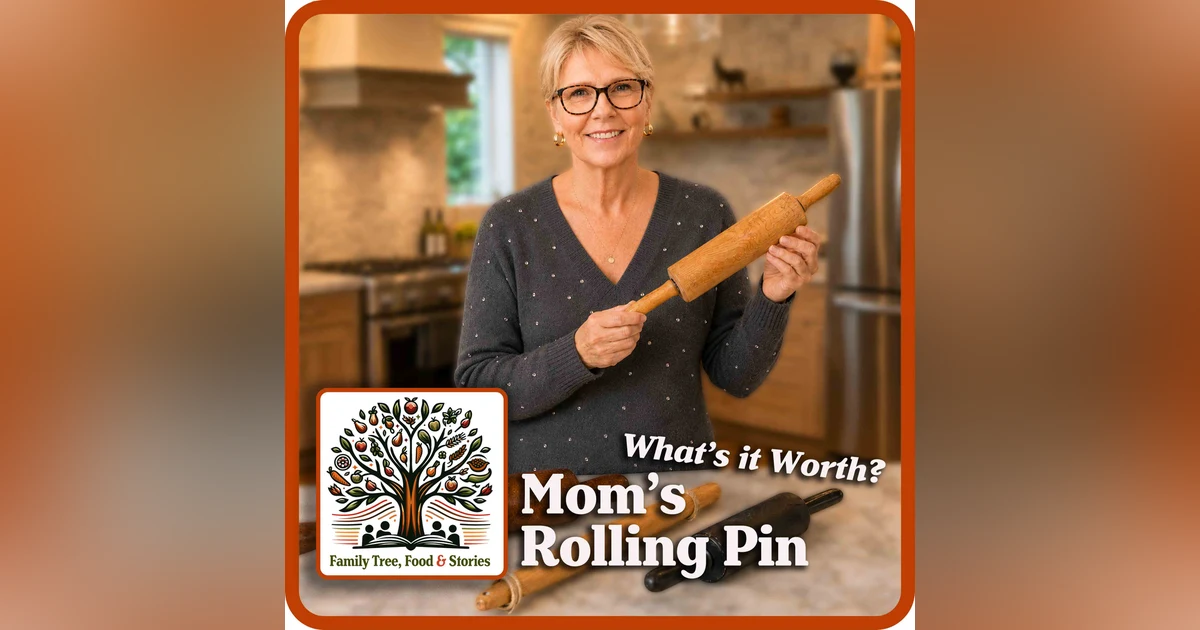
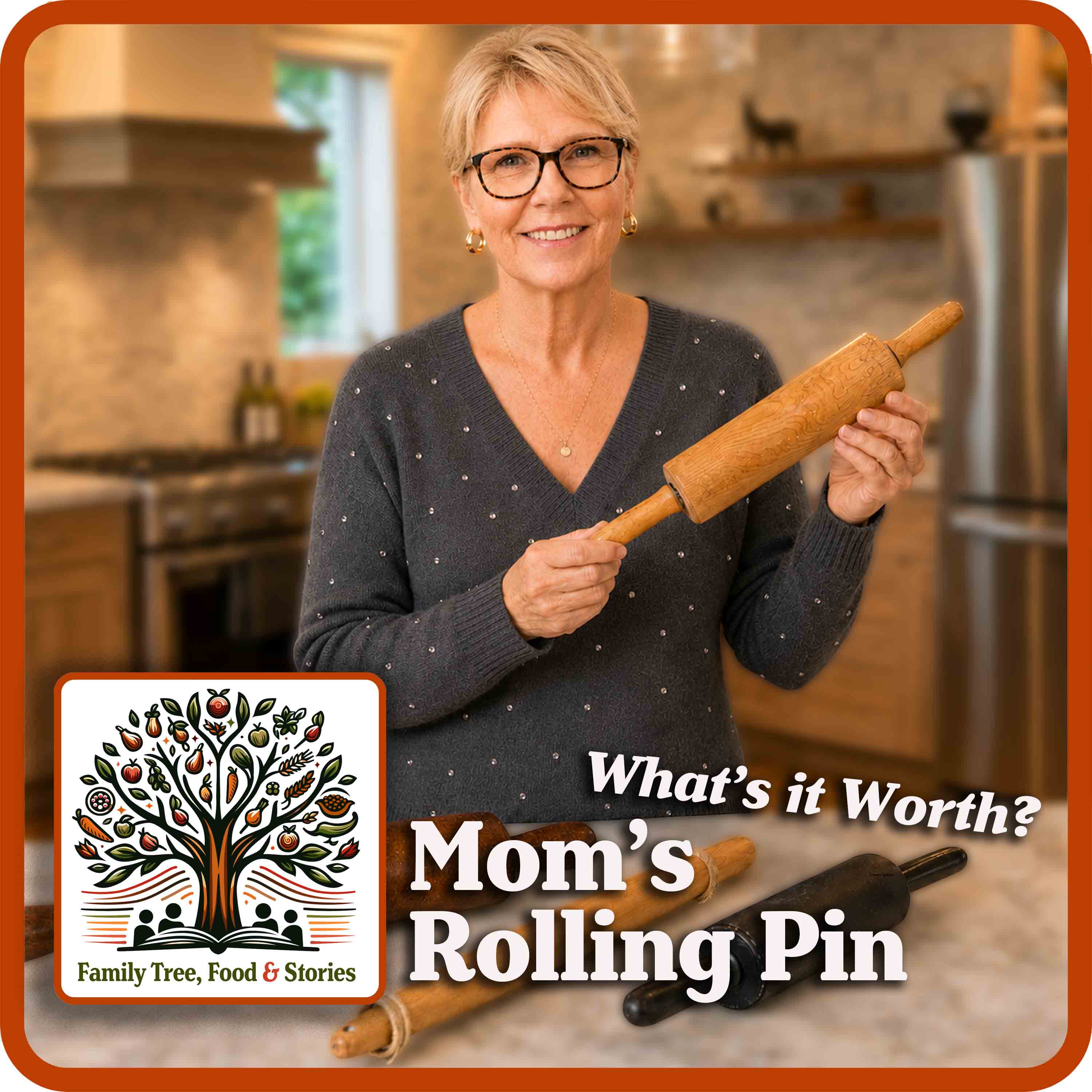


Before you donate Grandma’s old rolling pin, look at the ends. That mark you assumed was damage could reveal its age, maker, and if it’s worth $20 or even thousands.
Is your old rolling pin worth thousands, or nothing at all? Some antique rolling pins bring real money, and the clues are right there in the wood: the shape, the handles, the wear, and the maker's mark most people mistake for damage. Before you toss Grandma's rolling pin, here's how to read the one in your kitchen.
This is the first episode of our new Evidence-Based Series in Family Tree Food & Stories. In these next few shows, Nancy May and Sylvia France share six weeks of ordinary things sitting in your kitchen right now, and what each one can tell you about the family member or person it came from. This week, as you guessed, we start with the rolling pin, because over 70% of American households own one, only about 14% ever use it, and almost nobody knows how to read theirs.
In this episode of Family Tree Food & Stories, you'll learn about the various shapes and materials and what each was built to do. The handled American pin is the one most of us typically picture, the tapered French pin professionals use, and the odd antique that fits no category at all; well, we dig into that too. From the first hint of rolling pins found over 6,000 years ago, the handle-free pins of China, India, Turkey, and Italy, and then we finally get into what the material, the maker's mark, and the wear pattern each reveal, including JK Adams of Dorset, Vermont, still making pins here in the U.S. since 1944.
So go get the rolling pin out of your cabinet — the long one that never fits in the drawer. This one's meant to be listened to with it in your hand.
Key Takeways
- Whether yours is old or modern comes down to the handles.
- A name and a town might be the only things that identify your rolling pin if it's over 100 years old.
- The marks most people read as damage are the actual clue.
- Wear tells you the pin was loved, but it can't tell you who loved it.
Rolling Pin FAQs
Are old rolling pins worth anything?
Some are worth thousands; many are worth 20 or 30 dollars, and some are worth nothing at all. Value depends on age, maker, material, and condition.
How can I tell how old my rolling pin is?
Start with the handles. Turning handles mean a rod through the middle and a newer design; fixed handles carved from one piece of wood typically signal an older pin. A plastic collar at the barrel suggests a modern pin; bare wood or metal leans older.
What is a French rolling pin, and why do professionals use it?
A French pin is solid wood, tapered at both ends, with no handles. Bakers use the taper as a pivot and can feel the dough directly through the wood, which gives more control than a handled pin.
What are the different types of rolling pins?
The handled American pin most people picture, the tapered French pin, a straight dowel for flatbreads, a carved pin for stamping cookies, a small one-handed version for dumplings, and antique fixed-handle pins that fit none of those categories.
Why don't most rolling pins around the world have handles?
China uses a plain rod, India the belan, Turkey the oklava, Italy the mattarello — all essentially sticks. The handled barrel pin is mostly a European and American design, and no one recorded when or why the handles were added.
What is a Victorian ceramic advertising rolling pin?
A ceramic pin printed along its length with a brand name or slogan, usually blue or black on a white barrel. Grocers handed them out to customers, and the cool ceramic kept lard cool while rolling pastry.
Should I throw away a rolling pin with marks or an unfinished end?
No. The mismatched marks and burned or unfinished spots at the ends show the pin was made by hand—a clue for identification, not damage. Those are often the most valuable details on the pin.
Subscribe to Family Tree Food Stories, share this episode with your family’s molded-salad defender, and visit podcast.familytreefoodstories.com for more deliciously strange stories hiding in plain sight.
Additional Links Shared:❤️
- Book: My Family Tree, Food & Stories Journal Awarded #1 New Release on Amazon
- Instagram Story updates 📸
- Facebook Family Tree Food Stories GROUP👍
- TikTok: Family Tree Food Stories
- 👇Share Your Story With Nancy & Sylvia!: Leave us a voicemail
- You can send us a DM on Facebook.
Next Thursday: we're jumping into the secrets behind the famous Ball canning jars and why people love them. We learned a ton here too.
About Your Award-Winning Hosts:
Nancy May and Sylvia France are the powerhouse team behind Family Tree, Food & Stories, a member of The Food Stories Media Network, which celebrates the rich traditions and connections everyone has around food, friends, and family meals. Nancy, an award-winning business leader, author, and podcaster, and Sylvia, a visionary author, foodie, and business leader, combine their expertise to bring captivating stories rooted in history, heritage, and food. Together, they weave stories that blend history, tradition, and the love of food, where generations connect and share intriguing mealtime stories and kitchen foibles.
If you missed the first time around... now's your time to listen to Family Tree Food & Stories and get inspired to make better use of what’s already in your kitchen. Then visit our page to share how you're using your leftovers this year. Waste less. Cook smarter. Tell the story behind your fridge.
"Every Meal Has a Story, and Every Story is a Feast." (tm) is a trademark of the Family Tree Food & Stories podcast (c) copyright 2026, all US and International Rights Reserved.
@familytreefoodstories #familytreefoodandstories #rollingpin #frenchrollingpin #Foodhistory #podcast #foodpodcast #antiques #kitchenheirloom #foodtrends #kitchentools #rollingdough
That old rolling pin has a heart, and if you know
Speaker:where to look, you can find it.
Speaker:You might wanna think twice before fixing that old bent rod in your
Speaker:rolling pin because it could be worth a lot more than just a memory.
Speaker:And Grandma's rolling pin never talked, but oh, honey, the
Speaker:evidence of what's happened in her kitchen is written all over it.
Speaker:Wanna know more about what's rolling out in this episode?
Speaker:Stay tuned because we're talking rolling pins, big, small, little, and
Speaker:yes, with delicious outcomes for sure
Sylvia France:Well, when I received my latest rolling pin, my father
Sylvia France:put a Post-it Note on this pen.
Sylvia France:It's yellow, crinkled, his handwriting, and it was stuck to the barrel.
Nancy May:Oh, I've gotta see what this one's gonna say
Sylvia France:It literally said, "Rolling pin, Grandma Spivey, glass/Mom."
Nancy May:I don't get that one.
Nancy May:Glass/Mom
Sylvia France:That's it.
Sylvia France:I still haven't figured out, but I did find a lot about my
Sylvia France:great-grandmother's rolling pin.
Sylvia France:So That's probably everything anybody ever wrote about this rolling pin, and I
Sylvia France:can't tell you about half of what it means
Nancy May:Okay, on that note, welcome to Family Tree Food Stories.
Nancy May:I'm Nancy May
Sylvia France:And I'm Sylvia France.
Sylvia France:Thank you so much for being here,
Nancy May:And before we start, would you please go to
Nancy May:Podcast.FamilyTreeFoodStories.com and like, share, and subscribe to the show.
Nancy May:Because as we always like to say, every meal has a story,
Nancy May:and every story is a feast.
Nancy May:And this is a little shift in what we're doing.
Nancy May:It's the first of a series we're calling the Evidence-Based Series.
Nancy May:Six weeks, six things sitting in your kitchen right now, and what each one can
Nancy May:tell you about the people it came from
Sylvia France:Or at least where it was made.
Sylvia France:So Follow the show so you get the other five.
Sylvia France:And if you got 30 seconds, a review is how anybody new ever
Sylvia France:find us, and you can also share too
Nancy May:Of course.
Nancy May:Sharing is caring, as they say.
Nancy May:And hello to Tukwila, Washington.
Nancy May:We've got a few people out there, actually it seems like a lot of
Nancy May:people out there who are listening, so we wanna give you a shout-out.
Nancy May:It's a beautiful state, and thank you for listening and joining us at our table
Sylvia France:Tell us what you want to go after this episode.
Sylvia France:Somebody wrote about butter molds, so we're now got it on our list of to-dos
Nancy May:We do.
Nancy May:God, there's so much going on with butter too.
Nancy May:But let's get going because this one we're talking about something that
Nancy May:maybe was left behind or given to you
Sylvia France:Somebody dies or downsizes and a box lands into the hands of
Sylvia France:daughter, son, or grandchild who cares.
Sylvia France:Many times it contains photographs, recipe cards, costume jewelry,
Sylvia France:all of the little things
Nancy May:And you know, Sylvia, if you're lucky, it's a rolling pin,
Nancy May:which usually has a few stories, if not more, and memories attached to it.
Nancy May:Because I don't know about you, actually I think I do know about you, mine has
Nancy May:a lot of stories, and I think yours has got a lot more than mine, actually
Sylvia France:Well, you didn't have a Post-it Note, so I'm ahead
Nancy May:No, I didn't.
Sylvia France:So, the rolling pin might be of real value beyond the story.
Sylvia France:Some could bring thousands of dollars.
Sylvia France:Others might be worth only 20, 30, or in some cases nothing.
Sylvia France:You'll probably don't know which one is the one.
Sylvia France:Think antique roadshow, right?
Nancy May:it's one of my favorite shows.
Nancy May:Mine didn't come in a box, and mom thankfully wasn't
Nancy May:gone when she gave it to me.
Nancy May:she just asked if I wanted it when they moved to Florida.
Nancy May:. And of course, I said yes, because that's the one we always used.
Nancy May:But I also bought three more.
Nancy May:I've decided I've become a little fanatic about rolling pins.
Nancy May:You know, every time I go into one of those antique junk shops, there's
Nancy May:stacks of them, And that's where I usually end up looking, in all
Nancy May:the rolling pins for some reason.
Nancy May:I don't know why
Sylvia France:Well, there's an interesting, um, fact that I found
Sylvia France:that over 70% of households in the United States actually have
Sylvia France:rolling pins, but only 14% of the households actually use them
Nancy May:Well, maybe we can change that in this show, right?
Sylvia France:Yes.
Sylvia France:And I got my pin because my parents downsized, or at least one of
Sylvia France:the four, and they wanted me to have my great-grandmother's pin
Sylvia France:to go to the family historian.
Sylvia France:And yes, I'm the appointed one
Nancy May:Of course
Sylvia France:And ask us both what it's worth, and you'll probably
Sylvia France:get several different answers
Nancy May:Yep, I'd tell you what I paid and of course the story connected
Nancy May:with my mom's, which was nothing, but I got paid in a lot of memories
Sylvia France:And I'll tell you who held it, even though I never met her
Nancy May:So here's the deal.
Nancy May:We're gonna give you three things to look at when you pull out your rolling
Nancy May:pin to make a pie shell or Christmas cookies, and you'll have an interesting
Nancy May:story to share at your next family gathering or maybe with friends, that
Nancy May:we can promise, , and likely more than any of your siblings knew as well
Sylvia France:Oh, I like that, especially when I know more than my
Nancy May:Sibling rivalry.
Sylvia France:You have a sister, I have a brother.
Sylvia France:I know it well.
Sylvia France:So . now, if you can, before we start, go get that rolling pin
Sylvia France:that's sitting in your cabinet.
Sylvia France:It's likely not in your drawer because most of them are just too
Sylvia France:long to fit, or at least mine are
Nancy May:So let's start building that story around it now.
Nancy May:how did you first find yours, Sylvia?
Sylvia France:Well, I actually thought I had three, they were stuffed in
Sylvia France:the cabinet with all my other kitchen goodies like cutting boards and
Sylvia France:cooling racks, and I found the fourth
Nancy May:Ooh.
Nancy May:Oh, okay, Sylvia, let's keep our tradition going.
Nancy May:Well, let's say let's keep it rolling
Sylvia France:Oh, Nancy, is that yet another one of your bad food puns?
Sylvia France:You just can't help yourself, can you sometimes?
Nancy May:a punny person.
Nancy May:What can I say?
Nancy May:Yes, that's pun central.
Nancy May:But before we get to pulling out the rolling pins or hopefully
Nancy May:while everybody's out pulling out their rolling pins, let's do our
Nancy May:tradition, which is glasses up
Sylvia France:To whatever's just about to roll off your countertop
Sylvia France:. Nancy May: Cheers to the rolling pin and what history our moms
Sylvia France:and dads and grandmas have behind it, and the secrets they know
Sylvia France:So before you look at anything on your rolling pin, answer
this:How did you get yours, Nancy?
Nancy May:Well, there's usually a few typical ways that you get them:
Nancy May:inherited, a gift, bought new, an estate sale or garage sale, or in two of my
Nancy May:cases, junk and consignment shops.
Nancy May:But my mom's is my favorites
Sylvia France:If yours was inherited, you've at least got a
Sylvia France:person and a story to start with.
Sylvia France:It's just not an object.
Sylvia France:You know it was hers, and hopefully some connection to what she made with it
Nancy May:And the estate sale is the one that people typically write off.
Nancy May:Everything in there generally just came out of one household
Sylvia France:So it was somebody's, not yours, but it still has a ton
Sylvia France:of stories behind it, I'm sure
Nancy May:Yeah, and a dealer may already know about some of the secrets
Nancy May:hiding in that pin that you have.
Nancy May:So let's start with a few of those things and start with looking at yours, Sylvia
Sylvia France:All right.
Sylvia France:First, look at the shape because the shape tells you what the pin was built to do
Nancy May:And what shape is yours?
Sylvia France:It's solid wood, tapers at both ends, no handles.
Sylvia France:That's a French pin.
Sylvia France:That's what professionals use
Nancy May:Did you know that at the time that you got it?
Sylvia France:Actually, I did because it was a promo, a gift by some of the
Sylvia France:manufacturers at a cooking school/kitchen gadget shop that I worked at
Nancy May:Lucky Dog.
Sylvia France:I was.
Sylvia France:I had some really nice mice and other things
Nancy May:and so how does the taper work on it?
Nancy May:Because it's tapered on either ends, right?
Sylvia France:Yeah, you use it as a pivot so you can feel the
Sylvia France:dough right through the wood
Nancy May:Okay, and then there's the American, the fat barrel, two
Nancy May:handles, rod down the middle so that there's handles that turn.
Nancy May:That's the one that I have from my mom
Sylvia France:I have one of those, which is what most people picture
Sylvia France:when they think of a rolling pin
Nancy May:And that's fine for crusts and pies.
Nancy May:I've got one with the adjustable rings also which I picked up at
Nancy May:one of those junk shops, and it holds off, you know, at the center.
Nancy May:I don't particularly like that because when the dough gets really
Nancy May:large, the ends get cut off.
Nancy May:You know, it sort of rolls off the edge of the pie crust, and it gets flat.
Nancy May:Not my favorite
Sylvia France:Well, that's really annoying the way you described it.
Sylvia France:That would drive me nuts.
Sylvia France:Unless the only thing I've heard that when I was in the cooking school,
Sylvia France:what's nice is professional bakers who are proficient in cookies, that's
Sylvia France:perfect for them because they need a consistent, size across, dozens of cookies
Nancy May:Ah, so we had Magdalena in a, one of our shows way back
Nancy May:when, actually for last winter, who was telling me about how to make
Nancy May:Swedish ginger cookies, which I made.
Nancy May:I didn't have that pin at the time, but that would work perfect because
Nancy May:they have to get really thin, and one of our neighbors who's Swedish at
Nancy May:Christmas time said the cookies were delicious, but they weren't thin enough.
Nancy May:So we'll use that next time
Sylvia France:I like to call them bumpers.
Sylvia France:So it's like you really can't mess up when, you know, but
Sylvia France:it is, it's a rectangle.
Sylvia France:If you need something wider, it can be a pain in the butt
Nancy May:So that's totally it, but yes, it's annoying otherwise
Sylvia France:And then There's also a straight dowel for flatbreads, a carved
Sylvia France:one for stamping cookies, which would've been perfect for your ginger cookies, and
Sylvia France:a little one-hand v-version for dumplings
Nancy May:And yours
Sylvia France:And then the one my great-grandmother had,
Sylvia France:which doesn't fit any of those.
Sylvia France:The handles don't turn, even though it looks like it should, and they're
Sylvia France:part of the same piece of wood
Nancy May:Hmm, that's interesting.
Nancy May:I've never heard of those.
Nancy May:, But what was the first thing that you learned about that one?
Nancy May:' Sylvia France: Well, first thing is that there's plenty
Nancy May:of old pins that are like that.
Nancy May:If yours doesn't match a category, that's not a dead end.
Nancy May:That's actually a clue
Nancy May:So I went looking into the story of that kind of pin because
Nancy May:non-rotating handles sounds like it would be actually pretty difficult
Nancy May:to use versus the flat French one
Sylvia France:No, not really.
Sylvia France:But before we go there, let's dig into the history of our pins
Sylvia France:, Nancy May: The first connections to them, it seems like every food story
Sylvia France:starts there, was in Mesopotamia
Sylvia France:Yep, Mesopotamia yet again.
Sylvia France:Like the Bob stories, they keep showing up.
Sylvia France:But this time it was about 6,000 years ago
Nancy May:Those were actually used to make bread, beer of all things, I
Nancy May:can't figure that one out, cheese, and anything that needed to be large and flat.
Nancy May:. . I'm beginning to think that those folks in Mesopotamia were the ones
Nancy May:responsible for inventing just about everything in the kitchen.
Nancy May:Well, maybe except for the KitchenAid
Sylvia France:Aren't we glad we still have that?
Sylvia France:So Mesopotamia gets the credit for a lot.
Sylvia France:Well, almost everything, honestly, that's cookware
Nancy May:And the rolling pins, there is the one that's really got me though
Sylvia France:Which is
Nancy May:Most of the world doesn't even use handles at all.
Nancy May:, China rolls out dough with a plain wooden rod.
Nancy May:India has the Belan.
Nancy May:Turkey has the oklava.
Nancy May:I s- I think I'm pronouncing that right.
Nancy May:And Italy has the mattarello.
Nancy May:I'm not Italian, so excuse me, folks.
Nancy May:I
Sylvia France:Forgive her New York
Nancy May:need an Italian nonna to tell me that one for sure
Sylvia France:Well, I'm a nona but not Italian.
Sylvia France:and what's kind of ironic is all of them are just plain sticks or dowels
Nancy May:every one of them is a stick, and I've even read that you
Nancy May:can use a PVC pipe if you wanted to.
Nancy May:But they didn't have PVC back in Mesopotamia then, so I think I just
Nancy May:like saying that word, Mesopotamia.
Nancy May:But the different regions didn't have handles on theirs either.
Nancy May:A flat barrel, two handles, turns up in Europe and America,
Nancy May:mostly stays put right there
Sylvia France:So the pin most of our listeners own is the strange one actually
Nancy May:Yeah, , the odd man out or the odd pin out.
Nancy May:And there's no hard record noting when they even added them and why
Sylvia France:Nobody recorded why?
Sylvia France:That seems strange
Nancy May:Well, hold onto that because it's gonna turn, ha-ha,
Nancy May:another pun, into an argument later on
Sylvia France:I'd love to roll pasta paper thin the way they do in Italy.
Sylvia France:It takes years to learn how to do it well, and I'm in awe
Sylvia France:of the women who can do this.
Sylvia France:It's like second nature to them, and it's almost translucent
Nancy May:Ooh, I haven't seen that before, but you'd
Nancy May:need a stick for that one
Sylvia France:A stick and about a . Decade or so of practice,
Sylvia France:but I'll admit something.
Sylvia France:When I don't want to wash my rolling pin because they're kind of awkward, I've been
Sylvia France:known to pull a glass out off the shelf
Nancy May:Okay.
Nancy May:I get that.
Sylvia France:Well, you know, rolling pins can also be used as
Sylvia France:a great meat tenderizer as well
Nancy May:Nah, that's what I use the wine bottle for occasionally And then drinking
Sylvia France:Why, I'm not surprised
Nancy May:Well, that's enough sarcasm, I think, you know, or our punny stories.
Nancy May:, But the next time you will not get a glass at our house, you're gonna get
Nancy May:the rolling pin , , so now let's take a look at what these pins are made of
Sylvia France:Well, that's kind of obvious.
Sylvia France:You'll know by just picking it up and actually looking at it.
Sylvia France:It's typically , wood, plastic, glass, marble, steel.
Sylvia France:Some older are ceramic, and I actually heard they make them out
Sylvia France:of silicone as well these days
Nancy May:Ooh, I haven't seen those yet.
Nancy May:Each picked for a reason or a purpose because of its use.
Nancy May:The marble and the steel are designed to stay cold so your butter doesn't go
Nancy May:soft while you're working, - and that cold butter actually helps everything
Nancy May:rise better too, and stay flaky
Sylvia France:So how about the hollow ones?
Sylvia France:How do they work
Nancy May:Well, the glass and the plastic are the hollow ones.
Nancy May:. You fill them with cold water or ice water.
Nancy May:And you can put them in the freezer to chill, except I'd be careful about that
Nancy May:with the glass , and the wood can't go anywhere near water, obviously.
Nancy May:, Same often with ceramic , - because the old ones had printed
Nancy May:advertising slogans on them
Sylvia France:So - Now let's move on to the barrel type.
Sylvia France:Mine actually has a plastic collar where the handle meets the barrel.
Sylvia France:I bought it new and it looks new
Nancy May:And that's the one that you forgot, I'm gonna guess
Sylvia France:Yep, it hasn't been used much.
Sylvia France:That's the one I forgot.
Sylvia France:And the fourth pin that I have was actually a birthday present.
Sylvia France:- A friend of mine retired, likes making things cherry oak glue together
Nancy May:So why did he use two different types of wood?
Nancy May:Is there a particular reason for that?
Nancy May:.. Sylvia France: Nobody laminates or glues the pin wood together for strength.
Nancy May:He just liked how they looked side by side, and it is beautiful
Nancy May:Aw, that's really sweet.
Nancy May:But , hold that for a second because I have to tell everybody what my Bob
Nancy May:nearly did to an old one that I just got
Sylvia France:Right after this.
Sylvia France:Stay tuned
Sylvia France:.. Nancy May: So yes, we're back and with yet another Bob story.
Sylvia France:We have to get him in here on the show, right?
Sylvia France:I love Bob's stories.
Sylvia France:So what did he try to do this time?
Nancy May:Well, I found this beautiful heavy old wood rolling pin at one of
Nancy May:those antique kind of consignment shops.
Nancy May:I picked it up and it just felt beautiful and was absolutely gorgeous.
Nancy May:I haven't used it yet, but Bob took one look it and announced he could fix it
Sylvia France:What did he need to fix?
Nancy May:Well, there is this iron bar that runs through the middle so
Nancy May:that the handles roll on it, and it's bent just on one side just a little
Nancy May:bit so it's not perfectly even.
Nancy May:And he was gonna take it apart, cut the bar out, and put a new one in
Sylvia France:And then
Nancy May:Well, first of all, I freaked and I said, "No, it adds character."
Nancy May:And he said, "Nonsense." But then he took a second look and he said somebody
Nancy May:had put a bolt and a nut at the end, and well, Bob does some blacksmithing,
Nancy May:not horseshoe blacksmithing, but ironworking, and he knew exactly
Nancy May:what the metal was made out of.
Nancy May:And he stopped and said, " This one gets left alone
Sylvia France:So he actually wasn't being careless this time
Nancy May:No, he wasn't.
Nancy May:He was trying to help me, but he knew the ways of his errors
Sylvia France:Well, I understand that you need to do more research
Sylvia France:on that one because it's a regional anomaly having a metal bar between
Sylvia France:the barrels, ' so more clues for you
Nancy May:We're gonna have to dig that one out for sure.
Nancy May:But I bent it back just a little bit myself by gently slowing and
Nancy May:pushing on the end, and it's perfect.
Nancy May:Still has a little twist to it, but I think that's the charming of it.
Nancy May:It says somebody actually used it
Sylvia France:Well, when people try to take it apart because it doesn't work
Sylvia France:how they think it should, sometimes that's when things just totally disappear
Nancy May:And they can never go back together again,
Sylvia France:No, never.
Sylvia France:Not the same way
Nancy May:So yes, I left the flaw in on this one , and I love it just that way
Sylvia France:I can't wait to see it next time I'm at your place.
Sylvia France:Now, the one thing that finally got me thinking about my grandma's
Sylvia France:pin is asking, was it handmade or was it made by a factory?
Nancy May:Well, let's talk about how to tell about that one, because you
Nancy May:have to stand it up on one end, look straight down the barrel, then flip
Nancy May:it over and look at the other end
Sylvia France:Yes, it's dead center both times.
Sylvia France:And mine don't match at all.
Sylvia France:They're both different on each end
Nancy May:Oh, that's interesting.
Nancy May:And what do you think that means?
Sylvia France:Well, it means it shows how it was made.
Sylvia France:So the one at one end was torn a bit, it was lifted wood, and there was a
Sylvia France:dark hole on either side, a raised patch
Nancy May:And that's I'm gonna guess the lathe gripped
Nancy May:it when they were spinning it.
Nancy May:'Cause that's kind of what it sounds like
Sylvia France:You are a smart girl.
Nancy May:I know.
Sylvia France:The other end has a little smooth dent, a neat cone
Sylvia France:pressed into the wood kind of upward
Nancy May:So it got spun and nobody bothered to even sand the two ends
Nancy May:down, just leaving the character like my bent rolling pin handle
Sylvia France:Which is what happens in a factory process is when they smooth it off
Nancy May:Every time I like the character,
Nancy May:, Sylvia France: So can you tell me a little bit more if it's not wood?
Nancy May:Well, if it's not wood, glass has a faint seam typically running right
Nancy May:down the side from where it's molded.
Nancy May:Marble hasn't gotten one of those because, well, marble gets cut, not poured
Sylvia France:And there's one more thing on my great grandma's pen.
Sylvia France:-, a crack running out one handle and down the barrel.
Sylvia France:I always figured it was just character too
Nancy May:So it's actually more than that.
Nancy May:Your pen started out as a full tree from what I understand.
Nancy May:It was cut and whittled down from the main piece of the tree, which
Nancy May:I learned from my friend Peanut up at the sawmill in Sumpter, is
Nancy May:where the heart of the tree is.
Nancy May:So your pin actually has a heart.
Nancy May:Those rings you see at the end tell you where the center of the tree is and how
Nancy May:old it was when the pins were made.
Nancy May:And those pins often split
Sylvia France:So it was interesting that the crack was settled
Sylvia France:the day someone cut the blank.
Sylvia France:It wasn't after years of use
Nancy May:Nope, it wasn't, and it likely didn't happen then, but it
Nancy May:did happen as the wood dried, and the collectors love hunting for those cracks.
Sylvia France:So describe hunting for them
Nancy May:Well, small cracks are how you know a wooden pin is
Nancy May:really old 'cause it takes time for
Nancy May:that wood just to sort of get to that point of where the crack is gonna go
Sylvia France:And in glass
Nancy May:Well, I think that's pretty obvious, Sylvia.
Nancy May:A crack in a glass totally wrecks the pin and the value.
Nancy May:Those get collected to look at, not to use.
Nancy May:It's just too dangerous, especially in the ceramic ones, , which can have
Nancy May:lead in the paint in the ceramics
Sylvia France:See, I would actually think about it could be chunks
Sylvia France:in the dough, which is not good.
Sylvia France:So it's same flaw, different verdict, and it all depends
Sylvia France:entirely on what they're made of
Nancy May:Yes, but now we're gonna look to see if we can find a name on your pin.
Nancy May:There are only three places to really look for those
Sylvia France:Which three?
Nancy May:Well, first the middle of the barrel, then the
Nancy May:flat end, and then the handle
Sylvia France:Nobody actually looks at the handle, which is a huge miss
Nancy May:I agree.
Nancy May:And .. because that's where your hand is, and take it to
Nancy May:a window and turn it slowly.
Nancy May:Usually there's a worn stamp, well, probably 'cause of years of use.
Nancy May:If it's more than the 40% of the people who were not using them, or were using
Nancy May:them, I can't remember that number at the
Sylvia France:It was only 14% of
Sylvia France:the 17%.
Nancy May:14%.
Nancy May:So typically it only shows at an angle though because of the age and the wear
Sylvia France:Most wooden pins have nothing at all.
Sylvia France:If you do find something, write it down as you see it
Nancy May:So, and yours, does yours have a name on the pin?
Sylvia France:Yes, my French pin does.
Sylvia France:Mine says JK Adams with a little arrow, and I understand
Sylvia France:they are in Dorset, Vermont
Nancy May:Hmm.
Nancy May:So French Pen, Dorset, Vermont.
Nancy May:it's a family company that started in a garage in 1944 and is still
Nancy May:running, and I have another secret about Vermont and Dorset
Nancy May:I was wondering there had to be a story about Dorset
Nancy May:Of course.
Nancy May:Bob and I actually honeymooned at the Little Inn in Dorset
Sylvia France:So that pin has a name, a town, and a date on it.
Sylvia France:My great-grandmother's had nothing whatsoever except for a Post-it Note
Nancy May:And although it's the same basic purpose, it's a rolling pin
Nancy May:crafted purposely to have a brand name or a slogan on it the entire length.
Nancy May:These are the Victorian ones, the ceramic printed one with smallish kind of letters,
Nancy May:usually blue or black on a white barrel.
Nancy May:I've seen those at a place called Washed and Worn down here.
Nancy May:I love that shop
Sylvia France:So you're telling me they had advertising on a
Sylvia France:rolling pin, but it does kinda make sense, especially with flour
Nancy May:absolutely.
Nancy May:- And it was used predominantly when you added lard to pastry because the pin, the
Nancy May:ceramic, was cool and kept that lard cool.
Nancy May:And you'd get them from your local grocer who handed them out to his
Nancy May:customers probably like, I don't know, sample crackers at Costco.
Nancy May:Although I would've, I, think I would've liked the rolling
Nancy May:pin over the sample crackers.
Nancy May:But then the plastic came along, and the same thing, although the brand
Nancy May:name , was on the plastic pin's end cap, and it was molded into the end of those
Sylvia France:So did you find any of those clues on your pins?
Nancy May:Nope, I don't have plastic, I don't have glass,
Nancy May:and I don't have ceramic.
Nancy May:Not on any four of them.
Nancy May:But the big heavy one that I just recently got has kind of a half circle
Nancy May:burnt into it on the end, and it looks like it might just even be a mistake
Sylvia France:Or a mark, a clue, our Kitchen Sleuth clue
Nancy May:I'm gonna let you do the k- kitchen sleuth on that one.
Nancy May:I don't know which, but I'd rather say I don't know and then,
Nancy May:well, just let it be a mystery.
Nancy May:Our kitchen mystery
Nancy May:. Sylvia France: All right.
Nancy May:The argument you told me to hold on
Nancy May:Yep, here we go, the handles
Sylvia France:Everywhere you look, you'll read that turning handles
Sylvia France:arrived with the invention in the 1800s.
Sylvia France:So if yours doesn't turn, it must be older than that
Nancy May:I don't know, but here's something else that I
Nancy May:heard that I just absolutely love.
Nancy May:It was a dough invention that I learned about and was patented in 1884
Sylvia France:I think it was a dough kneader, a machine,
Sylvia France:two grooved rollers in a box.
Sylvia France:It's not a rolling pin at all.
Sylvia France:Let's add the story of the women who invented this
Nancy May:Well, it was one woman, and I love this because it was the idea
Nancy May:of the rolling pins and the handles and the grandmas that really were
Nancy May:used and connected to the patent, and that's how they get those dates.
Nancy May:But some people are just dating it back on their own antique pins
Nancy May:as it connected to this woman who created the bowling pin machine,
Sylvia France:Well, no one can really fully attest to when
Sylvia France:the handles were added, so the argument is still pretty open
Nancy May:Okay, now , let's go look at the last thing to inspect
Nancy May:on our own old rolling pins first.
Nancy May:This is the thing most people don't even think about, , or even why some of us
Nancy May:just toss it out, , and don't save them.
Nancy May:And that's where it's worn
Sylvia France:Warren
Nancy May:Well, , like where one handle might be slightly thinner than the other,
Nancy May:a spot on the barrel that's a little paler or darker, or smoother under the thumb.
Nancy May:you know that somebody loved it and used it quite frequently.
Nancy May:Mine came from my mom's, and it's the one that feels just right in my hand.
Nancy May:It makes this clacking sound.
Nancy May:I have no idea why, but honestly, it just feels that Mom's right
Nancy May:there with me every time I use it
Sylvia France:Aw, I really love that, Nancy
Nancy May:I do too, which is why I never really got rid of it.
Nancy May:It's not fancy.
Nancy May:It's probably from the '60s or so when she got it.
Nancy May:But eventually, it'll get worn around the same way that everybody else's, which
Nancy May:tells you it got used and washed the same way time after time, year after year,
Nancy May:there's that smoothness to it
Sylvia France:See, mine's the opposite.
Sylvia France:The barrel's been scrubbed and pale and both handles have gone dark
Sylvia France:. Nancy May: So with yours, your grandmother likely washed and held one
Sylvia France:end and washed it with the other hand
Sylvia France:And some pins have no wear on them at all, and they
Sylvia France:would also belong to my mother
Nancy May:Because they never really got used, right?
Nancy May:And in England, they hung them in parlor walls, and the story goes
Nancy May:that they came right down to the exactly once that they were used.
Nancy May:They rolled out pastry for these fancy ones, for a wedding or a funeral
Sylvia France:Is that true?
Nancy May:Well, that's what the collectors say at least.
Nancy May:I'd add this one to another folklore list because, uh, well,
Nancy May:I'll just leave it right there.
Nancy May:It seems kind of strange that somebody would hang , a rolling pin
Nancy May:up on their parlor and not use it
Sylvia France:So I'm gonna tell you about one more pen that I actually don't have.
Sylvia France:It was the one my mom had.
Sylvia France:It was hollow plastic, kind of this mustard yellow, and you
Sylvia France:had to unscrew it on the end
Nancy May:Ah, marigold yellow I'm gonna guess, likely Tupperware
Sylvia France:That's it.
Sylvia France:And I cannot see her using it, not once.
Nancy May:Well, she didn't bake as I understand, right?
Nancy May:Not
Sylvia France:know what happens when she bakes.
Sylvia France:Nope, nope, nope,
Nancy May:Just that one birthday cake and a catastrophe, and you
Nancy May:usually don't need a rolling pin for a birthday cake, Sylvia, right?
Sylvia France:No, she just needed a box of toothpicks and
Sylvia France:a carousel to hide everything.
Sylvia France:So , she'll tell you herself she doesn't cook.
Sylvia France:She made pecan pies though, but store-bought crust
Nancy May:well, so her rolling pin sat in the cabinet, that mustard yellow one
Sylvia France:It was ugly.
Sylvia France:I'm going to bet at least one of our listeners has
Nancy May:did you say?
Nancy May:I didn't hear that one.
Nancy May:Did you say it was ugly?
Sylvia France:it was ugly.
Sylvia France:But you know, now it's worth a lot of money.
Sylvia France:I wish I'd have kept it.
Sylvia France:I'm sure one of our listeners has one of those Tupperware pins, and I'm jealous.
Sylvia France:, Or just a rolling pin that no one ever used.
Sylvia France:That counts.
Sylvia France:It means somebody thought a kitchen was supposed to have one
Nancy May:And the store-bought crust tells you which part of the pie she
Nancy May:really cared about, I guess, the most
Sylvia France:Yes, the pecans, 'cause we lived in a pecan grove.
Sylvia France:And so , that was, um, forced labor.
Sylvia France:We'd have to go pick up pecans when we were little.
Nancy May:Lucky you.
Sylvia France:I wouldn't describe it that way.
Nancy May:So what's the story your pin?
Nancy May:Finally gave up?
Sylvia France:It was the one my dad gave me
Nancy May:And whose was that?
Sylvia France:Well, when I saw it, I originally thought it was my Grandma
Sylvia France:Spivey, and I realized it was his Grandma Spivey, so that would be my great-grandma,
Sylvia France:' .. i don't know what the glass was, but the glass was Mom, and that's how
Sylvia France:I kind of put the puzzle together.
Nancy May:That's kind of interesting.
Nancy May:So that's the Post-it Note at the beginning of the show that we talked about
Sylvia France:Yes, it is.
Sylvia France:And her name was actually Willie Mae Marie Spears, born 1888 in Georgia
Nancy May:And Spivey is your maiden name
Sylvia France:Which is how I knew what side of the family came from
Nancy May:Well, so now your pen has provenance as well
Nancy May:as a little flower on it.
Nancy May:And everything we talked about and shared, the sticky note, and well, that kind
Nancy May:of proves it too with your dad's story.
Nancy May:I love it
Sylvia France:I know.
Sylvia France:I still don't know what Glass means, but I know- who his mom was, so,
Sylvia France:you know, at least I can kind of get a little bit of information
Nancy May:Well, I love that story
Sylvia France:Yes.
Sylvia France:But before we go, tell me about your mother's pen and a
Sylvia France:memory that you have from it.
Sylvia France:You speak of it so fondly
Nancy May:yeah.
Nancy May:That clack, clack, clack on that rolling pin.
Nancy May:I'll have to record that and share that in our Facebook group.
Nancy May:But we made sheep cookies together with that rolling pin
Sylvia France:Sheep cookies, really?
Nancy May:Yes.
Nancy May:No, it wasn't sheep meat or mutton.
Nancy May:But one year I was down visiting them.
Nancy May:And we found a picture… You know how at Christmastime you buy all these
Nancy May:magazines and you look at the recipes and the pictures and the decorations
Nancy May:that you're never gonna do, right?
Sylvia France:So what did you do?
Nancy May:Well, we found this picture that had these cute sheep cookies.
Nancy May:They were big and fat, about the size of your hand, and they were all lined up on
Nancy May:ribbons on somebody's fireplace ledge
Nancy May:So we didn't have a recipe, we didn't have a cookie cutter, but I had a picture.
Nancy May:And I figured plain sugar cookies, so we got the recipe for that,
Nancy May:and no sheep cookie cookie cutter.
Nancy May:So you know what I did?
Sylvia France:Let me guess, you made a template
Nancy May:I did, with cardboard.
Nancy May:So we made a cardboard template, cut each of those cookies out with a sharp
Nancy May:knife, and , rolled them out, cooked them, put raisins in for eyes, a
Nancy May:little red ribbon from some icing, and then hung them with a hole on the top
Nancy May:of each cookie off their fireplace.
Nancy May:It looked perfect, just like the picture
Sylvia France:Oh, I wish I could have seen it.
Sylvia France:I hope you have pictures
Nancy May:Well, it became a tradition,
Nancy May:And Bob calls them not sheep cookies, he calls them sheep pig cookies.
Nancy May:They are enormous
Sylvia France:And that's exactly where all of this stops working.
Nancy May:Meaning?
Sylvia France:I can tell you how that wood was cut and
Sylvia France:where the machine held it.
Sylvia France:I could never get a cardboard sheep out of it.. That only exists because you said
Sylvia France:you could do it together with your mom
Nancy May:Yeah, well mom watched and I did it which is okay.
Sylvia France:Isn't that how that always goes?
Nancy May:But we had fun and that was part of the memory.
Nancy May:And yes, those cookies became a Christmas tradition in our house.
Nancy May:. Although I haven't done them in a few years, so now is the time to do
Nancy May:it and start that tradition up again
Sylvia France:Well, you said I was invited to your Christmas party,
Sylvia France:so I, expect to see them hung up with care when I get there.
Nancy May:And if you listeners are in Florida and you wanna come
Nancy May:to a Christmas party, just give me a little warning in advance.
Nancy May:So now let's wrap up this Rolling Pin show because we've got five things that
Nancy May:you can take with you about rolling pins
Sylvia France:One, if the handle turns, there's a rod through the middle.
Sylvia France:If they don't, it's one piece of wood and it's older
Nancy May:Two, look where the handle meets the barrel.
Nancy May:Plastic means modern.
Nancy May:Metal or bare wood usually means they're a little older
Sylvia France:Three, look at the ends dead center.
Sylvia France:Marks that don't match mean somebody made it by hand and never finished it
Nancy May:Four, hunt for a name.
Nancy May:It's either in the middle, the end, or on the handles.
Nancy May:A name and a town is the only thing that they'll typically identify
Nancy May:your rolling pin in 100 years or so.
Nancy May:Think Dorset, Vermont, although they're not 100 years old
Sylvia France:But five, the pin will tell you how it was made.
Sylvia France:It will not tell you who owned it
Nancy May:so write that part down.
Nancy May:What you find, keep it in a note with an object next to the cabinet
Nancy May:wherever you keep your rolling pins, or ideally in the My Family Tree Food and
Nancy May:Stories book with your recipes, right?
Nancy May:And in a cabinet.
Nancy May:Tape it inside the door, because it's got a story
Sylvia France:And if you don't have any of those, you can
Sylvia France:always write it on a crinkled old Post-it Note and hope it sticks.
Nancy May:Yes.
Nancy May:So on that note, glasses up
Sylvia France:To Willie Marie Sears Spivey and to ever cut a piece of tree
Sylvia France:into a rolling pin and never signed it
Nancy May:All right, that's where the heart of your rolling
Nancy May:pin is, just like the tree.
Nancy May:And if somebody you know has a kitchen mystery that they've been meaning to
Nancy May:get to the bottom of, send it to us
Sylvia France:And send us a photograph of the end of your rolling pin, just the end
Nancy May:And , somebody wrote that a good rolling pin is on
Nancy May:par with a cast iron skillet
Sylvia France:I will second that.
Sylvia France:Two tools, no moving parts, and they outlast everybody
Sylvia France:who owns them most of the time
Nancy May:W- most of the times, right?
Nancy May:Which brings us to next Thursday, cast iron, not one piece.
Nancy May:The skillet, the griddle, the Dutch oven, the bread pans.
Nancy May:There's a lot more about cast iron than I ever even thought ever existed
Sylvia France:And it's also one of my favorite stories my
Sylvia France:great-grandmother's cast iron pan.
Nancy May:Ooh
Sylvia France:On many cast iron pans, there's a mark on the bottom
Sylvia France:that most people read as damage.
Sylvia France:It isn't damage,
Nancy May:Find it all out next week
Sylvia France:Happy cooking, happy experimenting, and happy kitchen sleuthing
Nancy May:Yes.
Nancy May:And rolling.
Nancy May:Bye-bye