Aprons: The Most Powerful Object in the Kitchen You’ve Never Been Taught to Understand. Here's Why.
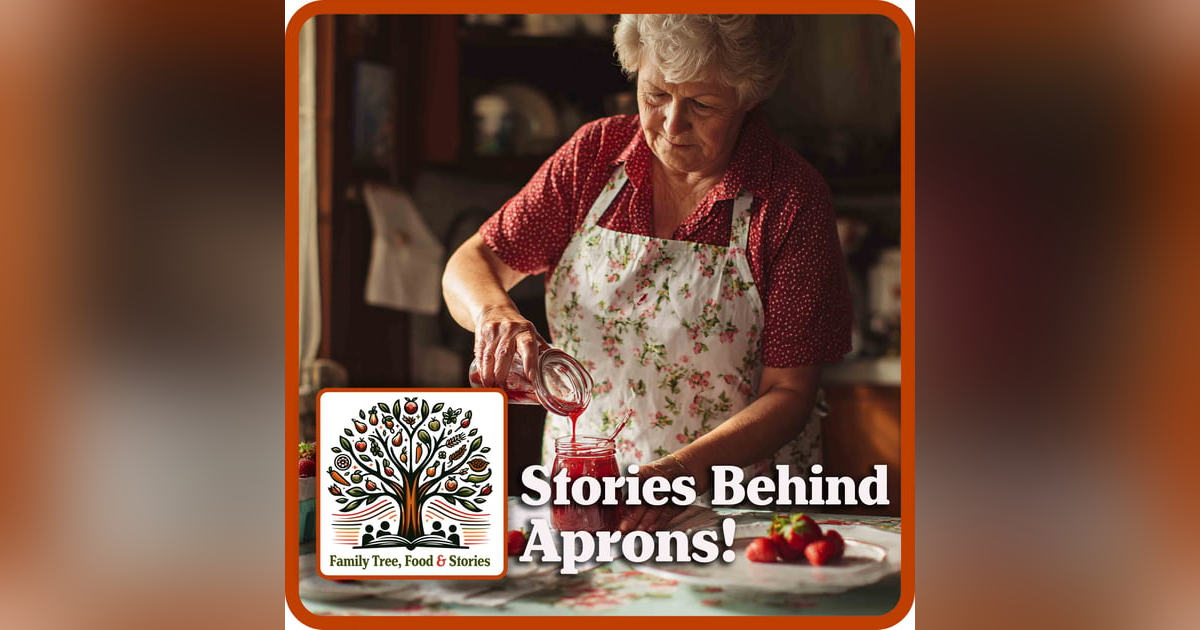


How a Simple Apron Quietly Shaped Food, Family Power, and Why They Matter More Than Your Grandma's Cookbook.
Most people think an apron is just something you tie on before cooking.
They’re wrong.
In this episode of Family Tree Food & Stories, Nancy May and Sylvia Lovely dig into the why of the apron, which may be the most powerful and misunderstood object in the kitchen—and why its disappearance signals the loss of something far more important than chintz fabric.
Long before it became a Halloween costume or a fashion statement in WWD, the apron was a tool of survival. It protected bodies from fire and labor. It carried food, tools, and children. They were worn by women and men alike. And the apron quietly set the stage for "who's in charge" by signaling authority, responsibility, and identity within the home—especially in the kitchen.
But here's the problem: almost no one was taught to see or respect the apron this way.
As kitchens modernized, aprons were dismissed as old-fashioned. What disappeared with them were unrecorded family stories, food traditions, and the invisible labor that shaped generations. That history didn’t make it into recipe cards or photo albums—and once the apron is gone, that story is usually gone for good.
But today, the apron is making a tiny comeback as a status symbol and fashion statement. Even on the haute couture runways of New York's Fashion Week.
Key Takeaways:
- Why aprons mattered more than cookbooks
- How they've helped preserve family memories and power plays in the kitchen
- Why do so many people regret throwing their mom's away?
- And what one “orphan apron” reveals about what we’ve lost
This is not an episode about fashion.
It’s about food history, family legacy, kitchen culture, even high fashion, and the everyday object that holds more meaning than you might realize—until it's too late.
If food has ever connected you to someone you loved…
If a kitchen table ever felt like home…
We hope this episode changes how you look at your next meal, or memories of those past with friends, family, and those you love and care about.
Additional Links ❤️
Please don't forget to take our survey so we dish up even more for you: Click for Survey Here
- SURVEY: Please Help Us Learn How To Do More For You
- Book: My Family Tree, Food & Stories Journal Awarded #1 New Release on Amazon
- Instagram Story updates 📸
- Facebook Family Tree Food Stories GROUP👍
- TikTok: Family Tree Food Stories
- 👇Share Your Story With Nancy & Sylvia!: Leave us a voicemail
- You can send us a DM on Facebook.
- 🎧 Subscribe now and never miss a bite or a good story.
Thank you to Catch 22 Music for this episode's introduction and outgoing music.
🎧If you enjoy stories that make you smarter, more curious, and just a little dangerous at the dinner table… then YES, this is your show!
Follow Us at: Family Tree Food & Stories.
Subscribe so you don’t miss the next episode.
And share this one with someone who still thinks ketchup is, well, “just ketchup.”
Because once you understand the story behind food, you start seeing everything differently.
Yes? Good. Pull up a chair, and enjoy the show!
About Your Award-Winning Hosts: Nancy May and Sylvia Lovely are the powerhouse team behind Family Tree, Food & Stories, a member of The Food Stories Media Network, which celebrates the rich traditions and connections everyone has around food, friends, and family meals. Nancy, an award-winning business leader, author, and podcaster, and Sylvia, a visionary author, lawyer, and former CEO, combine their expertise to bring captivating stories rooted in history, heritage, and food. Together, they weave stories that blend history, tradition, and the love of food, where generations connect and share intriguing mealtime stories and kitchen foibles.
If you missed the first time around... now's your time to listen to Family Tree Food & Stories and get inspired to make better use of what’s already in your kitchen. Then visit our page to share how you're using your leftovers this year. Waste less. Cook smarter. Tell the story behind your fridge.
"Every Meal Has a Story, and Every Story is a Feast." (tm) is a trademark of Family Tree Food & Stories podcast and the hosts.
@familytreefoodstories #foodpodcast #podcast #ApplePodcast #PodcastDiscovery #ListenNow #NewPodcastEpisode #TopPodcasts #awardwinningpodcast, #foodstories, #FoodAnthroplogy #FoodStoriesPodcast #psychologyofeverydaylife #persuasionpsychology #behaviorialscience #humanbehavior #trustandauthority #kitchenauthority #foodculture #kitchenstories #foodandmemory #culturehistory #storytellingfood #heritage #traditoinmatters #careandconnection
Hey there everybody.
Nancy May:It's Nancy and Sylvia once again.
Nancy May:How
Nancy May:you doing Sylvia?
Sylvia Lovely:I'm doing just fine.
Nancy May:Before we start, I want to share that we have created a survey for
Nancy May:you all to help us with, it's at podcast Family tree Foods stories.com/survey.
Nancy May:We'll have a link at the end of the show notes, but if you would be so
Nancy May:kind as to join us at the table and just answer a few questions so that
Nancy May:we can have a better show for you.
Nancy May:And we've got a pretty good one anyway, but we're having fun and
Nancy May:we wanna make sure that we include your stories and ideas as well.
Nancy May:And it's not just about Mo and Boo if that's a thing,
Sylvia Lovely:Yeah, it's great idea.
Sylvia Lovely:I'd love to hear from folks.
Nancy May:And then we have a special gift for you as well
Nancy May:if you complete that survey.
Nancy May:But in the meantime, please do not forget to subscribe and share the show
Nancy May:at Podcast Family Tree Food and Stories.
Nancy May:We're also on Facebook and Instagram.
Nancy May:And let's get on with the show because this one is near and dear to
Nancy May:my heart, although I never wore one.
Nancy May:I shouldn't say never, but not in a formal sense.
Nancy May:We're talking about aprons and objects of love in the kitchen, which bring
Nancy May:back lots of memories and traditions and all sorts of pictures and images
Nancy May:came back in my mind on aprons,
Sylvia Lovely:Yeah, I know.
Sylvia Lovely:It's it's just apron.
Sylvia Lovely:You know, I started wondering, wonder what that means.
Sylvia Lovely:'cause it's an odd.
Sylvia Lovely:Word, I should have looked that up.
Sylvia Lovely:But apron as an object, apron is memory and tradition.
Sylvia Lovely:You don't think much about an apron, but it really holds more
Sylvia Lovely:than just flower, dust and gravy.
Sylvia Lovely:And it's got plenty of that, right?
Sylvia Lovely:It holds memory, identity, and over the years, even fashion,
Nancy May:Oh, I saw in the New York Times the other day that they're taking the
Nancy May:apron style and actually turning it into runway fashion, which I find interesting.
Nancy May:So that whole nostalgia thing is coming back in many ways.
Nancy May:And there's some really high end aprons that are expensive.
Nancy May:They're big brand names now.
Nancy May:And every time I go into, I wouldn't call it junk shop, but I
Nancy May:love going into consignment shops.
Nancy May:The other day I saw one that looked like a Turkey, and of
Nancy May:course we've been doing aprons.
Nancy May:It's like the red car syndrome.
Nancy May:you think of a red car, you wanna buy a red car, there are no red cars, and
Nancy May:all of a sudden there are red cars.
Nancy May:Guess what?
Nancy May:There are aprons everywhere.
Nancy May:Now that I see.
Sylvia Lovely:There's such an heirloom, they're like rolling pins,
Sylvia Lovely:biscuit cutters, serving spoons.
Sylvia Lovely:There are all kinds of things in those, antique kinds of places.
Sylvia Lovely:It's just fascinating to see all the little gadgets that are out there
Sylvia Lovely:and apron as more than a gadget.
Sylvia Lovely:It's a lot of fun to look back on this.
Sylvia Lovely:Plus, you know, you mentioned trends.
Sylvia Lovely:Of course the tra wife trend is coming on too, so you know that
Sylvia Lovely:advertisers are gonna take that the next step, and make aprons a thing.
Sylvia Lovely:And so that's what's going on out there.
Sylvia Lovely:Now I'm anything but a trad wife, but,
Sylvia Lovely:We're too sassy for that, aren't we?
Nancy May:absolutely.
Nancy May:Oh my gosh.
Nancy May:So have you ever seen the aprons that well?
Nancy May:I have to say, I saw an apron when I was in, in Italy a number of years ago,
Nancy May:and they had them like dressed as well.
Nancy May:The, they were print on the front cover of the apron and it was
Nancy May:eight pack AB Roman gladiators.
Sylvia Lovely:Oh, I know there's.
Sylvia Lovely:You know, there's some really fun things, just like t-shirts, , people
Sylvia Lovely:with lions on their front.
Sylvia Lovely:so it's like anything goes right.
Sylvia Lovely:Have you ever really worn an apron though?
Nancy May:Not on purpose.
Nancy May:not at least at home, although there was a little.
Nancy May:I's a luncheonette place that I worked at in college and we had to wear an
Nancy May:apron, but it was more like those aprons, like the fancy chef aprons that you
Nancy May:wear around your waist and you tie, you probably have some of those at yours.
Nancy May:The white ones that tie in the front wrap around like 5 million
Nancy May:times in tie in the front.
Nancy May:and then in high school, while it was in high school, it was junior
Nancy May:high school, we had home ec.
Nancy May:Did you have home ec?
Sylvia Lovely:I never took that.
Sylvia Lovely:I never did.
Sylvia Lovely:I wished I had, yeah, that's one.
Sylvia Lovely:that's what a lot of people were, but I, for some reason I didn't do that,
Sylvia Lovely:which probably would've been good for me.
Nancy May:Right.
Sylvia Lovely:taking shop would've been good for me too.
Nancy May:We were forced to take home-ec and shop, so the boys took
Nancy May:home-ec as well as the girls, and then the girls took shop as well as the boys.
Nancy May:So we had a junior high school.
Nancy May:home EC teacher, Daisy Flower Garden.
Nancy May:Her real name is Miss Daisy and she referred to herself as Daisy
Nancy May:Flower Garden and she was from the south, I believe, Georgia Darling.
Nancy May:And she was just a hoot and a half.
Nancy May:She made sure that we wore our aprons and we were proper in class
Nancy May:and that we made our shrimp toast.
Nancy May:I still don't know what shrimp toast, even though I made it back then is.
Sylvia Lovely:I can imagine.
Nancy May:This was a very high tech homeit class shrimp toast.
Nancy May:So you get the idea.
Nancy May:But anyway that's my experience with wearing aprons.
Sylvia Lovely:Alright, you know what a drum roll.
Sylvia Lovely:I just had one on the other night.
Sylvia Lovely:We, yes.
Sylvia Lovely:My Kentucky Access to Justice Commission, for which I have
Sylvia Lovely:a tiny little part-time job.
Sylvia Lovely:We did an appreciation event for our volunteers.
Sylvia Lovely:I was the greeter.
Sylvia Lovely:I had also cut the cake, which was a mess.
Sylvia Lovely:But anyway, that's an art.
Sylvia Lovely:But I had on an apron as I greeted people at the door and I was the greeter.
Sylvia Lovely:and it was held at a barbecue place, which I'm sure at a barbecue place.
Sylvia Lovely:You need that apron.
Sylvia Lovely:So I've done cooking demos with my chefs over the years, and I have on an apron.
Sylvia Lovely:And I don't typically wear them.
Sylvia Lovely:My grandmother did.
Sylvia Lovely:My mother didn't much.
Sylvia Lovely:I think she just didn't think about it, but my grandmother did
Sylvia Lovely:and I it was always my image.
Sylvia Lovely:And it must be where they got those cartoons for little kids
Sylvia Lovely:where, you've seen them, they're really demeaning to grandmothers.
Nancy May:I know they're terrible.
Nancy May:Right?
Sylvia Lovely:Like these gray buns and then they always have on a
Sylvia Lovely:little apron and , all that kind of
Sylvia Lovely:stuff.
Sylvia Lovely:But yeah.
Sylvia Lovely:Yeah, little wire rim glasses, , the whole nine yards.
Sylvia Lovely:And so there it was.
Sylvia Lovely:But I did buy one once at the Mill City Museum in Minneapolis.
Sylvia Lovely:' cause that's where wheat was first started to be processed.
Sylvia Lovely:' when it came off the planes.
Sylvia Lovely:It said I couldn't resist, so I'm not Betty proper deal.
Sylvia Lovely:No.
Sylvia Lovely:So I'm not Betty Crocker deal with it.
Nancy May:I like the Fapa.
Nancy May:I'm not Betty proper.
Sylvia Lovely:I'm properly not.
Nancy May:That is one for the blooper books, but it was perfect.
Nancy May:So Betty Crocker, gosh, remember our show from icons on Betty Crocker and
Nancy May:Icon Brands Betty Crocker was not an AI character and she wasn't even real,
Nancy May:but it's interesting to see what's been going on over the years with the smell
Nancy May:of biscuits and baking and everything.
Nancy May:It just brings back home, even though I'm not from the South originally, but.
Nancy May:Apron stir up a lot of memories and I'm gonna share that.
Nancy May:One of my friends, Kathy, when I was growing up in the
Nancy May:neighborhood, her grandmother, grandma Fern, I remember this woman,
Sylvia Lovely:we love it.
Nancy May:thin and stern and had gray hair, but it was the blue,
Nancy May:gray, blue dyed gray hair.
Nancy May:Blue horn, women glass.
Nancy May:They weren't horn room glasses, they were blue cat's, eyeglasses that
Nancy May:sort of peaked up on the edge with
Nancy May:a few little blings.
Sylvia Lovely:a glass, some of those now
Sylvia Lovely:I want that retro look.
Nancy May:she was always wearing an apron.
Nancy May:An apron every single day for a different,, outfit that she had.
Nancy May:She's always perfectly dressed, smoking a cigarette,
Sylvia Lovely:I can hear.
Sylvia Lovely:I can see it.
Sylvia Lovely:I can see it.
Nancy May:a cup of coffee, not too far along and.
Nancy May:Ironing, but always in an apron.
Sylvia Lovely:Yeah.
Nancy May:I just, obviously, I remember it now more than ever,
Sylvia Lovely:Yeah.
Sylvia Lovely:And then you had your giant Turkey.
Nancy May:I have, I don't remember her cooking too much, but I do remember
Nancy May:her ironing in her apron and, the more I see the homemade ones, the more I
Nancy May:get nostalgic about the whole thing,
Sylvia Lovely:Oh yeah.
Sylvia Lovely:That's so cool.
Sylvia Lovely:You wanna hear about the history though?
Nancy May:Please tell me about the history
Nancy May:' of
Nancy May:aprons.
Nancy May:'cause I think it's gotta be fascinating.
Nancy May:It does a good date back to the Romans, like everything
Sylvia Lovely:Yeah,
Sylvia Lovely:I suspect they probably do, but yeah, , I think the quintessential ones for
Sylvia Lovely:me are the ones with the, , print maybe of like little tiny flowers or
Sylvia Lovely:something.
Sylvia Lovely:I can see a And the little ruffles, yeah.
Sylvia Lovely:Yeah.
Sylvia Lovely:Feminine and all that kinda stuff.
Sylvia Lovely:But so.
Sylvia Lovely:The earliest cooks, mostly women, were aprons for the very same reasons we
Sylvia Lovely:do safety and practicality, especially when they were cooking over open fires.
Sylvia Lovely:And imagine that truly the, you know, you had the hearth and that's the image I have
Sylvia Lovely:of a country woman cooking on the pot.
Sylvia Lovely:And then what happened?
Sylvia Lovely:Came the twenties.
Sylvia Lovely:What happened then?
Nancy May:I'm gonna ask you a question.
Nancy May:So aprons, they wore aprons in open fire cooking, but they were designed
Nancy May:predominantly to keep the soot and.
Sylvia Lovely:Yeah, that
Sylvia Lovely:too.
Nancy May:it.
Sylvia Lovely:Yeah.
Sylvia Lovely:Yeah.
Nancy May:New Yorkers would call it schmitz all over your outfits
Nancy May:as opposed to safety though, right?
Nancy May:Or is it just
Sylvia Lovely:I think it was everything.
Sylvia Lovely:Protection from sparks, blood, hot water, all of those things.
Sylvia Lovely:And you said Bob even wore
Nancy May:he wore an apron while he did his blacksmith iron work.
Nancy May:And that was a, like a leather one for protection for sparks.
Nancy May:His fancy jean duds blue.
Nancy May:He wasn't wearing when he was doing that work, but still.
Sylvia Lovely:Yeah.
Sylvia Lovely:And then after that, aprons became what you were saying in the beginning, aprons
Sylvia Lovely:have regained their stature as a fashion
Sylvia Lovely:statement, haven't they?
Sylvia Lovely:Like in the twenties, that's what they were, that look, the dropped
Sylvia Lovely:waist all of that kind of thing that kind of made them look fashionable.
Sylvia Lovely:And so they were a hit and
Sylvia Lovely:then
Nancy May:very simple.
Nancy May:It's a very simple line.
Nancy May:So without the frills, it can be kind of body hugging if it's done tied right.
Sylvia Lovely:Absolutely.
Sylvia Lovely:Yeah.
Sylvia Lovely:And , you just have that one little thing you have to put over your
Sylvia Lovely:head, but it isn't a great big deal.
Sylvia Lovely:And then you tie it in the back.
Sylvia Lovely:No, that's probably the biggest challenge, right?
Sylvia Lovely:Somebody have to tie it or you put it around the front.
Sylvia Lovely:But the the Great Depression hit hard and people were repurposing
Sylvia Lovely:everything, including flower sacks, and those sacks became a
Sylvia Lovely:lot of everything, aprons, dresses.
Sylvia Lovely:Curtains, and I always think of quilts, quilt aprons are a little bit like quilts.
Sylvia Lovely:I'm sure they used fabric from other, , clothing that they had.
Nancy May:I
Sylvia Lovely:Yeah.
Sylvia Lovely:And they became curtains and they become, became a lot of different things
Sylvia Lovely:because I just knew a lot of people.
Sylvia Lovely:And talk about kitchenware, the whole idea of repurposing broken plates.
Sylvia Lovely:That was what a woman told me once.
Sylvia Lovely:That's what they did.
Sylvia Lovely:They repurposed broken plates and used them.
Sylvia Lovely:Very resourceful.
Sylvia Lovely:And then the 1950s, what happened there?
Nancy May:That was the 1950s, I guess, was the golden age of the true trad wife
Nancy May:because The men came back from war in the forties and then the baby boom hit.
Nancy May:Moms didn't work.
Nancy May:I guess some, I shouldn't say moms didn't work.
Nancy May:Some did.
Nancy May:One of my mom's close friends and Mrs. Madarasz she worked in sales
Nancy May:at Bride Magazine, of course,
Sylvia Lovely:How
Nancy May:She, apparently, she says she, her entire career, she was on maternity
Nancy May:leave, but she was always working.
Nancy May:So,
Nancy May:But she was a very forward, progressive woman of her day . But the trad wife is a
Nancy May:whole new thing that's going on right now,
Nancy May:and people are giving up their careers, MBAs and PhDs and
Nancy May:doctors and everything else to
Nancy May:Domestic goddesses.
Sylvia Lovely:To each their own, I guess.
Sylvia Lovely:But you get down to people having contests on how many babies they can have.
Sylvia Lovely:Eh, it
Nancy May:ouch.
Nancy May:No, not me.
Nancy May:Not me.
Sylvia Lovely:leaves me behind, but, oh, and think about now
Sylvia Lovely:I remember this very well.
Sylvia Lovely:My mother sewed.
Sylvia Lovely:You know, most of the women in the fifties had sewing machines and I
Sylvia Lovely:remember she had McCall's patterns, remember McCall's patterns and they
Sylvia Lovely:had, , two or three versions of an apron.
Sylvia Lovely:' I'm not even sure why you would necessarily need that.
Sylvia Lovely:'cause aprons are can be very plain and ordinary, but if you wanted to dress it
Sylvia Lovely:up, then adding the ruffles and all of
Sylvia Lovely:that kinda stuff would be in the pocket.
Sylvia Lovely:And they say even some of them had padding.
Sylvia Lovely:You know what I'm saying?
Sylvia Lovely:Padding
Nancy May:the padding like in, in the top or.
Sylvia Lovely:a little bosomy, you know?
Sylvia Lovely:Why not?
Nancy May:I never thought about padding
Sylvia Lovely:that's true.
Nancy May:Ooh, lift and separate.
Nancy May:We're back to Jane Russell again.
Sylvia Lovely:But then, you know what, we had the feminist backlash but
Sylvia Lovely:aprons became the canvas for slogans.
Sylvia Lovely:Some of those you can't even say on air.
Sylvia Lovely:And of course it's just like t-shirts, right?
Sylvia Lovely:They made a statement and then there was the French maid look.
Sylvia Lovely:Hmm,
Nancy May:asking for that.
Sylvia Lovely:I, yeah.
Sylvia Lovely:An interesting thing would be to look up.
Sylvia Lovely:How popular the French made outfit is for Halloween parties.
Sylvia Lovely:of, yeah, It's a fun thing, , but it's, serious because
Sylvia Lovely:that kinda says something.
Sylvia Lovely:it.
Sylvia Lovely:says something.
Sylvia Lovely:Yeah.
Nancy May:No, I'm doing, I'm not doing that.
Nancy May:Sorry.
Nancy May:TMI, at least for this show.
Sylvia Lovely:Should that ever happen, I'd love a picture.
Sylvia Lovely:Okay.
Sylvia Lovely:So yeah.
Sylvia Lovely:And then, so it's rev edited itself today.
Sylvia Lovely:So what do we have who wears aprons today that you run into
Nancy May:Oh.
Nancy May:So the butcher, if you have a, if you go to a meat store, right?
Nancy May:Butcher
Sylvia Lovely:Yeah.
Nancy May:mongers you don't really see aprons in the the
Nancy May:grocery store, in the butcher area.
Nancy May:They wear the, those white coats that are all
Sylvia Lovely:Yeah.
Nancy May:looking.
Sylvia Lovely:Doctory.
Sylvia Lovely:Yeah.
Sylvia Lovely:Kind of
Nancy May:But baker bakeries
Nancy May:Can do that
Sylvia Lovely:Bartenders
Nancy May:bar bartenders.
Nancy May:That's right.
Nancy May:I never thought about bartenders.
Sylvia Lovely:Drag queens.
Nancy May:Oh, drag queens.
Sylvia Lovely:Talk about French maids.
Sylvia Lovely:We have a lot of that going on here.
Nancy May:Some of them are very trendy and very expensive.
Nancy May:You see the chefs on the TV shows that are wearing them, that have a particular
Nancy May:brand and they've got the leather straps and they're a thick, heavy duck material
Nancy May:in the pocket with the brand name on it.
Nancy May:And they're quite the thing if you see it and you know the brand, you definitely.
Nancy May:You like, oh that's that one.
Nancy May:And so they're branching out to doing some very interesting and expensive
Nancy May:things in a very simple way that, that we should go into the apron business.
Sylvia Lovely:yeah.
Sylvia Lovely:Let's do it.
Sylvia Lovely:A biz op,
Nancy May:I'll, I'll get a sewing machine.
Nancy May:I'll dust it off my mom's sewing machine and I'll take it from
Sylvia Lovely:The, hey, the year I made my kids dinosaur Halloween
Sylvia Lovely:costumes was the last I ever sewed.
Sylvia Lovely:They were hard.
Sylvia Lovely:Why?
Sylvia Lovely:I thought I had to do that, I don't know.
Nancy May:Yeah,
Nancy May:I know how to fix something every now and then, but it's been a long time since I've
Nancy May:actually purposefully made anything with the sewing machine, Daisy Flower Garden.
Nancy May:Thank you very much for teaching me how to do that.
Sylvia Lovely:I love that name.
Sylvia Lovely:I love that.
Sylvia Lovely:But it's identity, it's like everything people do is about identity, you
Sylvia Lovely:know, branding themselves and it's self-branding kind of thing.
Nancy May:It's a personal statement in the kitchen.
Nancy May:I have to say.
Nancy May:I do have an apron that I unintentionally got just before our Christmas show,
Nancy May:and I did the whole Mrs. Claus outfit.
Nancy May:It actually came with a Mrs. Claus apron
Sylvia Lovely:Yeah.
Sylvia Lovely:She always had one on.
Sylvia Lovely:Yeah.
Sylvia Lovely:Yeah.
Nancy May:we're gonna take a quick break and I've got a story about somebody I
Nancy May:met who was an apron manufacturer or an apron creator on an airplane ride
Nancy May:once
Sylvia Lovely:and the Apron Museum, we'll talk about that
Nancy May:Yeah, we'll talk about that too.
Nancy May:Hang tight.
Nancy May:We'll be right back.
Nancy May:Okay, Sylvia, before I tell my apron story let's talk about the
Nancy May:Apron Museum and the whole history of aprons, because I think this is.
Nancy May:Fascinating.
Nancy May:They have become a very big collectible
Sylvia Lovely:Yeah, this place has, the Apron Museum and , these people
Sylvia Lovely:decided to retire to her old hometown and it's looks like it's LUKA, but it's
Sylvia Lovely:actually IU a capital I looks just like capital L, just FYI UK y. So it's UKA.
Sylvia Lovely:So it's, I yuca.
Sylvia Lovely:Mississippi.
Sylvia Lovely:All right.
Sylvia Lovely:Keep that in mind.
Sylvia Lovely:So you only gonna go
Nancy May:That sounds like an old horn from a car.
Nancy May:A
Sylvia Lovely:Yeah.
Sylvia Lovely:Aah.
Sylvia Lovely:Visitors come from all over the world.
Sylvia Lovely:One man teared up as he looked at a apron that had been donated
Sylvia Lovely:and they reminded him of it.
Sylvia Lovely:So it's you know, memories by association even.
Sylvia Lovely:So, so yeah.
Sylvia Lovely:Yeah.
Sylvia Lovely:Tell us about who founded it though.
Nancy May:The apron regime was founded by Carolyn and Henry Terry after
Nancy May:they retired, as you'd mentioned.
Nancy May:And it has such a heartwarming story, the proof that the whole dream of the thread
Nancy May:of what happens with an apron can really bring, like you said, people to tears.
Nancy May:But it's something that's truly meaningful because.
Nancy May:Like my friend's grandmother Fern who wore these aprons.
Nancy May:These were very personal statements that women were wearing at the time, and today,
Nancy May:even the more modern ones are becoming.
Nancy May:I would say statements of identity in many w ays.
Nancy May:I think the French laundry they wore, you know, that the fancy restaurant
Nancy May:out in California, they wore aprons.
Nancy May:And these were big statements, not just from a professional perspective, but from
Nancy May:a very personal perspective in your home.
Nancy May:And, it was not a house code, it's.
Nancy May:Which I can't imagine people wore anyway to begin with, but it's even still, it's
Nancy May:an apron that protects and preserves and I think it's a tool that actually
Nancy May:takes care of the person that wears 'em,
Sylvia Lovely:It's a repository of memories.
Sylvia Lovely:These people started collecting aprons in 2006, and it all crystallized
Sylvia Lovely:around one very special apron.
Sylvia Lovely:It was an apron shaped like a bunny.
Sylvia Lovely:It reminds me of your Turkey.
Nancy May:Oh right, the Turkey.
Nancy May:I'll have to put the
Nancy May:picture of that one up.
Sylvia Lovely:It was given to them, by an 81-year-old woman who had
Sylvia Lovely:received it as a gift at age four.
Sylvia Lovely:She tried, this is awful.
Sylvia Lovely:This is painful.
Sylvia Lovely:She could find no family member who wanted it.
Sylvia Lovely:It was an orphan apron, and They took it in, and that was the beginning,
Sylvia Lovely:and now it houses over 6,000 of them from 18 hundreds to today
Nancy May:so the bunny was the first apron that they collected.
Sylvia Lovely:Yes, it was, , it really, I think they had collected them before,
Sylvia Lovely:but it gave birth to the idea of a museum and putting these things on display.
Sylvia Lovely:Even, you know, I think she may actually sell some aprons and things like
Sylvia Lovely:that, but she has them on display and
Nancy May:I wonder whether Hugh Hefner had any
Sylvia Lovely:there you go.
Sylvia Lovely:There's an apron.
Nancy May:and Gloria Steinem, who was a bunny.
Nancy May:I'll have to have to reach out to Gloria and see if she happens to have
Nancy May:a bunny apron in the closet somewhere.
Sylvia Lovely:Yeah.
Nancy May:Talk about padding, right?
Sylvia Lovely:yeah, these were made from everything, flower sack,
Sylvia Lovely:plastic, Muslim, and As we said before, repurposed clothing that was
Sylvia Lovely:just laying around in your closet.
Sylvia Lovely:And then we have modern times what's going on with aprons, and this is
Sylvia Lovely:one of my favorite stories FLO.
Nancy May:Oh, I love that.
Nancy May:I have to say I never realized or never even thought that Flo was
Nancy May:wearing an apron until we started to research and discuss this.
Nancy May:And when I really looked at that commercial,
Sylvia Lovely:Yeah, they're all wearing
Sylvia Lovely:aprons.
Sylvia Lovely:The men, the women, and it's all supposed to evoke this idea of a
Sylvia Lovely:diner, that, , you come into the diner, it wasn't set in a diner.
Sylvia Lovely:It was set in a big box store kind of thing.
Sylvia Lovely:Like you could buy insurance products and big
Nancy May:Originally that was the original commercial.
Nancy May:cause they're everywhere now.
Nancy May:they're out
Nancy May:in the fields and doing
Sylvia Lovely:Everywhere.
Sylvia Lovely:Yeah.
Sylvia Lovely:Yeah.
Sylvia Lovely:But anyway, I love this story too.
Sylvia Lovely:Nancy, I just love this story.
Sylvia Lovely:She started the role in 2008
Sylvia Lovely:and she Yeah.
Sylvia Lovely:Stephanie Courtney, Yeah.
Sylvia Lovely:The who plays and she said the word that so captured the job for her and
Sylvia Lovely:look at this woman I was reading that she's one of the wealthiest.
Sylvia Lovely:Not well-known actresses.
Sylvia Lovely:It's not like she's in big productions or anything like that, but it just,
Sylvia Lovely:here she was and she said the word wow.
Nancy May:And that's what got her
Sylvia Lovely:And she said it in such an evocative way that they
Sylvia Lovely:didn't interview anyone else.
Sylvia Lovely:And so she became what she was.
Sylvia Lovely:, And you notice she has that eyeliner the stereotypical diner waitress that we see
Nancy May:I love it when she poses, I guess they, they redress
Nancy May:her, like her sister wearing the
Nancy May:big pants and chewing the gum and the teased hair and she doesn't have time
Nancy May:to do anything 'cause she's on her treadmill or a bicycle, whatever it is.
Sylvia Lovely:Moving very slowly.
Nancy May:Yeah.
Nancy May:She's doing her workout.
Nancy May:I just think that's hysterical.
Nancy May:I guess you could work out in an apron too.
Nancy May:It
Nancy May:doesn't matter.
Nancy May:But even still working out in the kitchen is sometimes It's a lot of work.
Sylvia Lovely:That's right.
Sylvia Lovely:So it's the same warmth and reliability that we associate with
Sylvia Lovely:going into your favorite diner,
Nancy May:I did not know that.
Nancy May:That's why they use the apron.
Sylvia Lovely:It's very symbolic.
Sylvia Lovely:And then how she just looks so ordinary?
Nancy May:she's very approachable, and I think the idea of an apron makes
Nancy May:somebody feel a little bit more familiar
Sylvia Lovely:I'll have, yeah, I'll have a piece of that pie flow.
Nancy May:If somebody is cooking for you.
Nancy May:You've gotta trust them.
Nancy May:And if they're wearing an apron, you hope you gotta trust them.
Nancy May:You know, a little slip of the whatever.
Nancy May:But All that tapping into the old and the same warmth and reliability
Nancy May:associated with her grandmothers in the kitchen, it's, I, my grandmother,
Nancy May:I didn't know her in the kitchen.
Nancy May:She was in a wheelchair, as I always remember her as a kid.
Nancy May:And I don't know if, don't remember my mom ever wearing an apron.
Nancy May:So that's interesting.
Nancy May:It was always
Sylvia Lovely:don't either.
Sylvia Lovely:I don't know.
Nancy May:down the street.
Sylvia Lovely:Yeah.
Sylvia Lovely:so our aprons reaching in the past for shape, color, and grounding in
Sylvia Lovely:a world that seems disposable, maybe aprons still have some saving to do.
Sylvia Lovely:We should
Sylvia Lovely:go into the apron business.
Nancy May:although, wait a second.
Nancy May:I would say, is this an apron or is this a bib?
Nancy May:When you go
Nancy May:eat lobster.
Sylvia Lovely:get a bid.
Nancy May:You get a bib, that's not an apron.
Nancy May:So that's a throwaway That's a little different, but it still
Nancy May:gives me the idea that you're still being covered type of thing.
Nancy May:I don't, I haven't really seen throwaway aprons.
Sylvia Lovely:No.
Nancy May:kept
Sylvia Lovely:Yeah.
Nancy May:reused.
Sylvia Lovely:Think of that poor bunny.
Nancy May:No.
Nancy May:I feel so bad.
Sylvia Lovely:I know how special
Nancy May:But I guess that's part of the apron's endurance.
Nancy May:It's not something that you just toss away, even if nobody in this poor woman's
Nancy May:family didn't want her bunny apron, seeing that apron designed to look like
Nancy May:a Turkey in the consignment, antique consignment shop the other week, I felt
Nancy May:I feel bad for the Turkey.
Nancy May:I was like, oh, that poor Turkey.
Nancy May:Are you crazy?
Nancy May:Yes, I'm crazy.
Sylvia Lovely:I know.
Nancy May:apron.
Sylvia Lovely:Yeah.
Sylvia Lovely:You know, we lead such strange lives today though.
Sylvia Lovely:It's really hard to keep everything
Nancy May:I did leave.
Nancy May:the apron at the store as much as I didn't
Sylvia Lovely:Yeah.
Sylvia Lovely:What do you do?
Sylvia Lovely:, You got only so much space and I guess I lament the fact that I didn't save
Sylvia Lovely:one of my grandmother's aprons 'cause it's such an image in my mind of her.
Sylvia Lovely:But, over the years, through all this stuff you go through
Sylvia Lovely:to get where you are in life.
Sylvia Lovely:But, try to do that.
Sylvia Lovely:cause you'll, someday you'll regret it not to special things like that.
Sylvia Lovely:. Nancy May: So I've got a story about a woman that I met.
Sylvia Lovely:Flying down from New York to Florida to taking care of my parents.
Sylvia Lovely:'cause there were lots of those trips back and forth.
Sylvia Lovely:If anybody's taking care of an aging parent from long distance,
Sylvia Lovely:you know how that challenging can be, but it's also, it's a labor
Sylvia Lovely:of love, I would say for sure.
Sylvia Lovely:And I always ended up sitting next to somebody who was interesting to talk to.
Sylvia Lovely:Not that I was the yapper on the side seat, but this woman was the yapper.
Sylvia Lovely:And she was lovely,
Sylvia Lovely:And as we started to talk, , why she was going down and what was going on, she was
Sylvia Lovely:also taking care of some aging parents.
Sylvia Lovely:She mentioned what she did on the side, and she had started
Sylvia Lovely:an Etsy shop and was sewing and creating her own style of apron.
Sylvia Lovely:And she sh she happened to have some and she showed me.
Sylvia Lovely:I felt so bad I should have just now.
Sylvia Lovely:I look back, I should have just bought an apron from her right then and there, and
Sylvia Lovely:I didn't have cash on me because.
Sylvia Lovely:That was the thing I tended not to do.
Sylvia Lovely:Not a good thing, but I did and I look back and, her story was
Sylvia Lovely:so beautiful about all the detail that she put into her aprons.
Sylvia Lovely:They were the half aprons, you know, not the big fold that go
Sylvia Lovely:over your head kind of thing.
Sylvia Lovely:And the thrills and how she looked for the antique fabrics and everything
Sylvia Lovely:that brought back the nostalgic.
Sylvia Lovely:It's just I don't know.
Sylvia Lovely:Um.
Sylvia Lovely:In
Sylvia Lovely:How long ago was that?
Nancy May:of hotcakes.
Nancy May:The
Nancy May:other, which I don't think of hotcakes as a thing, I think of pancakes,
Nancy May:but hotcakes is more nostalgic.
Nancy May:And I
Nancy May:that brings back just warmth and especially when I was going down to
Nancy May:take care of mom and dad, that made
Sylvia Lovely:Yeah.
Nancy May:warmer and cozier.
Sylvia Lovely:Yeah.
Sylvia Lovely:How long ago that, so that was several years ago.
Nancy May:Oh, that was a while.
Nancy May:Mom's been gone now five years.
Nancy May:Dad's six.
Nancy May:So I'm gonna say it was probably about seven or eight years ago.
Sylvia Lovely:You know, Nancy, if you make something.
Sylvia Lovely:Somebody out there is gonna buy it.
Sylvia Lovely:No.
Sylvia Lovely:If you have
Sylvia Lovely:Advertising ability and you can spread the word wide enough,
Sylvia Lovely:there's someone sitting in front of a computer screen gonna buy it.
Sylvia Lovely:It's just fascinating to me.
Sylvia Lovely:Like I, I noticed that on cable television, people advertising
Sylvia Lovely:these things like the muddy map.
Sylvia Lovely:I want a muddy map 'cause my
Sylvia Lovely:dog's feet get that.
Sylvia Lovely:Yeah.
Sylvia Lovely:Or the pet rock and some group of people will buy those things.
Nancy May:Think of all the crazy things that have been sold on QVC and
Nancy May:HSN and all those networks, right?
Nancy May:And now on Amazon, there are tons of things that I think,
Nancy May:why would anybody want that?
Nancy May:But sure enough, they're
Nancy May:selling
Sylvia Lovely:Yeah.
Nancy May:hotcakes nostalgia.
Nancy May:Again,
Sylvia Lovely:So, yeah, so there's all kinds of interesting things going
Sylvia Lovely:on with memories and traditions.
Nancy May:do you
Sylvia Lovely:here we go.
Nancy May:in your restaurant?
Sylvia Lovely:Oh
Nancy May:So all
Nancy May:the waiters and waitresses have aprons, or do
Sylvia Lovely:I think they do.
Nancy May:of some sort?
Sylvia Lovely:No, they have to wear uniforms.
Sylvia Lovely:They have the shirts that have azura on them.
Sylvia Lovely:They're black.
Sylvia Lovely:And I know the bartender wears an apron
Sylvia Lovely:and
Nancy May:apron, or is it just like a waist tie around the
Sylvia Lovely:no, she wears a full one.
Sylvia Lovely:Then the chefs have their chef coats, but when they're actively cooking,
Sylvia Lovely:they have on aprons black aprons.
Sylvia Lovely:And I think I've seen some of the servers in aprons, like the food
Sylvia Lovely:runners, , people that take the food out of the window and deliver it.
Sylvia Lovely:So I don't that, that got me to thinking, I'm there every day.
Sylvia Lovely:Why didn't I notice that?
Nancy May:I think I'm gonna have to go back to trying an apron, one of
Nancy May:those kind that you tie on, like the chef waiter ones, because I'm always
Nancy May:pulling out a dish cloth to wipe my hands on and it's, and then I'm throwing
Nancy May:it on the floor and it's getting messy and it's cleaning stuff up.
Nancy May:But it would be very handy just to have something other than
Nancy May:my jeans to wipe my hands on.
Sylvia Lovely:Yeah.
Sylvia Lovely:I think we just don't think about it.
Sylvia Lovely:You know?
Sylvia Lovely:It's
Nancy May:No,
Nancy May:it would be very helpful.
Nancy May:But I'm gonna go back real quickly to the idea of cooking over an open
Nancy May:stove because or over, or a hot stove.
Nancy May:I shouldn't say cooking over a flame.
Nancy May:And have you ever cooked over a fire or even a, have you ever cooked
Nancy May:on a regular cast iron wood stove?
Sylvia Lovely:No, I've been on campfire kinds of things where you
Sylvia Lovely:do that outside, but no, not on any
Sylvia Lovely:kinda.
Nancy May:I had the experience of doing that once I can understand why.
Nancy May:Women or even men who were cooking, wore some kind of apron of some sort.
Nancy May:Whether it's a cloth one or a leather one, probably a leather
Nancy May:one would be a lot better.
Nancy May:But the amount of work that goes into cooking on a wood stove, we did it
Nancy May:up in Maine with friends who had a family cabin and the only kind of
Nancy May:stove that they had on this island,
Nancy May:Mounty Mountainy Pond was, and then they had a family compound as many
Nancy May:families did around that particular pond.
Nancy May:And it was your regular, traditional.
Nancy May:I guess it was a cast iron, but it was an iron wood stove with just amazing.
Nancy May:We cooked spaghetti and Turkey and biscuits.
Nancy May:I was surprised what we could cook on that thing.
Nancy May:Thankfully, Jeanette the guys.
Nancy May:Wife or girlfriend, actually girlfriend, eventually wife,
Nancy May:knew how to use these things.
Nancy May:But it's a lot of work and sparks do fly
Nancy May:and it's quite interesting and quite an education.
Nancy May:Honestly, I think everybody should have at least one experience in their
Nancy May:life trying that because it gives you a different appreciation of the
Nancy May:ability to, oh, this is, talk about tradition, the ability to slow down.
Nancy May:And just take in the moment of what you
Sylvia Lovely:And just chatting with people and and all of
Nancy May:waiting and the time it takes to actually put the wood in the stove.
Nancy May:In the morning we would take turns each morning.
Nancy May:We would get up one morning and stoke the stove and take care of it.
Nancy May:And then they would get up the next morning.
Nancy May:'cause we had to start at six o'clock in the morning to heat that thing up
Nancy May:and make sure it was hot enough to do everything that we needed to do.
Nancy May:But wearing an apron, I probably could've seen myself wearing an apron and
Sylvia Lovely:Yeah.
Nancy May:maybe not a long skirt, but I would not want to do that for a lifetime,
Sylvia Lovely:Now.
Sylvia Lovely:My only experience with doing that was not a good one.
Sylvia Lovely:So Bernie and I were traveling, we were doing a grand tour of the
Sylvia Lovely:West before I started law school, and we went to the Grand Tetons
Sylvia Lovely:and we were gonna rough it, right?
Sylvia Lovely:We were gonna have our fire, we were gonna make bacon and eggs.
Sylvia Lovely:After four hours of not being able to sustain the fire or get it going,
Sylvia Lovely:we gave up and found a restaurant.
Sylvia Lovely:So
Sylvia Lovely:there you have.
Sylvia Lovely:Yeah.
Sylvia Lovely:Yeah.
Sylvia Lovely:No, that, that didn't work out for us, but I can see the point of, taking your time
Sylvia Lovely:and just, that's what people do when they gather together and just, that, that's
Nancy May:It gives you time to pause and think about probably too much, but
Nancy May:typically what's in front of you only,
Nancy May:which is very helpful I think from a.
Sylvia Lovely:Mindfulness.
Nancy May:Um, yeah, mindfulness.
Nancy May:Not even a mindfulness, but just being able to take a moment to
Nancy May:take a breath and stop everything.
Nancy May:So, on that note, stop.
Nancy May:I'm glad you're here.
Nancy May:We're both glad you're here.
Nancy May:Subscribe to podcast at Family Tree Food Stories.
Nancy May:How's that for a pause?
Sylvia Lovely:You're into
Nancy May:I
Sylvia Lovely:world now.
Nancy May:the zone, right?
Nancy May:Go get your book, my Family Tree, food and Stories.
Nancy May:Take a pause, write your stories.
Nancy May:Remember what you did when you were kids, maybe even grandma's apron.
Nancy May:And if grandma didn't have an apron, maybe somebody else you knew had an apron,
Nancy May:or friends had friends', grandmother had an apron, write that in your story.
Nancy May:With your recipes that you want to have passed down for
Nancy May:generations to come because it's not our family tree food stories.
Nancy May:It's your family tree, food and stories.
Nancy May:And please don't forget to also like and share this show and others with your
Nancy May:friends and family and take our survey so that we can bring even more wonderful
Nancy May:stories and memories and traditions to your house and to your kitchen.
Nancy May:And better yet, your table.
Nancy May:Take care.
Nancy May:Bye-bye.
Sylvia Lovely:Thank you.


